


 中文简体
中文简体 Français
 русский
 Español
 عربى
عربى Deutsch



Electric Counterbalanced Stacker for High-Efficiency Pallet Handling
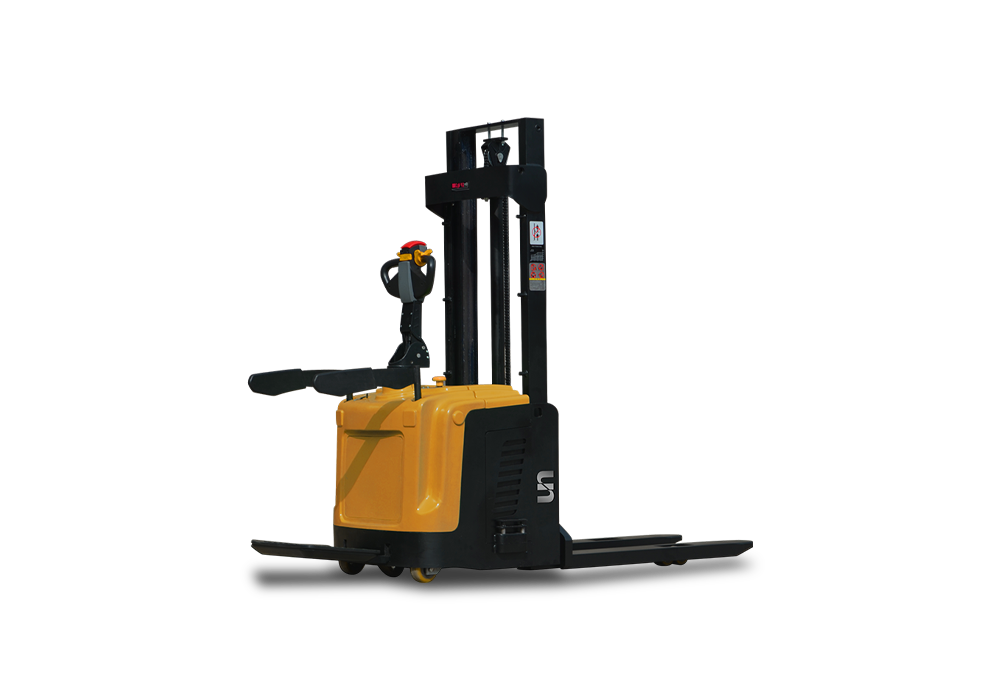
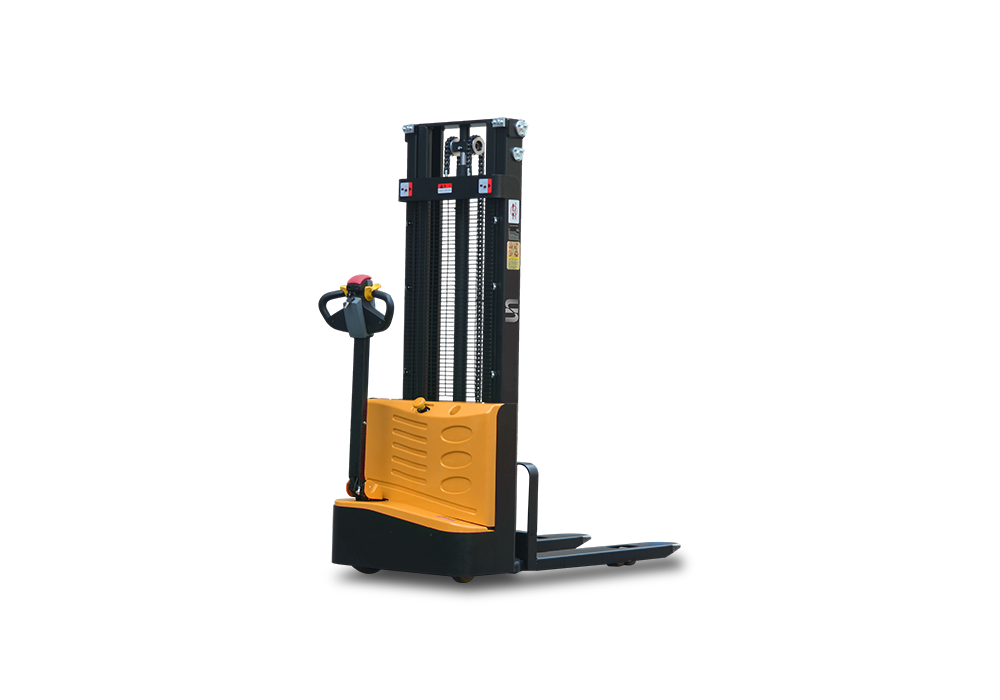
Admin 2026-06-21In modern warehousing, manufacturing, distribution, and vehicle loading operations, the demand for compact, safe, energy-efficient, and productive pallet handling equipment continues to grow. The Electric Stacker PS12/15CB-C is designed for precisely this environment: a workplace where loads must be moved, lifted, positioned, and stored with control, stability, and repeatable efficiency. With rated capacities of 1200 kg and 1500 kg, a counterbalanced structure, electric travel, electric lifting, and optional standing operation, this stacker offers a practical solution for businesses that need more capability than a simple walkie stacker but do not require the size, cost, or operating footprint of a full counterbalanced forklift.
The PS12/15CB-C is particularly suitable for factories, warehouses, logistics centers, lorries, loading bays, assembly areas, packaging zones, and general material handling sites where pallets, crates, and industrial goods must be handled safely. It combines the usability of pedestrian equipment with the productivity potential of a rider platform. This makes it attractive to operations that handle goods over medium distances, change working zones frequently, or require flexible equipment for both loading and stacking tasks.
Unlike many conventional stackers that rely on support legs or straddle arms, this model is built as an electric counterbalanced stacker. That design gives it a major operational advantage: it can approach closed pallets and loads without interference from front stabilizing legs. For many warehouses, this difference is critical. It enables more flexible handling of various pallet types, especially when goods are stored on pallets that cannot easily accommodate straddle legs. The result is a more versatile machine that can perform in situations where ordinary stackers may be restricted.
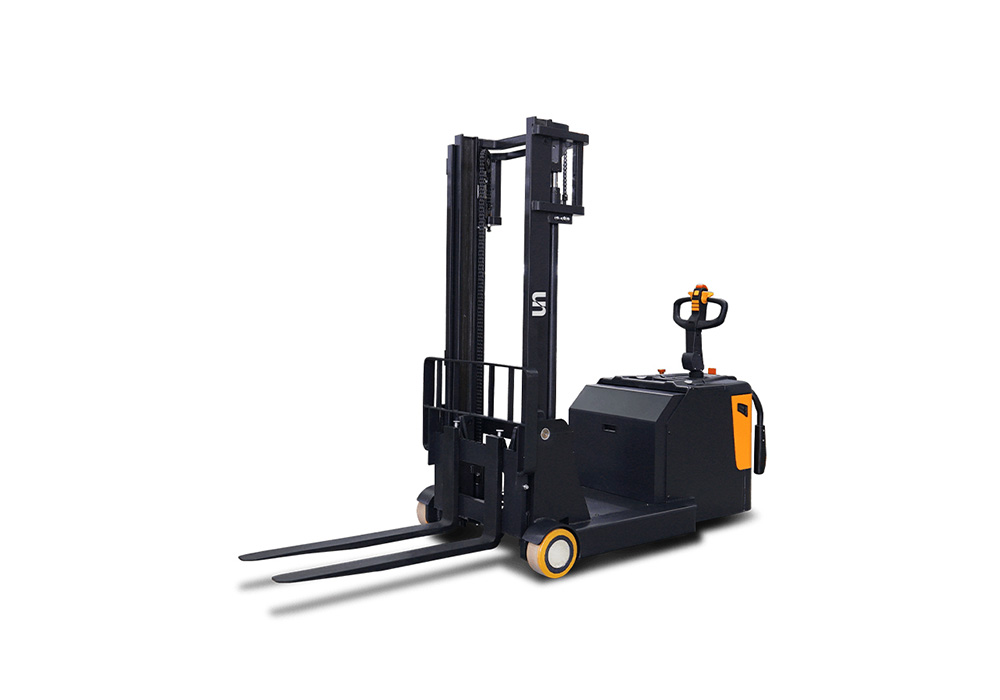
Product Overview
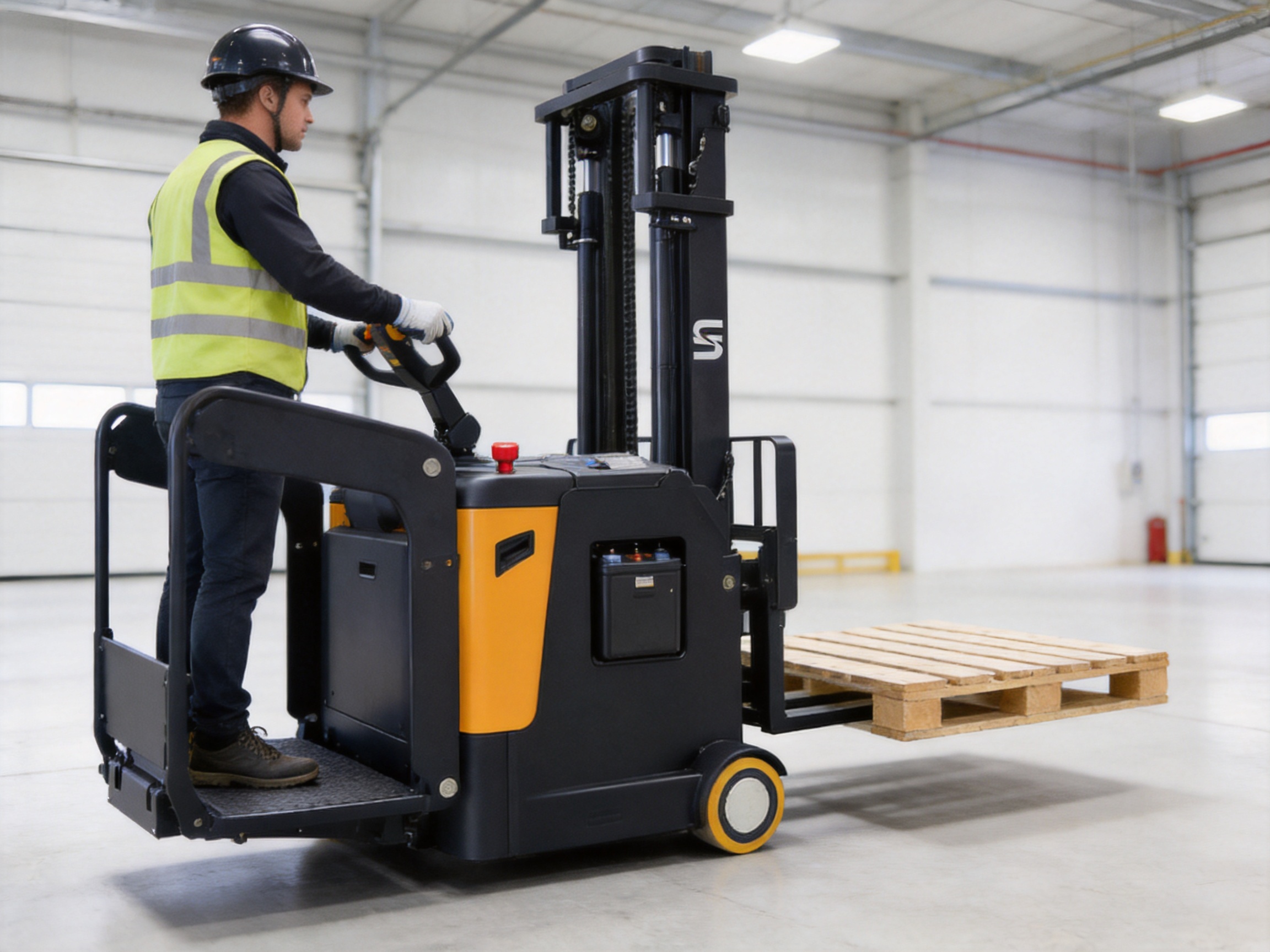
The Electric Stacker PS12/15CB-C is available in two main capacity configurations: the PS12CB-C with a 1.2-ton rated load capacity and the PS15CB-C with a 1.5-ton rated load capacity. Both versions are electric-powered and designed for pedestrian or standing operation. The optional foldable platform allows the operator to ride when travel distances are longer, while the pedestrian mode remains useful for tight spaces and short-distance positioning.
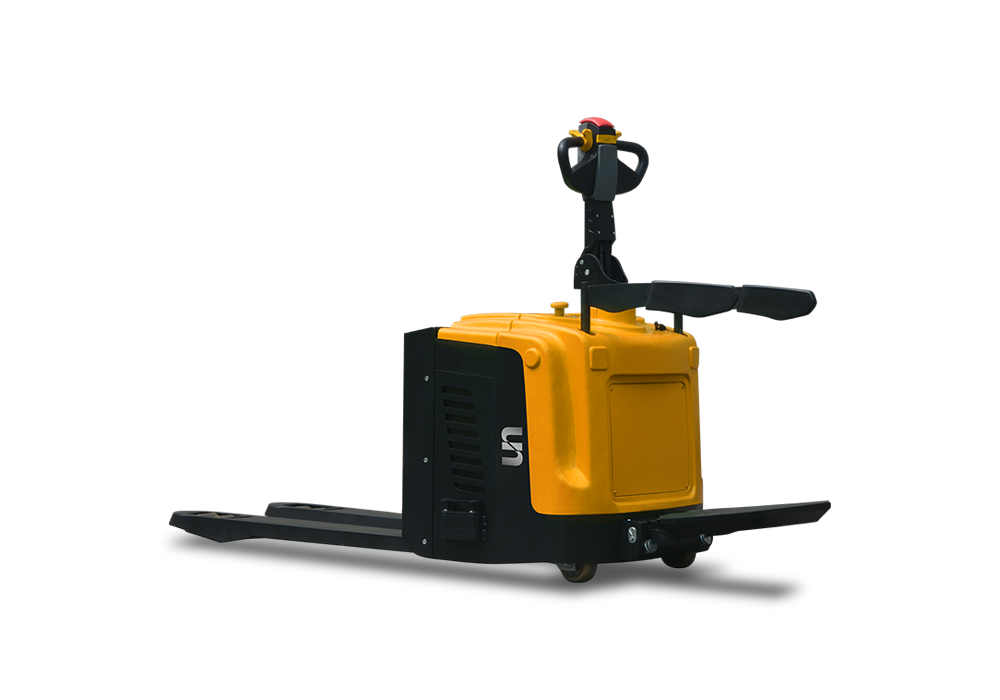
This dual operating approach is one of the most valuable features of the product. In smaller warehouses, narrow aisles, or loading areas, pedestrian control allows precise maneuvering. In larger facilities, the foldable platform improves travel efficiency and reduces operator fatigue. When protective side arms are used with the platform, the operator gains additional stability and confidence during travel. Compared with equipment that is only pedestrian-operated, the PS12/15CB-C can improve productivity in operations where repeated travel is required.
The stacker uses a 24 V industrial lead-acid battery system, with the PS12CB-C equipped with a 24 V / 210 Ah battery and the PS15CB-C equipped with a 24 V / 270 Ah battery, with an optional 350 Ah battery available for extended working time. This battery configuration is suitable for daily industrial use and supports long operating hours in normal pallet handling environments. For customers who prioritize predictable performance, maintainability, and familiar charging infrastructure, the lead-acid battery system remains a proven and cost-effective choice.
The machine also includes an AC vertical drive system, electric power steering, an emergency switch, a high-performance hydraulic pump, a robust battery cover with storage space, polyurethane wheels, and an electromagnetic service brake. These elements work together to deliver a balance of power, stability, maneuverability, operator comfort, and safety.
Core Technical Highlights
Item |
PS12CB-C |
PS15CB-C |
Operational Benefit |
Rated Load Capacity |
1.2 t |
1.5 t |
Supports common pallet handling requirements in warehouses and factories. |
Power Type |
Electric |
Electric |
Low noise, zero local exhaust emissions, and suitable indoor operation. |
Operating Method |
Pedestrian / Standing |
Pedestrian / Standing |
Flexible use for both short-distance handling and longer travel routes. |
Load Center |
500 mm |
500 mm |
Matches common pallet load distribution requirements. |
Lift Height |
3600 mm |
4500 mm |
Suitable for stacking, storage, loading, and elevated placement tasks. |
Battery |
24 V / 210 Ah |
24 V / 270 Ah, optional 350 Ah |
Provides dependable operating time for daily material handling. |
Travel Speed |
5.5 / 6 km/h laden / unladen |
5.5 / 6 km/h laden / unladen |
Supports efficient movement without compromising control. |
Drive Motor |
1.6 kW |
1.6 kW |
Offers stable traction and controlled movement in warehouse environments. |
Lift Motor |
2.2 kW |
3.0 kW |
Provides lifting performance matched to capacity and lift height. |
Service Brake |
Electromagnetic |
Electromagnetic |
Improves stopping reliability and safety during operation. |
Counterbalanced Design and Practical Versatility
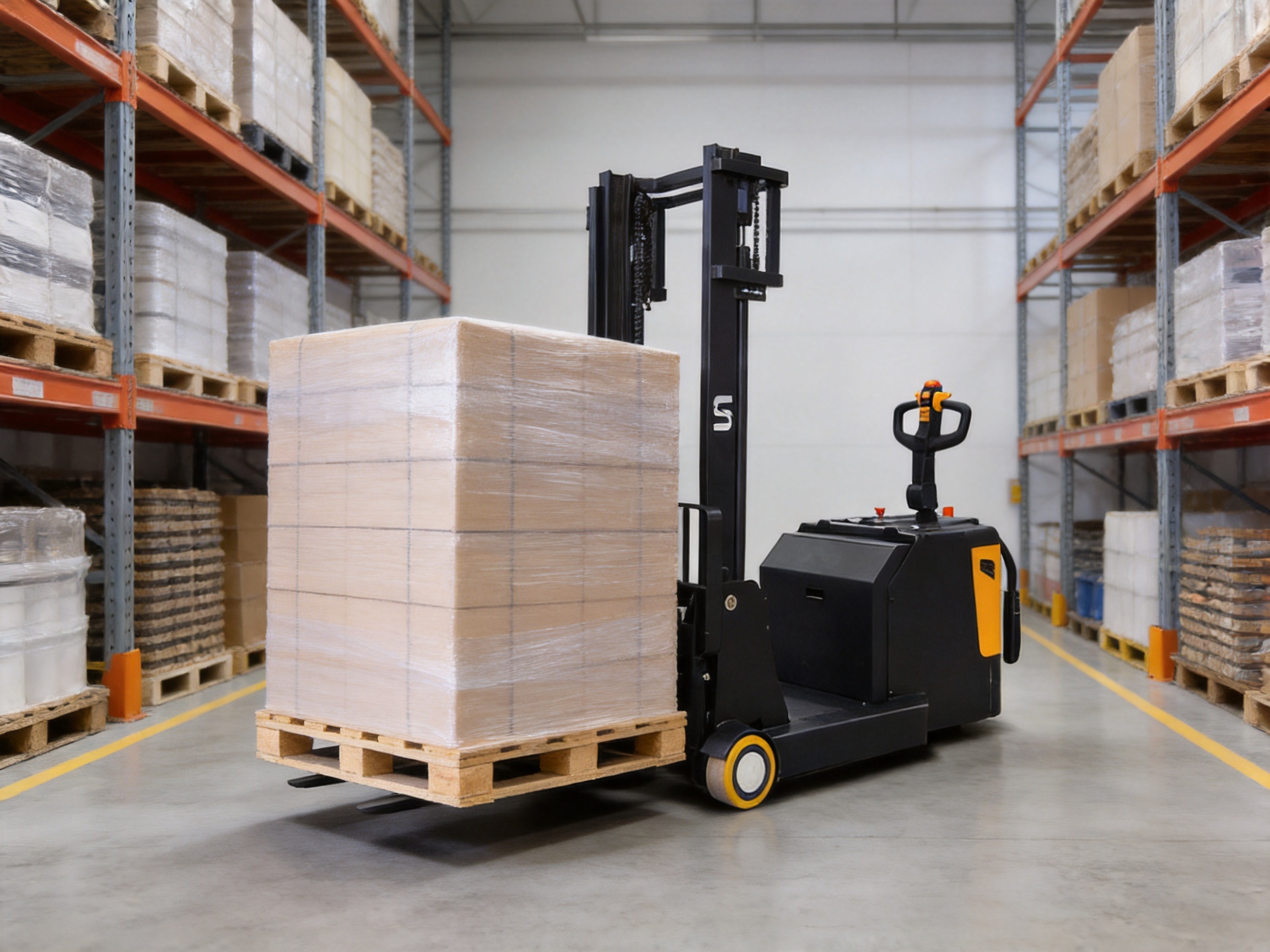
The counterbalanced structure is one of the strongest advantages of the PS12/15CB-C. Many warehouse stackers rely on support legs positioned in front of the machine to maintain stability. While this design is economical and simple, it may limit pallet compatibility. Straddle legs can interfere with closed-bottom pallets, special load carriers, lower deck boards, or certain loading positions. In contrast, a counterbalanced stacker uses rear weight distribution to support load handling, allowing the forks to approach loads more like a small forklift.
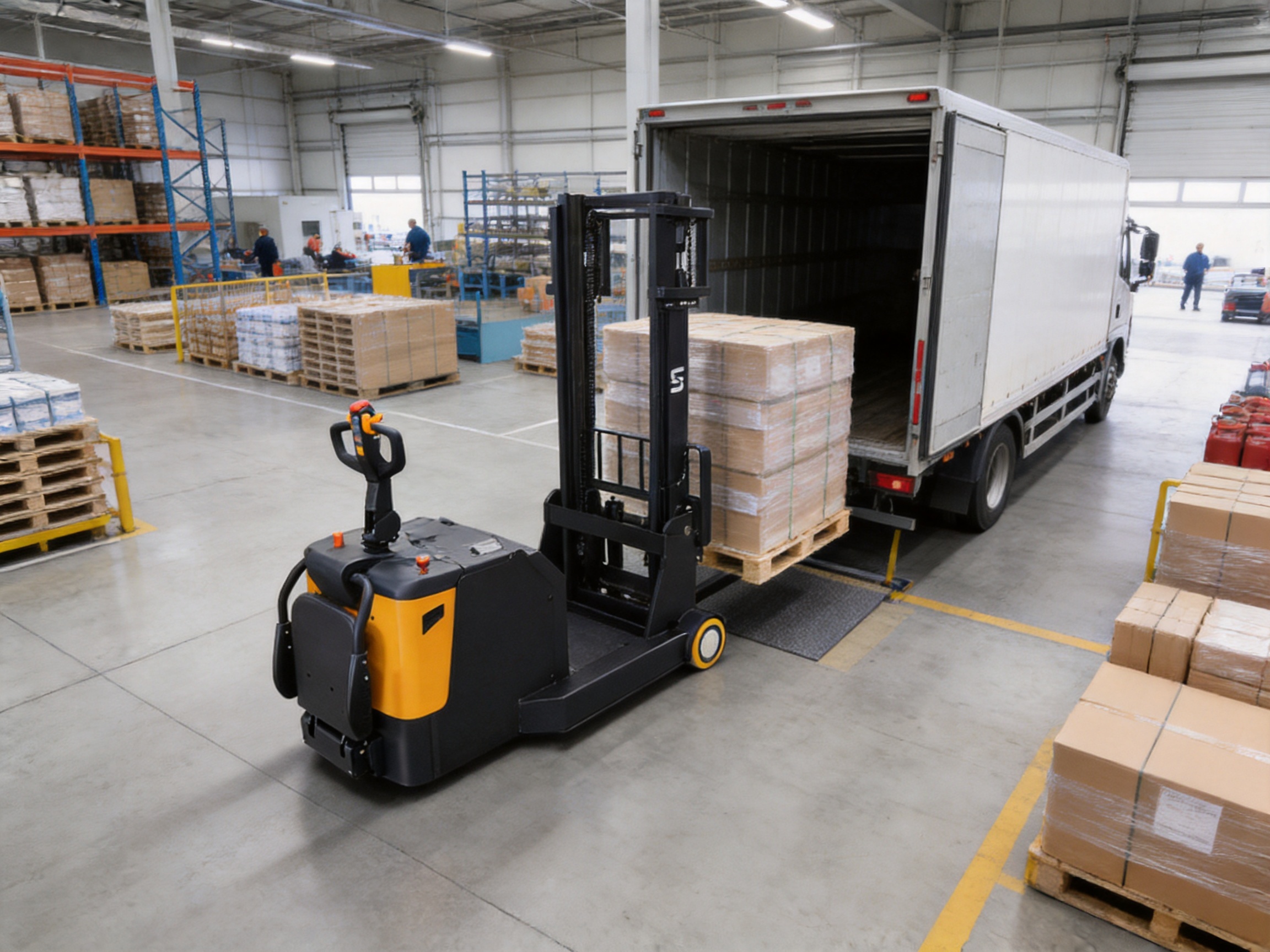
This makes the PS12/15CB-C more adaptable than many ordinary pallet stackers. It can be used in loading and unloading goods from lorries, stacking pallets in warehouse racks, supplying production lines, transferring materials between departments, and positioning goods in packaging or dispatch areas. For companies that handle different pallet standards or receive goods from multiple suppliers, this flexibility can reduce handling complications.
Another benefit of the counterbalanced format is improved fork access. The fork dimensions and adjustable distance between fork arms allow the stacker to handle different pallet widths and load bases. The fork-arm spacing range of 220 to 760 mm provides useful adaptability for industrial operations. This can be especially important in facilities where pallet types are not standardized or where loads include crates, bins, and custom bases.
Compared with a full electric counterbalanced forklift, the PS12/15CB-C remains compact and efficient. It is not intended to replace every forklift function, but it offers an ideal middle ground. It can lift higher than basic pallet trucks, handle loads more flexibly than many straddle stackers, and occupy less space than larger forklifts. In facilities where aisle width, operating cost, and energy use are important, this balance can be a major advantage.
Electric Power for Clean and Efficient Indoor Handling
Electric material handling equipment has become increasingly important as companies focus on workplace cleanliness, energy efficiency, emissions reduction, and lower operating noise. The PS12/15CB-C supports these priorities by using electric drive and electric lifting systems. Because it produces no local exhaust emissions, it is suitable for indoor environments such as warehouses, food-related storage areas, manufacturing plants, retail distribution centers, and enclosed loading zones.
Compared with internal combustion equipment, electric stackers are generally quieter, easier to operate indoors, and more comfortable for workers nearby. Lower noise levels help reduce operator fatigue and improve communication in busy facilities. The sound level at the driver’s ear is listed at 68 dB(A), which supports a more comfortable operating environment than many fuel-powered alternatives.
The product’s low energy consumption and long working hours are important for customers who want dependable daily operation without unnecessary energy waste. The battery capacity options allow users to select a configuration that fits their workload. The PS12CB-C is fitted with a 24 V / 210 Ah battery, while the PS15CB-C includes a 24 V / 270 Ah battery and may be optionally equipped with a 350 Ah battery for longer work cycles. This gives customers flexibility according to shift length, usage intensity, travel distance, and charging schedule.
Electric operation also supports easier maintenance planning. With fewer combustion-related components, no engine oil system, no exhaust treatment system, and fewer heat and vibration issues than engine-powered vehicles, electric stackers can be easier to manage in many warehouse fleets. The PS12/15CB-C further improves this with its AC vertical drive system, which is designed to increase performance, reduce maintenance cost, and improve working efficiency.
AC Vertical Drive System
The AC vertical drive system is one of the most important performance features of this electric stacker. AC drive technology is widely valued in material handling equipment because it offers strong controllability, efficient energy use, smooth acceleration, and reduced maintenance compared with traditional DC systems. In the PS12/15CB-C, the AC vertical drive system supports efficient travel and stable operation in daily industrial handling tasks.
A major advantage of AC drive technology is the reduction of wear-prone components. Since AC motors do not require brushes in the same way as traditional brushed DC motors, they can help lower service requirements and downtime. For fleet managers, this means fewer maintenance interruptions and more predictable equipment availability. In busy warehouses, even short periods of downtime can disrupt shipping schedules, production supply, or loading operations. A drive system designed for reliability therefore contributes directly to operational efficiency.
The vertical arrangement of the drive system also supports compact machine design. In warehouse environments where aisle space is valuable, compact component layout is essential. The PS12/15CB-C achieves a practical balance between counterbalanced stability and maneuverability. Its overall length, turning behavior, and steering support make it useful in environments where larger forklifts may be less efficient.
The drive motor rating of 1.6 kW is matched to the intended operating conditions of the stacker. It provides sufficient power for travel in typical warehouse and factory applications while maintaining energy-conscious performance. The listed travel speed of 5.5 km/h laden and 6 km/h unladen supports productive movement without encouraging unsafe high-speed operation in confined areas.
Electric Power Steering for Easier Maneuvering
Electric power steering is another important benefit of the PS12/15CB-C. In warehouse operations, the ability to maneuver precisely and comfortably can strongly influence productivity and safety. Manual steering can become tiring during repeated turns, especially when loads are heavy or when the operator must work in narrow aisles for long periods. Electric power steering reduces steering effort and makes the machine easier to control.
This feature is particularly valuable when the stacker is used in narrow spaces. Operators can position the forks more accurately, approach pallets more confidently, and make repeated steering corrections with less fatigue. Reduced operator effort can improve consistency over a full shift. A comfortable operator is more likely to maintain attention, follow safe handling procedures, and avoid sudden or excessive movements.
Electric power steering also helps when the optional standing platform is used. Standing operation over longer travel distances benefits from smooth steering feedback and controlled turning. When combined with protective side arms, the platform setup can support faster and safer movement between work zones. This is especially useful in logistics operations where the same machine may be used for picking up pallets, transporting them across the warehouse, and placing them at staging or loading locations.
High-Performance Pump and Accurate Fork Positioning
Lifting and lowering performance are essential for a stacker. The PS12/15CB-C uses a high-performance pump designed to ensure accurate positioning of the forks during lifting and lowering. This is important because safe stacking requires more than raw lifting power. Operators need controlled movement, predictable acceleration and deceleration, and smooth fork response when approaching rack beams, pallet openings, lorry beds, and production stations.
The lift speed of the PS12CB-C is listed at 95 / 135 mm/s laden / unladen, while the PS15CB-C offers 100 / 200 mm/s laden / unladen. The lowering speed is listed at 100 / 100 mm/s for the PS12CB-C and 180 / 180 mm/s for the PS15CB-C. These performance values support efficient handling while maintaining controlled operation. Faster lifting and lowering can reduce cycle times, but uncontrolled movement can create safety risks. The pump design helps balance productivity and precision.
Accurate fork positioning is particularly useful when handling fragile goods, stacked loads, or materials in narrow rack locations. If forks move unevenly or unpredictably, operators may need extra time to correct the load position. Smooth lifting and lowering reduce the chance of pallet damage, product disturbance, and unnecessary impacts. Over thousands of handling cycles, this can lead to measurable savings in time and reduced damage costs.
Safety-Focused Features
Safety is central to any material handling product. The PS12/15CB-C includes several features that support safe operation in daily use. The emergency switch ensures that the operator can quickly stop the machine when required. This is particularly important in busy warehouses where pedestrians, other equipment, and obstacles may be present.
The electromagnetic service brake improves stopping reliability. Compared with purely mechanical stopping methods, electromagnetic braking can provide consistent braking response and integrate effectively with electric drive control. This supports safe travel, especially when the machine is carrying a load or operating near racks, doors, or loading zones.
The optional suspension foldable platform with sideways protective arms is another safety-focused feature. When operators ride the machine, side arms help provide a protected standing position and improve confidence during movement. The foldable design also allows the platform to be stowed when pedestrian operation is preferred. This gives the machine flexibility while maintaining attention to operator protection.
Electric power steering also contributes to safety by improving control and reducing fatigue. Smooth steering makes it easier to avoid sudden corrections and helps the operator maintain stable movement in narrow spaces. The combination of controlled drive, accurate lifting, reliable braking, emergency stop capability, and optional protective platform equipment makes the PS12/15CB-C a practical choice for safety-conscious material handling operations.
Operator Comfort and Daily Usability
A stacker can only deliver its full value when operators can use it comfortably and efficiently throughout the workday. The PS12/15CB-C is designed with practical daily use in mind. The optional foldable platform allows operators to ride during longer travel tasks, reducing walking fatigue. The electric power steering makes turning and positioning easier. The low-noise electric drive helps create a more comfortable working environment.
The robust battery cover includes a storage area for tools and stretch film used for packaging. This may seem like a small detail, but in real warehouse work, practical storage can reduce wasted time. Operators often need access to simple tools, labels, wrapping material, or packaging accessories. A convenient storage space helps keep essential items close at hand and supports better work organization.
The tiller height range supports comfortable control in operating position, and pedestrian control allows the machine to be used in tight spaces where riding is not ideal. This adaptability is valuable in facilities that handle many different tasks during a shift. One machine may be used for unloading goods in the morning, supplying production lines during the day, and staging pallets for shipment later. Operator-friendly design helps the same equipment perform these varied duties effectively.
Performance in Warehouses and Factories
The PS12/15CB-C is well suited to warehouse and factory environments where pallet handling is frequent but space is limited. In a warehouse, it can be used for stacking pallets, retrieving goods, transferring loads between storage and dispatch areas, and supporting loading operations. In a factory, it can move raw materials to production lines, transport semi-finished goods, and place finished products in storage or shipping zones.
The machine’s lift height capability expands its usefulness. The PS12CB-C offers a listed lift height of 3600 mm, while the PS15CB-C offers a listed lift height of 4500 mm. These heights enable the machine to support multi-level storage and elevated placement tasks. The extended mast heights of 4200 mm and 5395 mm should be considered when planning facility clearance and rack layout.
The aisle width requirements for standard pallet handling are also important for facility planning. For pallets measuring 1000 by 1200 mm crossways, the aisle width is listed at 2991 mm for the PS12CB-C and 3125 mm for the PS15CB-C. For pallets measuring 800 by 1200 mm lengthways, the aisle width is listed at 3076 mm for the PS12CB-C and 3210 mm for the PS15CB-C. These values help warehouse planners determine whether the stacker can work efficiently in existing layouts.
Compared with larger forklifts, the PS12/15CB-C can offer improved efficiency in medium-duty indoor tasks. It is easier to position, consumes less space, and is more purpose-built for pallet stacking and movement. Compared with basic walkie stackers, it offers improved pallet compatibility and the productivity advantage of optional standing operation. This makes it a strong candidate for operations that need to upgrade from simple equipment without moving directly to larger lift trucks.
Advantages Over Common Competing Equipment
The PS12/15CB-C stands out against competing equipment in several ways. First, its counterbalanced design gives it greater pallet compatibility than many straddle stackers. In operations where closed pallets, mixed pallet types, or non-standard load bases are common, this can be a decisive advantage. A straddle stacker may be efficient when all pallets match its leg spacing, but it can become inconvenient when pallet types vary. The counterbalanced design reduces this limitation.
Second, the optional rider platform gives it an advantage over pedestrian-only stackers. Pedestrian stackers are useful for short-distance work, but they can become tiring and slower when operators must travel repeatedly across larger facilities. A foldable platform allows operators to ride when appropriate and walk when necessary. This flexibility improves productivity without sacrificing maneuverability.
Third, the AC vertical drive system can reduce maintenance needs compared with older drive technologies. Lower maintenance demand supports better fleet availability and reduced operating cost. For businesses comparing equipment over its full lifecycle rather than only purchase price, this is an important advantage.
Fourth, electric power steering provides a clear comfort and control benefit. Some lower-cost stackers rely on manual steering, which may be acceptable for occasional use but less ideal for intensive daily operation. Electric steering supports smoother maneuvering, reduced fatigue, and improved precision, especially in narrow spaces.
Fifth, the high-performance pump supports accurate lifting and lowering. Competing products may offer similar rated capacities, but handling quality depends on how smoothly and precisely the machine raises and lowers loads. The PS12/15CB-C is designed to make acceleration and deceleration more stable and safer, which can improve confidence and reduce product damage.
Manufacturing Strength and Industrial Experience
The manufacturer behind the PS12/15CB-C has long experience in material handling equipment. Founded in 1978, Zhejiang UN Forklift Co., Ltd. has developed into a professional manufacturer integrating research and development, production, sales, and service. With a production site covering 53,400 square meters and an annual production capacity of 15,000 units, the company has the scale needed to support consistent manufacturing, product improvement, and global supply.
Industrial experience matters because material handling equipment must perform reliably under repeated daily use. A stacker is not a decorative machine; it is a working asset that must carry loads, withstand vibration, perform lifting cycles, and remain safe in demanding environments. Decades of manufacturing experience help the company understand the real requirements of warehouses, factories, logistics centers, and international customers.
The company offers a broad range of forklifts and material handling equipment, including multiple varieties, series, and specifications. This wide product base supports cross-technical knowledge. Experience with electric forklifts, internal combustion forklifts, reach trucks, narrow aisle equipment, and new energy models helps strengthen the engineering foundation behind products such as the PS12/15CB-C.
The company has participated in the development of electric forklift industry standards in China and holds national patents related to electric forklift technologies. Such participation reflects technical capability and industry involvement. It also suggests that the company is not merely assembling generic equipment, but actively contributing to the development of the sector.
Advanced Manufacturing Processes
Advanced manufacturing for material handling equipment depends on several essential processes: structural fabrication, welding, machining, component integration, electrical assembly, hydraulic system installation, painting, inspection, and final testing. For an electric counterbalanced stacker, each of these processes directly affects the machine’s safety, stability, durability, and operating feel.
The frame and mast structure must be manufactured with strict dimensional control. Load-handling equipment experiences stress during lifting, lowering, travel, braking, and turning. Accurate fabrication helps maintain mast alignment, fork movement, and chassis stability. High-quality welding and structural assembly are especially important for a counterbalanced stacker because the machine must balance load forces while remaining compact.
The hydraulic system requires careful installation and testing. The high-performance pump, lifting components, hoses, cylinders, and control elements must work together to provide smooth motion and dependable load control. Precision in hydraulic assembly helps prevent leaks, unstable lifting, and premature component wear. Each lifting system should be checked for response, load handling, and controlled lowering.
Electrical assembly is another critical area. The AC drive system, battery system, steering control, emergency switch, braking system, and control circuits must be integrated reliably. Proper cable routing, connector quality, insulation protection, and control calibration all influence long-term performance. Since electric stackers often operate in dusty, busy, and vibration-prone environments, electrical reliability is essential.
Painting and surface treatment also contribute to product value. A durable finish protects structural components from corrosion and wear, especially in warehouses where equipment may encounter moisture, dust, packaging materials, and frequent contact with pallets or racks. A well-finished machine is easier to clean and maintain and presents a professional appearance in customer facilities.
Quality Control and Testing
Quality control is a key part of competitive advantage. For products such as the PS12/15CB-C, quality cannot be judged only by appearance. It must be verified through dimensional inspection, electrical testing, hydraulic testing, braking checks, steering response checks, lifting performance testing, and final operational inspection.
Load capacity verification is essential. A 1.2-ton or 1.5-ton stacker must safely handle its rated load under defined operating conditions. Testing helps confirm that the frame, mast, hydraulic system, drive system, and braking system perform as intended. Stability and braking behavior are especially important in real warehouse operation, where operators may work near racks, vehicles, and pedestrians.
Battery and charging system compatibility should also be checked carefully. The industrial lead-acid battery must provide stable power, fit securely in the compartment, and connect safely to the electrical system. Battery weight also contributes to the counterbalanced design, so correct battery specification is part of both power supply and stability management.
Final testing should include travel performance, steering, lift and lowering functions, emergency stop operation, electromagnetic braking, and control responsiveness. By conducting systematic inspections before delivery, the manufacturer can reduce the likelihood of early service issues and improve customer confidence.
Global Service and Application Knowledge
The company has developed a worldwide sales and service network with partners in Europe, South America, North America, Africa, and Asia. This global presence is important because material handling equipment is used in very different operating environments. Warehouses in Europe may prioritize energy efficiency and safety compliance. Customers in North America may emphasize productivity and fleet integration. Users in developing markets may value durability, ease of maintenance, and cost-effectiveness. A global network helps the manufacturer understand these varied needs.
Application knowledge improves product recommendations. The right stacker configuration depends on load weight, pallet type, lift height, aisle width, travel distance, battery charging schedule, operator preference, and working environment. A supplier with experience across multiple markets can help customers select the most suitable model and avoid mismatched equipment.
Service support also affects long-term value. Spare parts availability, technical guidance, maintenance advice, and after-sales communication all influence the ownership experience. Since the PS12/15CB-C is intended for daily industrial use, dependable support helps customers keep equipment operating efficiently over time.
Energy Saving and Environmental Direction
The material handling industry is moving steadily toward cleaner and more energy-efficient equipment. Electric stackers such as the PS12/15CB-C support this transition by reducing local emissions and lowering workplace noise. For companies seeking to improve environmental performance, electric equipment is often one of the most practical steps.
The manufacturer has emphasized concepts such as energy saving, environmental protection, high efficiency, and safety. In recent years, it has actively developed new energy forklifts, including diesel-to-lithium-ion conversions and standard lithium-ion battery forklift models. Although the PS12/15CB-C described here uses an industrial lead-acid battery system, it is part of a broader product environment focused on cleaner and smarter material handling.
For many businesses, lead-acid technology remains attractive because it is familiar, widely supported, and cost-effective. The optional higher-capacity battery for the PS15CB-C provides flexibility for operations needing longer work periods. At the same time, the company’s broader new energy development shows readiness for markets that increasingly demand lithium-ion, high-efficiency, or low-carbon solutions.
Best-Fit Applications
The PS12/15CB-C is best suited for operations that require compact lifting equipment with stronger versatility than a standard walkie stacker. It is useful in warehouses that handle mixed pallet types, factories that require regular material supply, logistics centers with staging and loading tasks, and businesses that need to load or unload lorries without using a large forklift.
In production environments, the stacker can move raw materials from storage to workstations, transfer components between departments, and place finished goods in temporary storage. In warehousing, it can place pallets onto racks, retrieve goods for dispatch, and support order preparation. In loading operations, it can help move goods between warehouse floors and vehicles when conditions are suitable.
The 1.2-ton model is appropriate for lighter handling tasks where compactness and efficiency are priorities. The 1.5-ton model is better for heavier pallets or applications requiring higher lifting capability. Customers should choose the model based on maximum load weight, load center, lift height, frequency of use, travel distance, and aisle conditions.
Because the machine is electrically powered, it is especially well suited to indoor environments. Polyurethane wheels support smooth movement on suitable warehouse floors. The listed ground clearance at the center of the wheelbase is 52 mm, so the equipment is best used on relatively even industrial surfaces rather than rough outdoor terrain.
Selection Considerations for Buyers
Before purchasing the PS12/15CB-C, buyers should evaluate several key factors. The first is load weight. If the operation regularly handles loads near or above 1500 kg, a higher-capacity forklift may be required. If most loads are below 1200 kg, the PS12CB-C may offer sufficient capability with efficient operation.
The second factor is lift height. The PS12CB-C offers a listed lift height of 3600 mm, while the PS15CB-C offers a listed lift height of 4500 mm. Buyers should compare these values with rack heights, lorry bed requirements, mezzanine levels, and storage plans. The lowered and extended mast heights should also be checked against doorways, ceilings, containers, and other clearance limits.
The third factor is aisle width. Warehouse layouts should be measured carefully, especially if the stacker will be used with standard pallets in narrow aisles. The listed aisle width values for 1000 by 1200 mm and 800 by 1200 mm pallets provide a useful planning reference.
The fourth factor is battery requirement. Operations with longer shifts or heavy use may benefit from the optional 350 Ah battery on the PS15CB-C. Charging space, ventilation, maintenance procedures, and battery handling practices should be planned before implementation.
The fifth factor is operating style. If the equipment will be used mostly for short-distance positioning, pedestrian operation may be sufficient. If operators must travel longer distances, the optional foldable platform with protective side arms can improve productivity and reduce fatigue.
Q&A Section
What type of equipment is the PS12/15CB-C?
The PS12/15CB-C is an electric counterbalanced pallet stacker designed for lifting, moving, stacking, loading, and unloading palletized goods. It is available in 1.2-ton and 1.5-ton rated capacity versions.
What is the main advantage of a counterbalanced stacker?
A counterbalanced stacker does not rely on front straddle legs in the same way as many conventional stackers. This allows better access to closed pallets and a wider range of load bases, making the machine more versatile in mixed pallet environments.
Can the operator ride on the machine?
Yes. The stacker can be configured with an optional suspension foldable platform and sideways protective arms. This allows standing operation for longer travel distances while still permitting pedestrian operation when the platform is folded.
What battery does the machine use?
The PS12CB-C is equipped with a 24 V / 210 Ah industrial lead-acid battery. The PS15CB-C is equipped with a 24 V / 270 Ah battery, with an optional 350 Ah battery available for longer operating time.
Why is the AC vertical drive system important?
The AC vertical drive system improves performance, supports efficient energy use, reduces maintenance requirements, and helps the machine operate smoothly in warehouse and factory environments.
How does electric power steering benefit the operator?
Electric power steering reduces steering effort, improves maneuverability, and makes operation easier in narrow spaces. It also helps reduce operator fatigue during repeated handling cycles.
What are typical applications for this stacker?
Typical applications include warehouse stacking, factory material transfer, loading and unloading goods, production line supply, pallet staging, packaging area support, and general indoor material handling.
Is the PS12/15CB-C suitable for outdoor rough terrain?
The machine is designed mainly for indoor industrial floors and smooth operating surfaces. Its polyurethane wheels and compact ground clearance make it best suited to warehouses, factories, and loading areas with suitable flooring.
What makes this product competitive against ordinary pedestrian stackers?
Its counterbalanced design, optional rider platform, electric power steering, AC drive system, high-performance pump, and flexible fork spacing give it advantages in versatility, operator comfort, productivity, and pallet compatibility.
What should buyers check before choosing a model?
Buyers should check load weight, lift height, aisle width, pallet type, operating distance, battery capacity needs, charging arrangements, and whether pedestrian or standing operation is preferred.
Conclusion
The Electric Stacker PS12/15CB-C is a practical and competitive solution for businesses that need efficient pallet handling without the size and cost of a full forklift. Its 1.2-ton and 1.5-ton capacity options, counterbalanced design, electric drive, optional standing platform, electric power steering, AC vertical drive system, high-performance pump, and safety-focused components make it suitable for a wide range of warehouse and factory tasks.
Its strongest value lies in versatility. It can handle pallet types that may be difficult for straddle stackers, support both pedestrian and standing operation, work cleanly indoors, and provide controlled lifting performance for stacking and loading applications. For operations seeking to improve productivity, reduce operator fatigue, and maintain safe handling standards, the PS12/15CB-C offers a balanced and reliable choice.
Behind the product is a manufacturer with decades of experience, broad production capability, global market reach, research and development strength, and involvement in electric forklift technology standards. This manufacturing background strengthens the product’s value by supporting consistent quality, technical development, service availability, and long-term improvement.
For warehouses, factories, and logistics operations looking for a compact electric counterbalanced stacker with strong practical features, the PS12/15CB-C deserves serious consideration. It brings together clean electric operation, flexible handling, operator-friendly control, and proven industrial design in a machine built for everyday productivity.
References
1. Product specification sheet for Electric Stacker PS12/15CB-C.
2. Industrial truck performance and safety principles based on common warehouse material handling practices.
3. Electric forklift and pallet stacker application guidance for indoor logistics operations.
4. General engineering references on AC drive systems, electric steering, hydraulic lifting systems, and industrial lead-acid battery operation.
5. Manufacturer background information on production capacity, product range, research and development, and global service network.
Product: Electric Stacker PS12/15CB-C
For exclusive deals and latest offers, sign up by entering your email address below.
Stay In Touch
ADDRESS : NO.1 ROAD ONE, XINDENG NEW DISTRICT, FUYANG, HANGZHOU, ZHEJIANG, CHINA 311404.
PHONE : +86-571-8688 8355 (AMERICA)
PHONE : +86-571-8886 9363 (EUROPE)
PHONE : +86-571-8688 8377 (ASIA, AFRICA, OCEANIA)
EMAIL : [email protected]
EMAIL : [email protected](PARTS INQUIRY)

