


 中文简体
中文简体 Français
 русский
 Español
 عربى
عربى Deutsch



N Series 1.5T–1.8T LPG and Gasoline Forklifts: Clean, Compact Handling for Demanding Workplaces
Admin 2026-07-31Introduction
Modern material-handling operations need more than lifting capacity. A forklift must deliver dependable performance, precise control, safe operation, comfortable ergonomics, straightforward maintenance, and a reasonable total cost of ownership. These requirements become especially important in warehouses, distribution centers, manufacturing plants, retail logistics facilities, and indoor loading areas where space is limited and operating conditions change throughout the day.
The N Series 1.5T–1.8T LPG and gasoline forklift is designed to meet these practical demands. With rated capacities of 1,500 kg and 1,800 kg, a 500 mm load center, compact dimensions, and a low-emission internal-combustion power system, the forklift provides a useful balance between maneuverability and working capability. Its LPG and gasoline configuration is particularly suitable for operations that require longer working cycles than a battery-electric truck can provide while still seeking cleaner operation and lower noise than many conventional diesel forklifts.
The forklift combines a carefully engineered chassis with a reliable GCT power system, hydraulic components from Shimadzu, a transmission system designed to comparable Japanese technology standards, and a range of operator-protection and comfort features. These elements are not isolated specifications. Together, they create a working machine intended to perform consistently in repetitive, high-utilization applications.
Manufactured by Zhejiang UN Forklift Co., Ltd., a material-handling equipment producer with decades of experience, the series also benefits from broad engineering, production, and service capabilities. The company integrates research and development, manufacturing, sales, and after-sales service, allowing product design and field requirements to influence one another continuously.
This article examines the N Series 1.5T–1.8T LPG and gasoline forklift in detail. It explains the product’s operating advantages, key technical specifications, safety features, maintenance benefits, manufacturing strengths, application suitability, and competitive position.
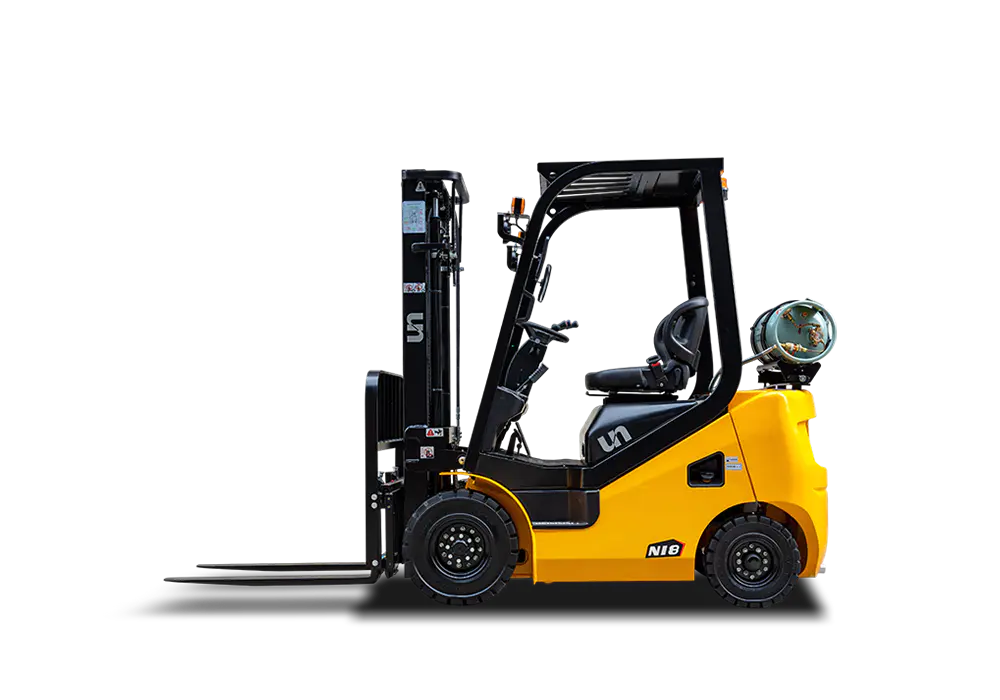
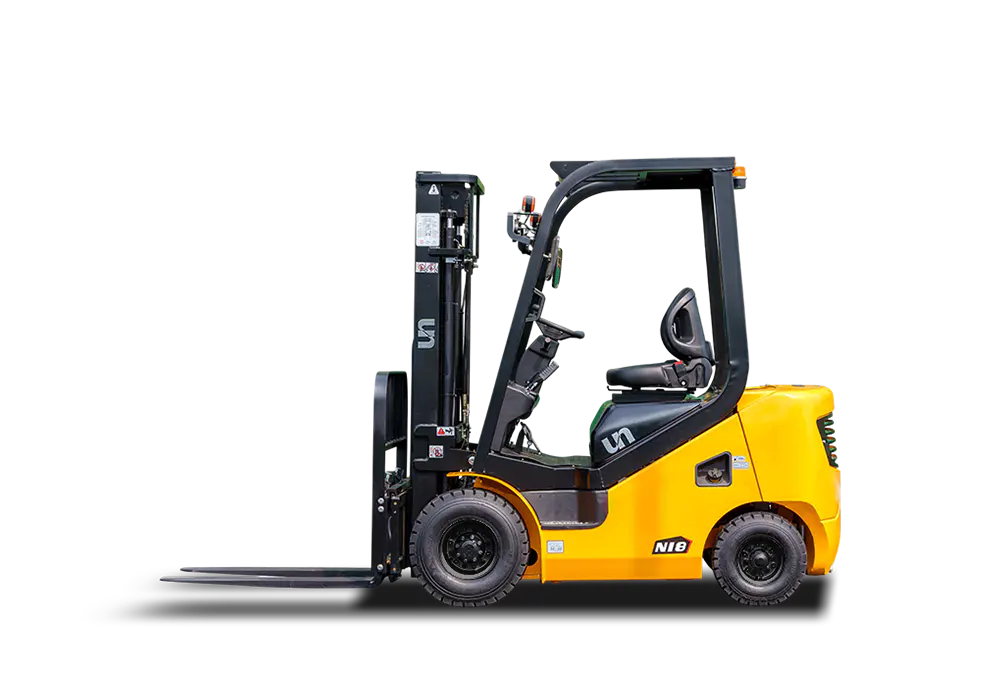
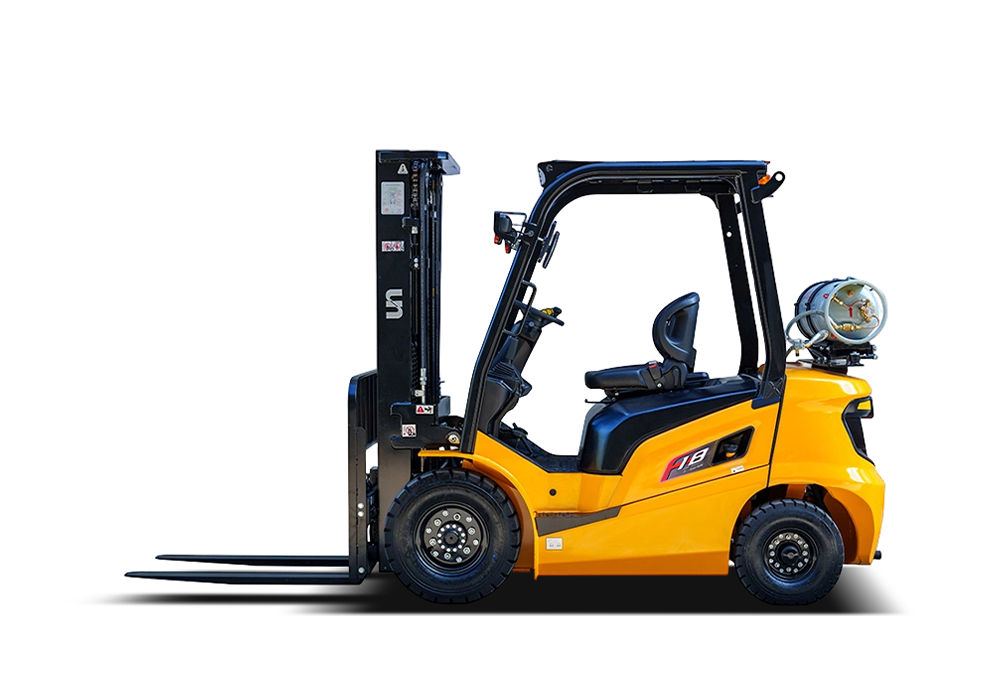
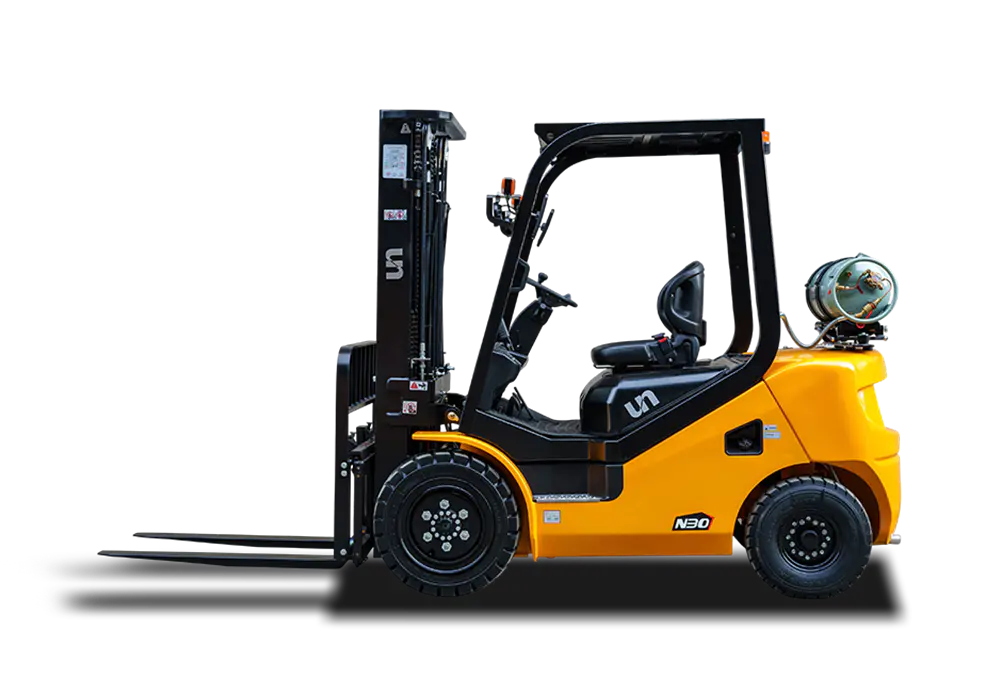
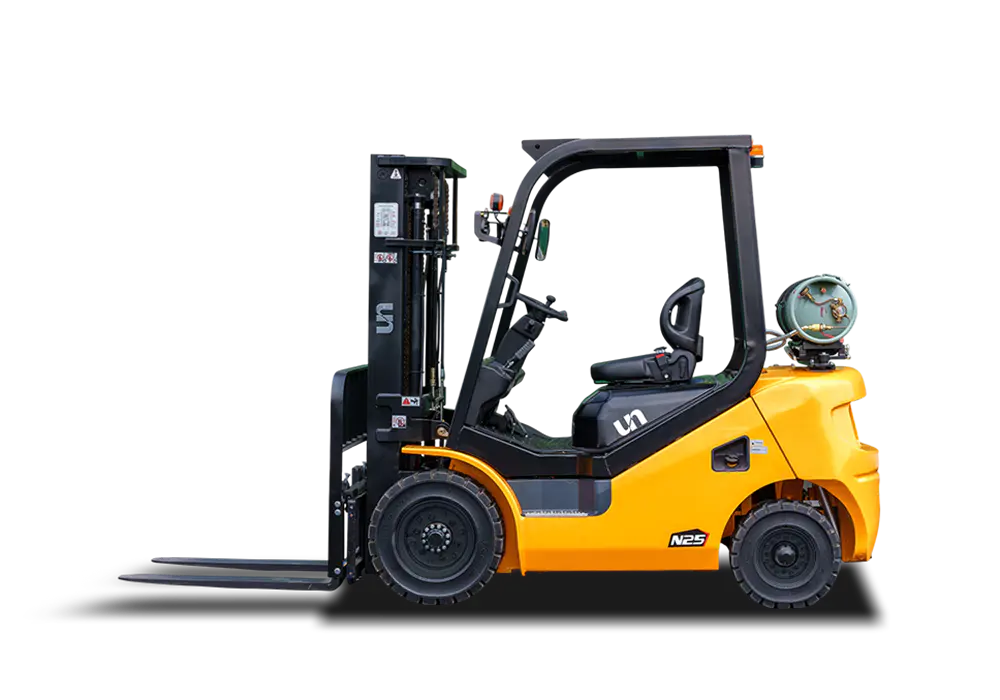
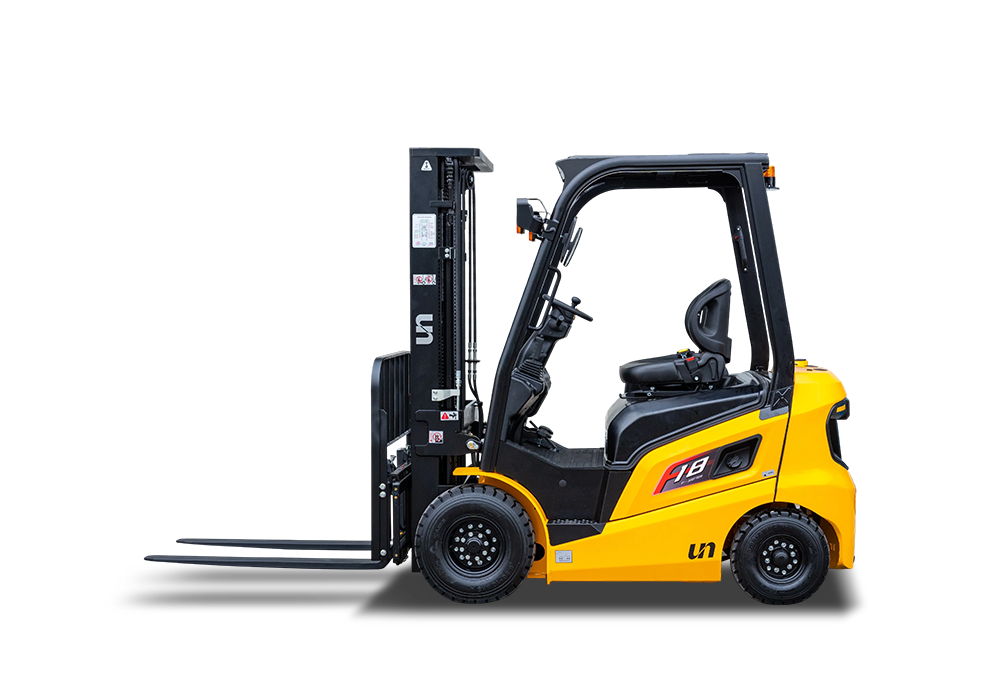
N Series 1.5T-1.8T LPG&Gasoline Forklift
1. Product Positioning and Intended Applications
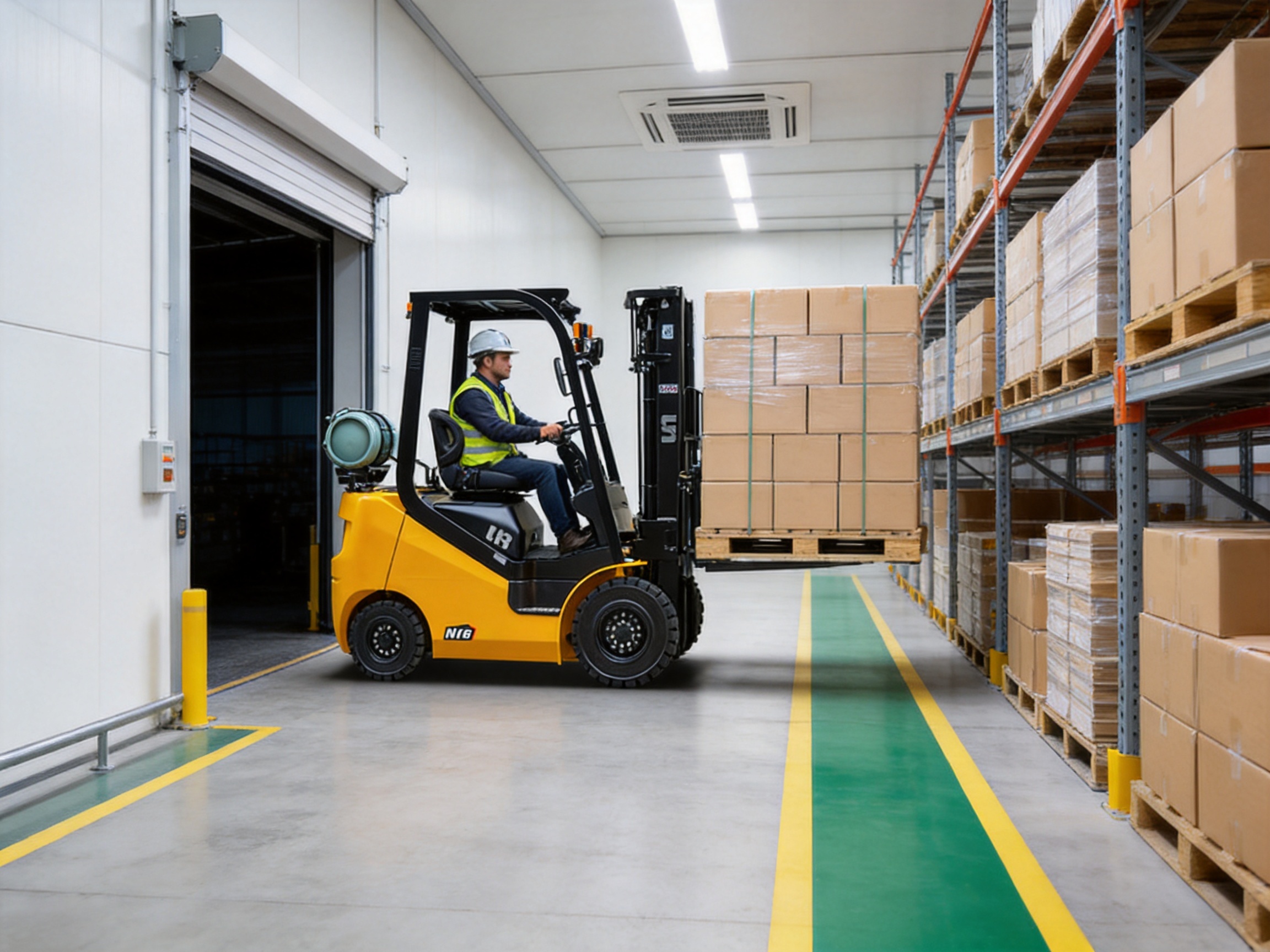
The N Series 1.5T–1.8T forklift is positioned as a compact internal-combustion truck for professional material handling. Its 1.5-ton and 1.8-ton capacity classes cover a wide range of routine warehouse and industrial tasks, including pallet movement, trailer loading and unloading, production-line feeding, storage-area replenishment, and short-distance transport.
Compared with a larger forklift, the compact N Series can operate more easily in confined areas. Its listed overall width is approximately 1,082 mm, and its outside turning radius is approximately 2,100 mm. These dimensions support maneuvering in warehouse aisles, loading bays, workshops, and production environments where every meter of floor space matters.
The truck is especially appropriate for users who need the flexibility of an internal-combustion machine but do not require the size or capacity of a heavy-duty forklift. A 1.5T model can handle common palletized goods, packaged products, components, and general industrial materials. The 1.8T model provides additional capacity for heavier loads while maintaining a similar basic layout and operating concept.
LPG and gasoline power gives the operator flexibility in applications where equipment may need to work for extended shifts. Refueling is generally faster than recharging a battery, which can reduce interruptions in operations that have limited spare equipment or operate continuously. At the same time, the product description emphasizes low emissions and low noise, making the series more appropriate for clean indoor environments than many conventional diesel alternatives.
The product should always be used according to local regulations, ventilation requirements, fuel-system procedures, and the manufacturer’s operating instructions. LPG and gasoline trucks are not automatically suitable for every enclosed area. However, when the workplace is properly ventilated and the machine is correctly maintained, this power configuration can provide a practical compromise between clean operation, productivity, and refueling convenience.
Typical operating environments
The forklift is suitable for warehouses handling consumer goods, food-related packaging, building materials, machinery parts, furniture, textiles, appliances, and other palletized products. It can also serve factories where materials must be moved between receiving areas, storage locations, assembly lines, and finished-goods zones.
Its low-noise characteristics are valuable in workplaces where operators work near office areas, retail spaces, indoor loading docks, or production teams. Reduced noise can improve communication and contribute to a more comfortable working environment, although actual sound levels depend on load, surface, engine condition, attachments, and operating technique.
The compact chassis also benefits businesses that are expanding storage capacity without expanding the building. Narrower aisles and tighter turning areas can be challenging for oversized machines. A truck with a smaller footprint can help improve access to existing storage positions while still providing adequate lifting performance for common loads.
2. Core Performance Advantages
Reliable power and transmission integration
The design of a forklift depends on the interaction between the engine, transmission, chassis, hydraulic system, steering system, and counterweight. A powerful engine alone cannot guarantee good performance. The N Series addresses this relationship through a chassis and powertrain developed to work as an integrated system.
The product information identifies the GCT K21/25 engine family for the N Series description, while the detailed 1.5T–1.8T specification data identifies the GK21 engine, manufactured by GCT. The listed engine output is 31.2 kW at 2,300 revolutions per minute, with rated torque of 144 N·m at 1,600 revolutions per minute. The four-cylinder engine has a displacement of 2,065 cc, a bore and stroke of 89 mm by 83 mm, and is configured for LPG and gasoline operation according to the selected model.
This output level is well matched to a compact forklift in the 1.5T–1.8T class. It provides sufficient power for normal travel, lifting, ramp operation, and pallet handling without requiring the larger engine package associated with higher-capacity trucks. A properly matched engine can also support efficient fuel use by avoiding unnecessary excess capacity.
The hydraulic transmission is designed to provide smooth directional changes and controlled movement. The product information refers to an IMPOCO shift system and a transmission system comparable to Japanese technology standards. In daily operation, a well-matched transmission helps the operator start, stop, reverse, and position the truck with less shock. Smooth power delivery can also reduce stress on the load, mast, driveline, and tires.
Hydraulic precision
Hydraulic performance directly affects productivity and load control. The N Series uses Shimadzu pumps and valves, which are specified as premium components intended to provide precise and smooth lifting and steering. When the hydraulic circuit is correctly calibrated, the operator can position forks more accurately, approach pallets with greater confidence, and reduce unnecessary corrective movements.
The listed rated lifting speed under full load is 560 mm per second for the 1.5T and 1.8T models. This supports efficient pallet placement and retrieval while maintaining a controlled operating feel. The standard rated lift height is 3,000 mm, which is suitable for many warehouse storage systems and general industrial applications.
The mast tilt angle is listed as 6 degrees forward and 12 degrees backward. Forward tilt can assist with load placement, while backward tilt helps stabilize a load during travel when used within safe operating limits. Operators must always keep the load within the rated capacity and follow safe mast and fork procedures.
Stable thermal performance
Forklifts often work in demanding environments where engines, hydraulic systems, and transmissions generate substantial heat. This is particularly true during repeated loading cycles, ramp travel, summer operation, and work in areas with limited airflow.
The N Series uses a large-capacity radiator and an efficient cooling design to help maintain stable operating temperatures. Good cooling performance protects the powertrain from heat-related stress and helps the truck maintain consistent output during extended work. It can also reduce the risk of performance degradation caused by excessive temperature, provided that the radiator, coolant, hoses, and airflow channels are inspected and maintained correctly.
Stable cooling is an important advantage over poorly matched or inadequately ventilated machines. In real-world operations, productivity is influenced not only by maximum rated speed but also by whether the truck can complete a full shift without overheating, unexpected derating, or frequent stoppages.
Travel and gradeability
The detailed specifications list a no-load travel speed of 14.5 km/h for the 1.5T and 1.8T models. The maximum gradeability under full load is listed as 20 percent. These figures provide a useful performance baseline for internal logistics routes, loading ramps, and yard transitions.
Actual travel speed should be adjusted to the operating environment. Congested aisles, pedestrian zones, uneven floors, wet surfaces, ramps, and elevated loads all require careful speed control. A forklift’s value is not determined by traveling as fast as possible; it is determined by moving materials safely and efficiently over the entire operating cycle.
The maximum drawbar pull is listed as 17 kN under full load and 14.5 kN under no load for the 1.5T and 1.8T models. This indicates that the truck has useful traction and pulling capability for ordinary industrial movement. Tire condition, floor quality, load distribution, and ramp surface will influence practical traction in the field.
3. Compact Dimensions and Maneuverability
One of the strongest advantages of the N Series is its compact layout. The 1.5T and 1.8T configurations use a short wheelbase of approximately 1,410 mm, an overall width of approximately 1,082 mm, and an outside turning radius of approximately 2,100 mm. These dimensions help the truck turn within restricted areas and approach pallets without excessive repositioning.
The minimum aisle width for pallets is listed as approximately 3,700 mm. Aisle requirements vary according to pallet dimensions, rack layout, fork length, mast configuration, load overhang, operator skill, and local safety margins. Even so, the specification indicates that the product is designed for relatively space-conscious environments.
Compactness improves more than storage density. A maneuverable forklift can shorten travel paths, reduce the number of adjustments required at each pallet, and help operators work around columns, doors, machinery, and other fixed obstacles. It can also reduce the need for costly building modifications when a company changes its storage arrangement.
The standard fork dimensions for the 1.5T model are listed as 920 mm by 120 mm by 35 mm. For the 1.8T model, the listed fork dimensions are 1,070 mm by 120 mm by 40 mm. These dimensions should be matched to the pallet design and load shape. Optional forks or attachments may be available depending on the required application, but every attachment affects residual capacity, visibility, and stability.
The listed fork overhang is 409 mm for the 1.5T model and approximately 414 mm in the extended specification data for the 1.8T model. The detailed tables also contain broader N Series values for related capacity classes. Buyers should confirm the exact configuration, tire type, mast, fork length, and dimensional drawing before finalizing an aisle plan.
Comparison with larger conventional forklifts
Larger forklifts may offer higher capacity, but they generally require more floor space, wider aisles, and greater turning clearance. They may also consume more fuel and impose higher tire, maintenance, and infrastructure costs when used for loads that do not require their full capacity.
The N Series offers a more proportionate solution for businesses whose normal loads fall between 1,000 kg and 1,800 kg. Selecting the correct capacity class can reduce unnecessary capital expenditure while maintaining appropriate safety margins. It also allows the truck to be sized to the operation rather than selected solely according to the highest possible load.
4. Operator Safety and Ergonomics
Safe material handling depends on both machine design and operator behavior. The N Series includes several features intended to support awareness, load control, and physical comfort during repetitive work.
Operator Presence System and seat switch protection
The forklift is equipped with an Operator Presence System, commonly referred to as OPS, together with seat switch protection. These systems are designed to help prevent certain driving or operating functions when the operator is not correctly seated or when the required operating conditions are not met.
Presence-detection systems are not substitutes for training, inspection, or safe driving procedures. Their value lies in providing an additional layer of protection against unintended movement or operation. They can be particularly useful in busy workplaces where operators frequently stop, reposition, or leave the truck during a work cycle.
Wide-vision mast
Visibility is a major factor in forklift safety. The wide-vision mast is designed to help maintain a clearer line of sight toward the load and travel path. Improved visibility can reduce the need for awkward body movement and help the operator identify pallet openings, rack beams, pedestrians, and floor obstacles more easily.
Visibility still depends on the load height, load shape, mast position, lighting, attachment design, and travel direction. When the load blocks forward visibility, the operator should travel in reverse when appropriate, maintain a safe speed, and use a spotter or other site procedure where necessary.
Overhead guard protection
The strong overhead guard helps protect the operator from falling objects and provides a protective structure around the driving position. The listed overhead guard height is approximately 2,160 mm for the 1.5T and 1.8T models.
Before purchase, users should compare this height with doorways, container entrances, sprinkler systems, rack clearances, and other overhead restrictions. The overhead guard is a protective component, but it does not make it safe to operate beneath unstable loads or damaged storage systems.
Suspended frame and operator comfort
The suspended frame provides additional foot space and contributes to a more comfortable operator environment. Adjustable steering and a comfortable seat allow the operator to adapt the driving position to individual body size and preferred posture.
Ergonomics has a direct relationship with productivity. Operators who experience less fatigue can maintain better concentration and more consistent control over a full shift. Reduced fatigue may also lower the likelihood of errors caused by uncomfortable seating, restricted legroom, excessive vibration, or repeated awkward movements.
The product information also identifies an optional suspended powertrain. This option can provide greater flexibility for users who place a higher priority on ride comfort, vibration reduction, or performance customization. Availability should be confirmed according to the selected model and market.
5. Maintenance and Serviceability
Maintenance design influences the long-term value of a forklift as much as its initial purchase price. A machine that is difficult to inspect may receive less frequent service, increasing the chance that minor faults become major failures. The N Series includes features intended to make routine access quicker and more convenient.
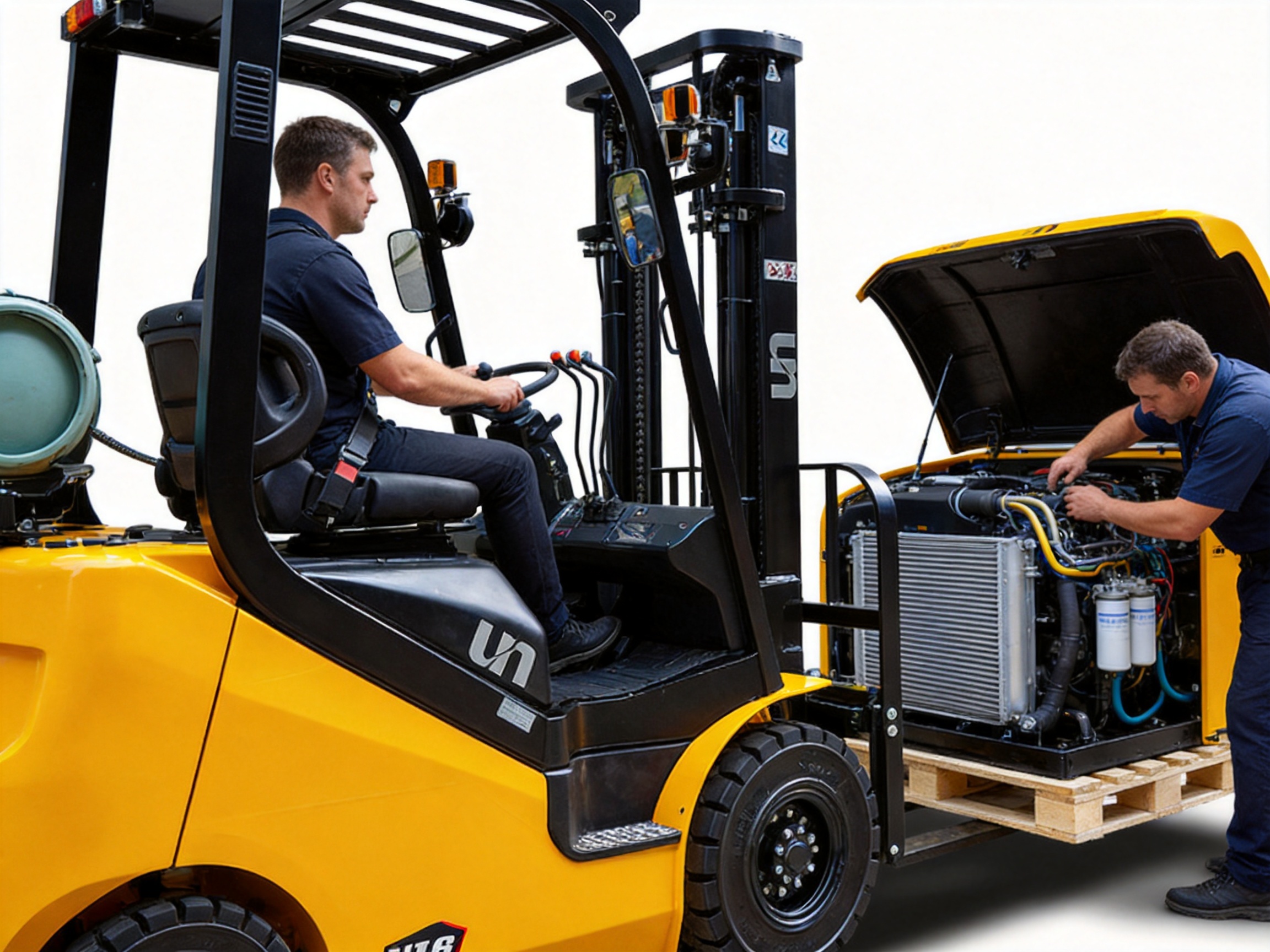
Wide-opening engine hood
The engine hood opens to nearly 90 degrees, creating a broad access area around the engine compartment. This makes it easier for service personnel to inspect belts, hoses, filters, fluid levels, wiring, and other components. It also supports faster replacement of service parts.
Good access reduces the time required for preventive maintenance. It can also improve the quality of maintenance because technicians are less likely to skip inspections when components are easy to reach. For fleet operators, a shorter maintenance process can help return the truck to service more quickly.
Transmission oil filter replacement
The design also simplifies transmission oil filter replacement. Transmission filtration is important because contaminants can affect hydraulic and shifting performance. Easy filter access encourages regular replacement according to the maintenance schedule.
Routine servicing should be carried out by trained personnel using the correct filters, lubricants, fuel-system procedures, and torque specifications. The exact service interval will depend on operating hours, working conditions, fuel quality, dust exposure, load intensity, and local recommendations.
Maintenance as a competitive advantage
Some forklifts appear attractive at the time of purchase but become expensive because routine service takes too long or requires excessive disassembly. A service-friendly design can reduce labor costs, limit downtime, and improve fleet availability.
The N Series benefits from the combination of accessible engine-compartment design, recognized hydraulic components, a conventional internal-combustion layout, and a service network supported by the manufacturer. These factors can be especially valuable for companies operating mixed fleets that need predictable parts supply and technician support.
6. Main Specifications for the 1.5T and 1.8T Models
The following table summarizes the principal specifications identified for the 1.5T and 1.8T LPG and gasoline configurations. Because equipment specifications may vary according to mast, tire, fuel system, attachment, and market requirements, buyers should confirm the final configuration with the supplier.
| Specification | Unit | 1.5T Model | 1.8T Model |
|---|---|---|---|
| Rated load capacity | kg | 1,500 | 1,800 |
| Load center | mm | 500 | 500 |
| Power type | Gasoline/LPG | Gasoline/LPG | |
| Rated lift height | mm | 3,000 | 3,000 |
| Free lift height | mm | Approximately 135 | Approximately 140 |
| Fork size | mm | 920 × 120 × 35 | 1,070 × 120 × 40 |
| Mast tilt angle | degrees | 6° forward/12° backward | 6° forward/12° backward |
| Overall width | mm | 1,082 | 1,082 |
| Mast lowered height | mm | 2,025 | 2,025 |
| Mast extended height with backrest | mm | 4,055 | 4,055 |
| Overhead guard height | mm | 2,160 | 2,160 |
| Outside turning radius | mm | 2,100 | 2,100 |
| Minimum pallet aisle width | mm | 3,700 | 3,700 |
| Travel speed without load | km/h | 14.5 | 14.5 |
| Lifting speed at full load | mm/s | 560 | 560 |
| Maximum gradeability at full load | percent | 20 | 20 |
| Wheelbase | mm | 1,410 | 1,410 |
| Total weight | kg | Approximately 2,860 | Approximately 2,990 |
| Engine model | GK21 | GK21 | |
| Rated output | kW/rpm | 31.2/2,300 | 31.2/2,300 |
| Rated torque | N·m/rpm | 144/1,600 | 144/1,600 |
| Number of cylinders | 4 | 4 | |
| Displacement | cc | 2,065 | 2,065 |
| Fuel tank capacity | L | 50 | 50 |
| Battery | V/Ah | 12/60 | 12/60 |
| Transmission | Hydraulic | Hydraulic |
The supplied technical material also includes broader N Series data for 2.0T, 2.5T, 3.0T, and 3.5T configurations. These larger models use different dimensions, tire sizes, lifting speeds, weights, and operating pressures. They demonstrate the scalability of the product family but should not be treated as specifications for the 1.5T and 1.8T versions.
7. LPG and Gasoline Compared with Other Power Options
Advantages over diesel forklifts in clean indoor work
Diesel forklifts are valued for high torque and outdoor durability, but they may produce greater exhaust emissions, more engine noise, and stronger vibration than desired in enclosed or semi-enclosed workplaces. The LPG and gasoline N Series is intended to provide a cleaner and quieter alternative for applications where diesel power is excessive.
Lower noise can improve communication between operators and pedestrians. Lower emissions can make the machine more suitable for indoor areas, subject to ventilation and regulatory requirements. The gasoline and LPG configuration also avoids the long battery charging periods associated with some electric fleets.
Advantages over battery-electric forklifts in continuous operation
Electric forklifts offer zero tailpipe emissions during operation and are highly attractive for many indoor facilities. However, fleet managers must plan battery charging, spare batteries, charging infrastructure, battery replacement, and thermal performance. In some high-utilization environments, these requirements can complicate operations.
LPG and gasoline forklifts can be refueled quickly, allowing the truck to return to work with limited interruption. This can be beneficial for loading docks, production support, and multi-shift operations where every minute of equipment availability matters.
The correct choice depends on the entire operating profile. Electric trucks may be preferable where zero-emission operation is mandatory. LPG and gasoline trucks may be preferable where rapid refueling, flexible shift coverage, and mixed indoor-outdoor use are more important. The N Series gives buyers another option between conventional diesel capacity and electric operation.
Advantages over oversized capacity classes
Using a 3-ton or 3.5-ton forklift for routine 1.5-ton loads may provide unused capacity but can increase purchase cost, fuel consumption, turning requirements, tire expense, and floor loading. The N Series allows the machine to be selected according to the normal load profile rather than an occasional exceptional requirement.
Correct equipment sizing can produce measurable operational benefits. A compact truck is easier to position, easier to store, and often more economical to operate. It may also reduce wear on floors and facilities compared with a heavier machine.
8. Manufacturing and Engineering Strengths
Product performance is strongly influenced by the capabilities of the manufacturer behind it. Zhejiang UN Forklift Co., Ltd. was founded in 1978 and has developed into an integrated material-handling equipment manufacturer covering research and development, production, sales, and service.
The company operates on a site of approximately 53,400 square meters and has an annual production capacity of approximately 15,000 units. This scale supports standardized processes, dedicated production resources, supplier coordination, quality-control procedures, and the ability to serve both domestic and international customers.
Integrated research and development
An integrated research and development function allows the manufacturer to develop products around real application requirements. Forklifts must combine structural strength, hydraulic precision, visibility, ergonomics, driveline performance, stability, and maintainability. These areas cannot be optimized effectively when each system is treated in isolation.
The company’s product history includes the development of China’s first reach forklift and very-narrow-aisle truck. It also holds national patents related to electric forklift technologies and has participated in the development of Chinese electric forklift industry standards. Although the N Series is an LPG and gasoline product, this broader engineering background demonstrates experience across multiple material-handling technologies.
Production capability and process consistency
Consistent manufacturing is essential for commercial forklift fleets. A fleet customer expects the same model to provide predictable dimensions, controls, service access, and replacement-part compatibility across multiple units.
A structured production process generally includes material inspection, component machining or preparation, frame and chassis fabrication, welding, surface treatment, painting, powertrain installation, hydraulic assembly, electrical integration, mast installation, functional testing, and final inspection. Each stage influences reliability. A strong frame is not enough if hydraulic connections, wiring, controls, or alignment are inconsistent.
The N Series reflects this systems-based approach through the integration of the chassis, GCT engine, hydraulic components, transmission, mast, and operator-protection systems. The manufacturer’s production scale provides a foundation for applying repeatable procedures across the product range.
International supply and service experience
The company maintains a worldwide sales and service network with partners in Europe, South America, North America, Africa, and Asia. International experience is important because export forklifts must meet different regulations, operating practices, climate conditions, fuel standards, and customer expectations.
Global customers also require documentation, replacement parts, warranty procedures, technical training, and responsive communication. A manufacturer with international partners is better positioned to support these requirements than a supplier focused only on one local market.
The company also serves as an original-equipment manufacturer for recognized domestic and overseas businesses, including Hyundai Heavy Industries and Xuzhou Construction Machinery Group, according to the supplied company information. OEM experience typically requires disciplined quality systems, specification control, delivery reliability, and the ability to adapt products to customer requirements.
9. Quality, Reliability, and Total Cost of Ownership
Forklift buyers should evaluate more than the purchase price. Total cost of ownership includes fuel, scheduled maintenance, tires, hydraulic oil, filters, downtime, operator training, attachments, repairs, insurance, and eventual resale or replacement costs.
The N Series supports cost control through several design choices. Its compact engine package is matched to the 1.5T–1.8T capacity class. The hydraulic system uses established pump and valve technology. The engine hood provides broad service access. The transmission oil filter is designed for convenient replacement. The structure is intended for repeated industrial use rather than occasional light-duty handling.
Reliability also depends on proper use. Operators should avoid overloading, sudden direction changes, excessive speed, impacts against racks, driving with elevated loads, and operation on surfaces that exceed the truck’s design conditions. Scheduled inspections should cover tires, forks, chains, mast rollers, hydraulic hoses, steering components, brakes, lights, seat systems, fuel lines, radiator cleanliness, engine fluids, and transmission oil.
When these practices are followed, a forklift can maintain productive service over a long operating life. Preventive maintenance is generally less expensive than emergency repair, and accessible components make it more practical for fleet managers to follow a planned service schedule.
Fuel flexibility and fleet planning
The power type is listed as gasoline/LPG, with a fuel tank capacity of 50 liters in the detailed specification data. The final fuel arrangement should be confirmed according to the selected model and local market. Fleet managers should consider fuel availability, storage requirements, local safety codes, operator training, and the expected daily operating hours.
For companies operating several forklifts, the N Series can be incorporated into a mixed fleet. Electric forklifts may serve sensitive indoor areas, while LPG and gasoline units handle loading docks, variable-shift work, or routes requiring rapid refueling. This approach can reduce pressure on charging infrastructure while maintaining low-emission capability in appropriate zones.
10. Practical Productivity Benefits
Productivity is created by the complete operating cycle: approach, fork insertion, lifting, reversing, travel, positioning, lowering, and return. The N Series contributes to this cycle through compact dimensions, responsive hydraulic control, adequate travel speed, and operator-focused design.
A wide-vision mast can reduce alignment time at racks and pallets. Smooth hydraulic operation helps the operator position the forks accurately. The 560 mm per second full-load lifting speed supports efficient placement. The 14.5 km/h no-load travel speed helps reduce empty travel time on suitable routes.
These advantages become more significant when repeated hundreds of times per shift. Even a small reduction in cycle time can improve daily throughput. At the same time, safety must remain the primary constraint. Faster handling is valuable only when loads remain stable, pedestrians are protected, and the equipment stays within its rated limits.
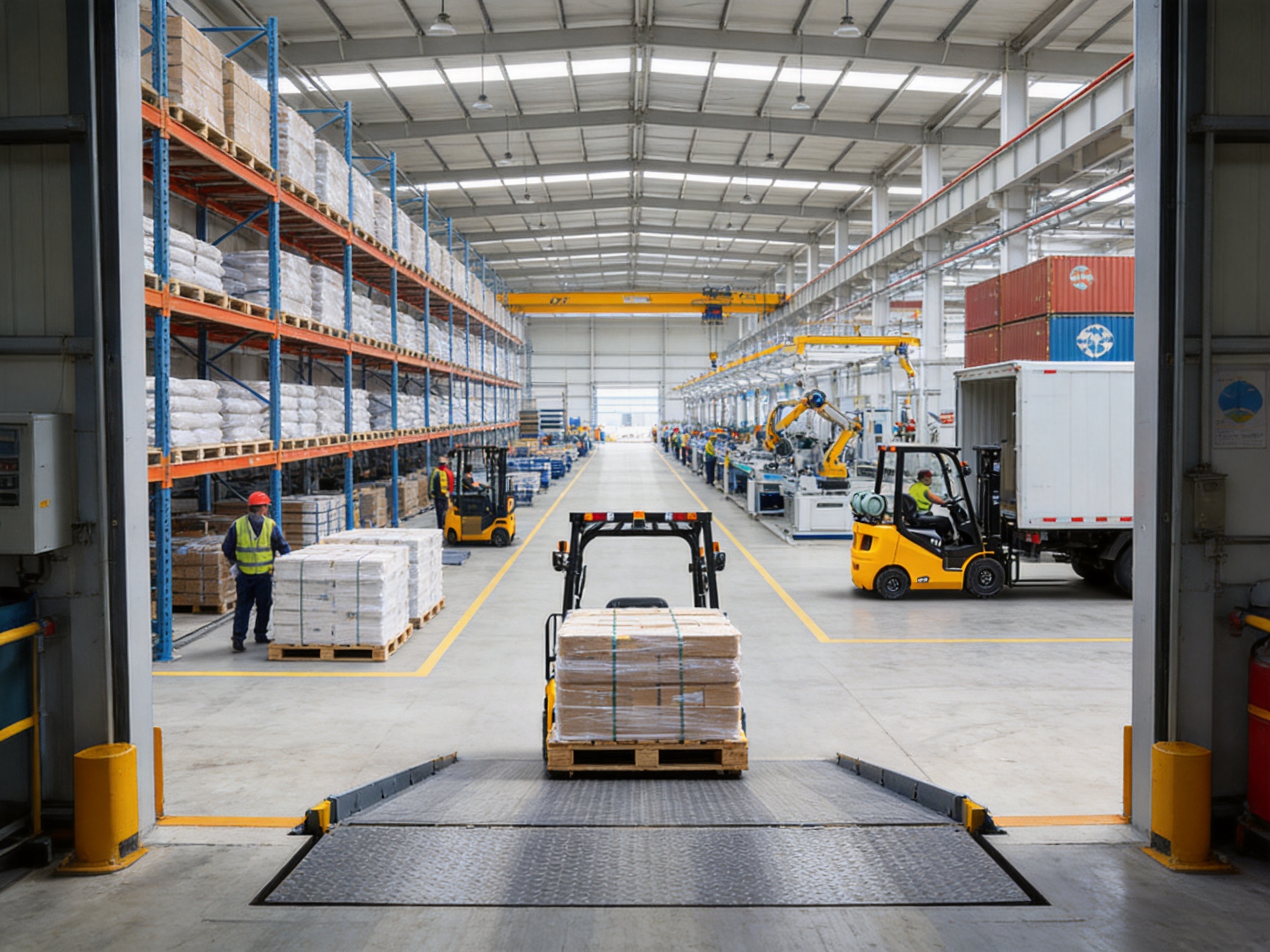
Loading and unloading
At loading docks, forklift maneuverability is often more valuable than extreme top speed. The operator may need to turn within a trailer approach, align with pallets, reverse carefully, and negotiate changes in floor level. The short wheelbase and compact turning radius help support these movements.
LPG and gasoline power can also be useful when trucks work between indoor staging areas and outdoor loading zones. Rapid refueling helps avoid long interruptions during periods of high shipment volume.
Production-line support
Manufacturing facilities frequently need reliable material movement at predictable intervals. A compact forklift can deliver components to production lines, remove finished pallets, and transport packaging materials without occupying excessive aisle space.
The comfortable operator station is important in this application because production support may involve many short travel cycles. Adjustable steering, a comfortable seat, and additional foot space can improve usability throughout the shift.
Warehouse replenishment
Warehouse replenishment requires accurate fork positioning and good visibility. The 3,000 mm rated lift height is suitable for many standard storage arrangements, while the mast tilt function supports load stabilization and placement control.
Warehouse planners should verify the actual rack beam height, pallet dimensions, clearances, and required residual capacity. If loads are unusually deep, tall, unstable, or offset, the standard configuration may need an attachment or alternative mast arrangement.
11. Selecting the Correct Configuration
The 1.5T and 1.8T models share many dimensions and operating characteristics, but capacity selection should be based on the heaviest regular load, load center, attachment weight, elevation, and operating conditions.
The 1.5T model is appropriate when most loads are comfortably below 1,500 kg and compact handling is the primary objective. The 1.8T model provides a higher rated capacity for heavier pallets and offers an additional safety margin when loads approach the upper end of the 1.5T range.
Capacity should never be selected solely according to the weight printed on the pallet. Load center distance affects forklift capacity substantially. A load that extends farther forward creates a greater overturning moment. Attachments also reduce available capacity in many applications. Buyers should review the manufacturer’s capacity chart for the exact mast height, load center, attachment, and configuration.
Important configuration questions
Before ordering, customers should confirm whether the truck will operate primarily indoors, outdoors, or in both environments. They should identify the required fuel type, tire specification, mast height, fork length, attachment type, aisle width, overhead clearance, door height, floor condition, ramp gradient, and working temperature.
Customers should also determine whether the truck needs special emission compliance, lighting, warning devices, corrosion protection, cold-weather equipment, non-marking tires, side shifters, fork positioners, clamps, or other options. The manufacturer can then provide a configuration that more closely matches the actual work.
12. Competitive Advantages at a Glance
| Evaluation area | N Series advantage | Practical customer benefit |
|---|---|---|
| Capacity range | 1.5T and 1.8T configurations | Suitable sizing for common warehouse and industrial loads |
| Power system | LPG and gasoline operation | Lower-emission alternative to many diesel applications with rapid refueling |
| Chassis design | Compact width and short wheelbase | Easier maneuvering in restricted work areas |
| Hydraulic system | Shimadzu pumps and valves | Smooth lifting, steering, and load positioning |
| Powertrain | GCT four-cylinder engine and hydraulic transmission | Balanced output and practical industrial performance |
| Cooling | Large-capacity radiator | More stable operation during demanding cycles and warm conditions |
| Visibility | Wide-vision mast | Improved awareness around loads, racks, and pedestrians |
| Operator protection | OPS, seat switch, and overhead guard | Additional safeguards for daily operation |
| Ergonomics | Suspended frame, adjustable steering, comfortable seat | Reduced fatigue during repetitive work |
| Maintenance | Nearly 90-degree engine hood and accessible transmission filter | Faster inspections and easier routine service |
| Manufacturer support | Integrated R&D, production, sales, and service | More coordinated product and after-sales support |
13. Safe and Responsible Operation
Every forklift requires trained operators and a controlled workplace. Before each shift, the operator should inspect the forks, mast, chains, hydraulic hoses, tires, steering, brakes, horn, lights, seat belt, fuel system, warning systems, and fluid levels. Any defect that may affect safe operation should be reported and corrected before the truck is used.
Loads should be centered on the forks and kept within the rated capacity. The operator should insert the forks fully where possible, avoid lifting damaged pallets, keep the load low during travel, and tilt the mast appropriately. Travel speed should be reduced near corners, intersections, doors, ramps, wet areas, and pedestrian crossings.
The LPG system requires particular attention to cylinder condition, valve integrity, hoses, connectors, mounting, and leak detection. Fuel cylinders should be installed, stored, and replaced according to local regulations and approved procedures. Gasoline handling also requires strict fire prevention and ventilation controls.
Operators should never carry passengers unless the truck is specifically designed and approved for that purpose. The overhead guard should not be used as a lifting point, and the forks should not be used to push loads unless the application and equipment are specifically designed for it.
14. Manufacturer Background and Long-Term Development
Zhejiang UN Forklift Co., Ltd. has operated in the material-handling industry since 1978. Its product portfolio covers multiple forklift categories, including internal-combustion forklifts, electric forklifts, reach trucks, very-narrow-aisle trucks, warehouse equipment, and new-energy products.
The company reports a range of 17 varieties, 96 series, and more than 200 specifications. Such breadth allows customers to source different types of equipment from one manufacturing organization. It also gives the manufacturer experience in comparing internal-combustion, electric, warehouse, and specialized truck requirements.
In response to global carbon-reduction goals, the company has developed products such as diesel-to-lithium-ion forklifts and standard lithium-ion battery forklifts. It also supplies models designed for higher emission requirements in markets including the European Union and North America.
This development direction complements the N Series rather than replacing it. Different applications require different power solutions. LPG and gasoline trucks remain valuable where rapid refueling and flexible deployment are important, while lithium-ion and other electric models address operations that prioritize zero tailpipe emissions and charging-based energy management.
The company’s emphasis on energy saving, environmental protection, efficiency, and safety provides a broad foundation for product development. Customers can therefore evaluate the N Series not only as an individual forklift but also as part of a wider material-handling strategy.
15. Conclusion
The N Series 1.5T–1.8T LPG and gasoline forklift is a compact, capable, and practical solution for businesses that need reliable internal-combustion handling in clean indoor or mixed indoor-outdoor environments. Its 1,500 kg and 1,800 kg capacity classes address common industrial loads without the excessive dimensions of larger forklifts.
Its principal advantages include a compact chassis, approximately 2,100 mm turning radius, 1,082 mm overall width, 3,000 mm rated lift height, 14.5 km/h no-load travel speed, 20 percent full-load gradeability, and 560 mm per second full-load lifting speed. These specifications support efficient pallet movement and maneuvering in space-conscious workplaces.
The forklift also benefits from a GCT engine, hydraulic transmission, Shimadzu hydraulic components, large-capacity radiator, wide-vision mast, OPS and seat switch protection, strong overhead guard, suspended frame, adjustable steering, comfortable seating, and accessible maintenance points.
Compared with many diesel forklifts, the LPG and gasoline configuration offers lower noise and lower emissions for appropriate applications. Compared with battery-electric equipment, it offers fast refueling and extended operating flexibility. Compared with oversized capacity classes, it can provide a more economical and maneuverable match for everyday loads.
The manufacturer’s long operating history, integrated research and development, production capacity, international service network, OEM experience, and broad product portfolio further strengthen the product’s commercial appeal. For businesses seeking a dependable forklift for warehouse, factory, loading, and distribution work, the N Series provides a balanced combination of performance, safety, ergonomics, serviceability, and operating flexibility.
Questions and Answers
What loads can the N Series 1.5T–1.8T forklift handle?
The 1.5T model has a rated load capacity of 1,500 kg, while the 1.8T model has a rated load capacity of 1,800 kg. These ratings apply under specified conditions, including the stated 500 mm load center and approved mast configuration. The actual capacity must be confirmed using the capacity chart for the selected truck and attachment.
Is the forklift powered by LPG, gasoline, or both?
The product range is described as an LPG and gasoline forklift. Detailed data identifies the power type as gasoline/LPG. The exact fuel arrangement and market configuration should be confirmed when ordering, because available fuel-system options can vary by model, region, and regulatory requirements.
Can it be used indoors?
It is designed for clean indoor environments with low-emission and low-noise operation. Indoor use must still comply with local ventilation, fuel-storage, fire-safety, and emissions regulations. The site should be evaluated carefully before deployment.
What is the standard lift height?
The listed rated lift height for the 1.5T and 1.8T models is 3,000 mm. Other mast heights may be available depending on the required application. The final mast selection should be matched to rack height, ceiling clearance, doorway dimensions, and required free lift.
How maneuverable is the forklift?
The 1.5T and 1.8T specifications list an overall width of approximately 1,082 mm, a wheelbase of approximately 1,410 mm, and an outside turning radius of approximately 2,100 mm. These dimensions make the forklift suitable for many restricted warehouse and industrial environments.
What engine is used?
The detailed 1.5T–1.8T specification identifies the GCT GK21 engine. It is listed with four cylinders, 2,065 cc displacement, 31.2 kW output at 2,300 rpm, and 144 N·m torque at 1,600 rpm. The broader product description also refers to the GCT K21/25 engine family.
What safety features are included?
The product information identifies OPS and seat switch protection, a wide-vision mast, a strong overhead guard, an adjustable steering system, and a comfortable operator seat. Safe operation also requires trained operators, daily inspections, proper load placement, and compliance with site procedures.
How does the forklift support maintenance?
The engine hood opens to nearly 90 degrees for easier inspection and parts replacement. The transmission oil filter is also designed for convenient replacement. These features can reduce service time and encourage regular preventive maintenance.
Are attachments available?
The specifications refer to operating pressure for attachments, indicating that attachment configurations may be supported. Available options should be confirmed according to the truck model, hydraulic requirements, residual capacity, and intended application.
What should buyers confirm before ordering?
Buyers should confirm rated capacity, load center, mast type and height, fork dimensions, tire type, fuel arrangement, attachment requirements, aisle width, overhead clearance, emission requirements, operating environment, warranty terms, spare-parts support, and local service availability.
References
1. Product information and technical specifications supplied for the N Series 1.5T–1.8T LPG and gasoline forklift.
2. Manufacturer information supplied for Zhejiang UN Forklift Co., Ltd., including company history, production capacity, product portfolio, and international service network.
3. General principles of industrial truck capacity selection, load-center evaluation, and safe material handling.
4. General preventive-maintenance practices for LPG, gasoline, hydraulic, and internal-combustion forklifts.
5. General workplace guidance concerning forklift operator training, pedestrian safety, ventilation, fuel handling, and storage-system clearance.
Product: N Series 1.5T-1.8T LPG&Gasoline Forklift
For exclusive deals and latest offers, sign up by entering your email address below.
Stay In Touch
ADDRESS : NO.1 ROAD ONE, XINDENG NEW DISTRICT, FUYANG, HANGZHOU, ZHEJIANG, CHINA 311404.
PHONE : +86-571-8688 8355 (AMERICA)
PHONE : +86-571-8886 9363 (EUROPE)
PHONE : +86-571-8688 8377 (ASIA, AFRICA, OCEANIA)
EMAIL : [email protected]
EMAIL : [email protected](PARTS INQUIRY)

