


 中文简体
中文简体 Français
 русский
 Español
 عربى
عربى Deutsch



3.0–3.5 Ton Four-Wheel Electric Forklift: Power, Precision, and Productive Material Handling
Admin 2026-07-25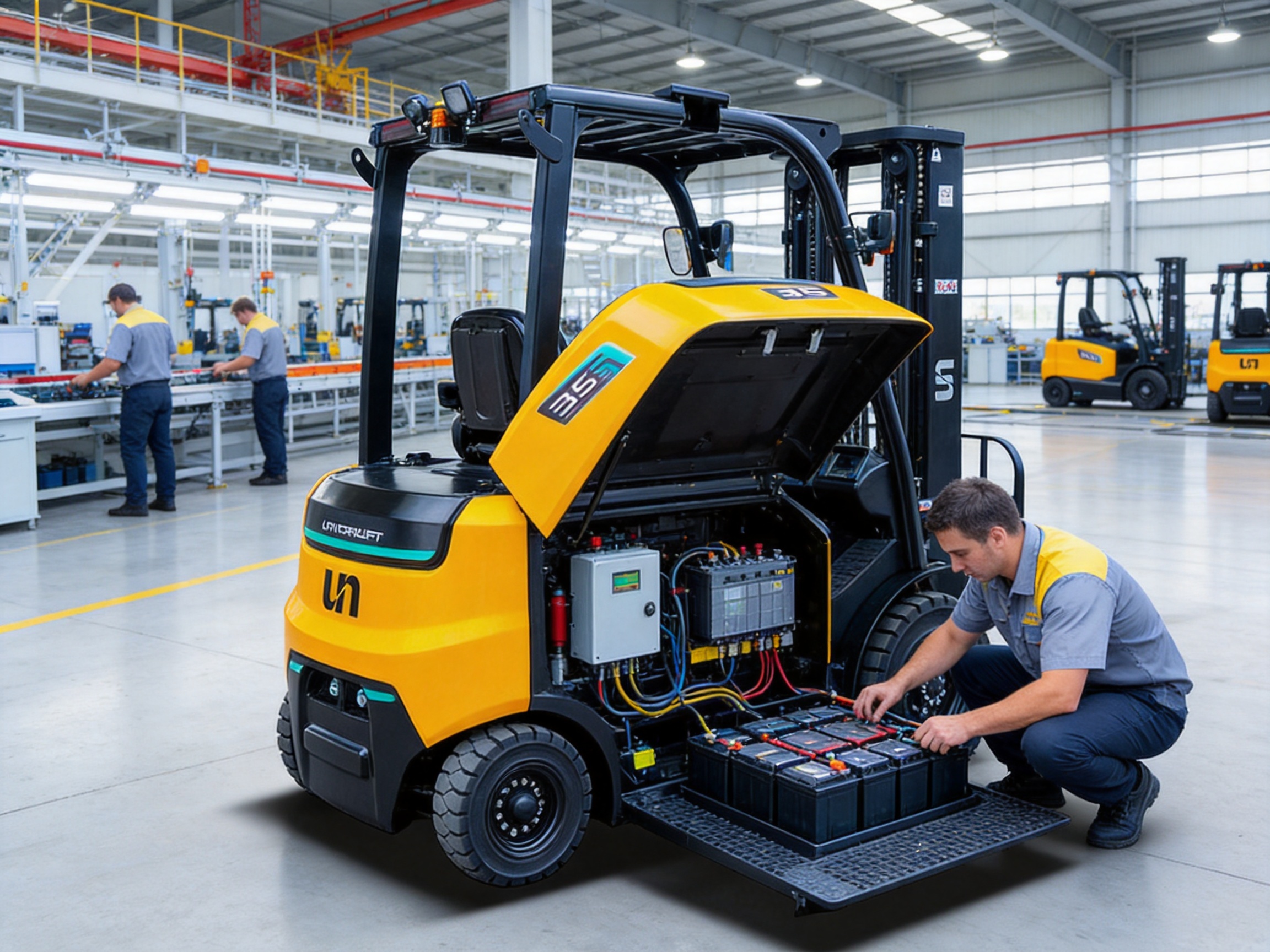
Modern warehouses, manufacturing plants, distribution centers, and industrial yards are under increasing pressure to move more material in less time while controlling energy consumption, operating costs, noise, and emissions. A forklift is no longer judged only by its rated lifting capacity. Fleet managers now examine the complete operating package: productivity, battery endurance, maneuverability, safety, operator comfort, maintenance access, reliability, and the ability to work consistently across demanding shifts.
The FE Series 3.0–3.5 ton four-wheel electric forklift is designed around these requirements. It is a fully upgraded electric forklift developed from an established four-wheel platform and engineered for medium- to high-intensity handling operations. With a rated capacity range of 3,000 to 3,500 kilograms, the forklift combines a robust chassis, full AC drive technology, high-capacity battery options, adaptive energy management, a powerful hydraulic system, and a comprehensive safety package.
Compared with many conventional electric forklifts, this model is intended to deliver a more balanced combination of capacity, stability, energy efficiency, and operating continuity. It provides the clean and quiet performance expected from an electric truck while retaining the structural strength and working capability required for heavier loads.
Designed for Demanding Industrial Applications
A 3.0–3.5 ton forklift occupies an important position in the material-handling market. Smaller electric trucks may be efficient but lack the capacity for heavier pallets, machinery components, metal products, construction materials, or dense industrial loads. Larger internal combustion forklifts may provide high power, but they can introduce exhaust emissions, higher noise levels, greater ventilation requirements, and increased fuel-related costs.
The FE Series addresses the middle ground with an electric platform capable of handling substantial loads while remaining suitable for indoor and semi-indoor working environments. It is particularly appropriate for factories, logistics centers, storage facilities, loading areas, paper and packaging operations, food and beverage facilities, building-material warehouses, and industrial distribution hubs.
Its four-wheel configuration supports stable load handling and predictable driving behavior. The design is suitable for operations that require repeated travel, frequent pallet positioning, tight turns, and regular lifting cycles. The truck can also be configured with different mast options and lifting heights according to facility clearance, racking design, and load-handling requirements.
The model is based on a seated operator configuration, allowing the driver to work through extended shifts with a practical driving position and clear access to the controls. The overhead guard, wide-view mast, LED lighting, lifting controls, and speed management functions work together to improve visibility and operational awareness.
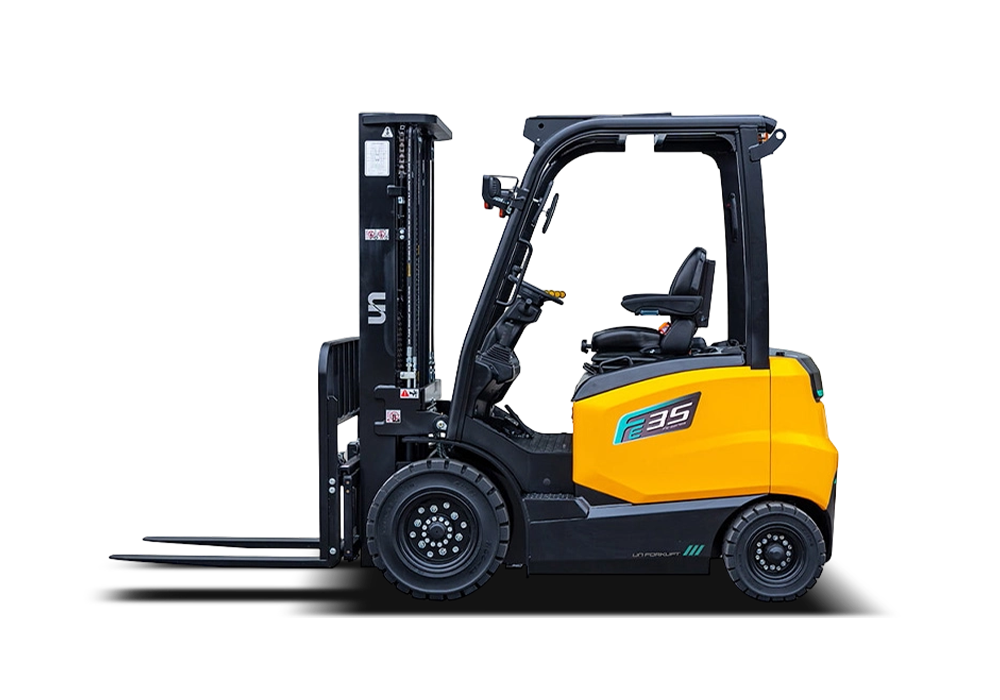
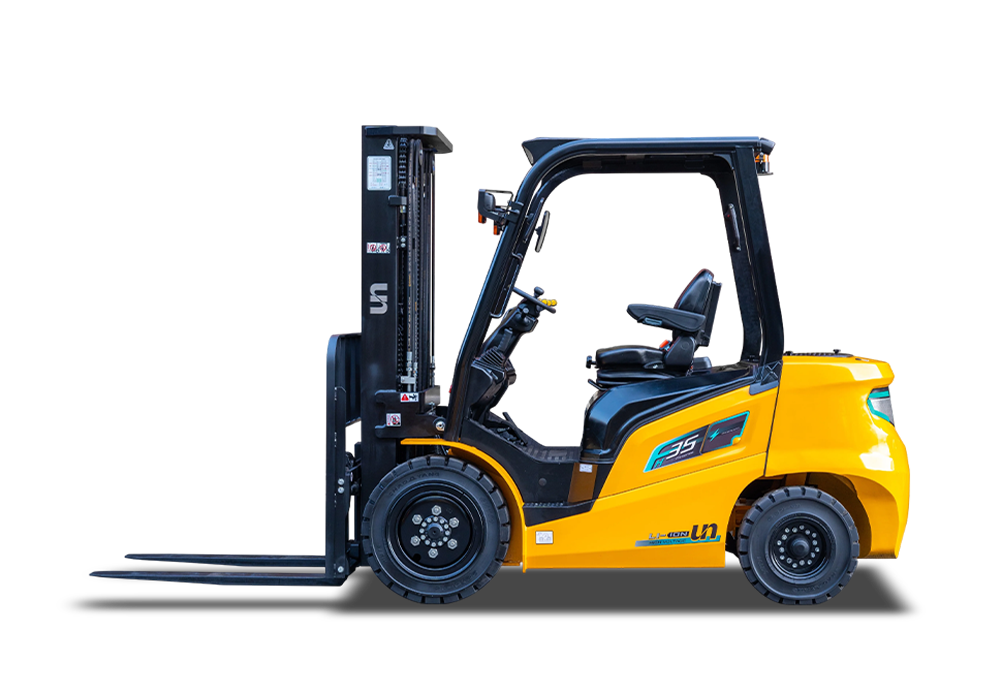
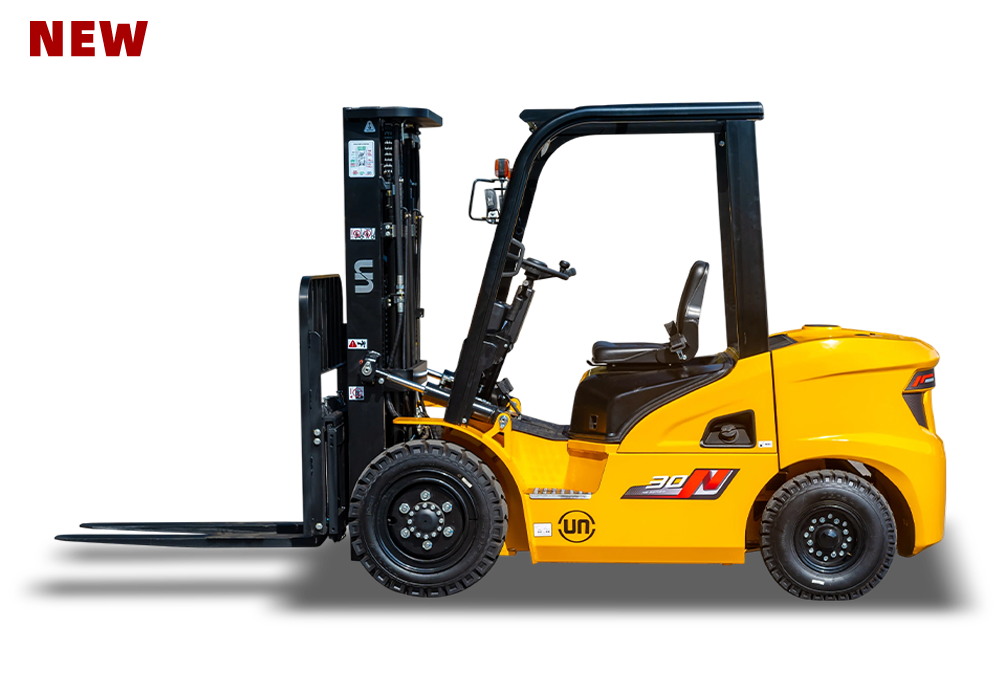
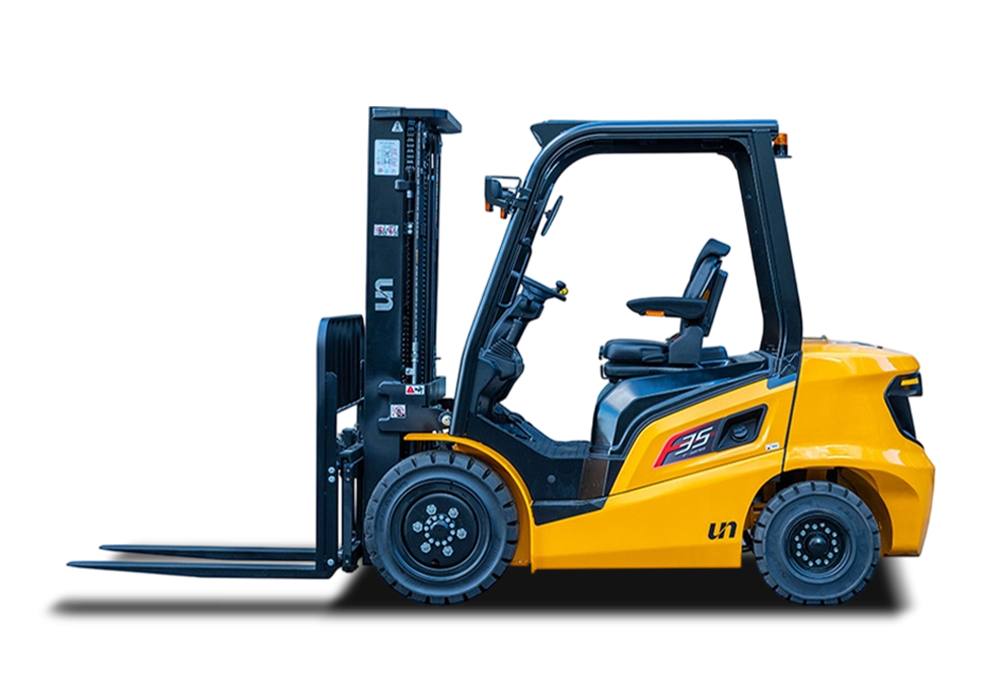
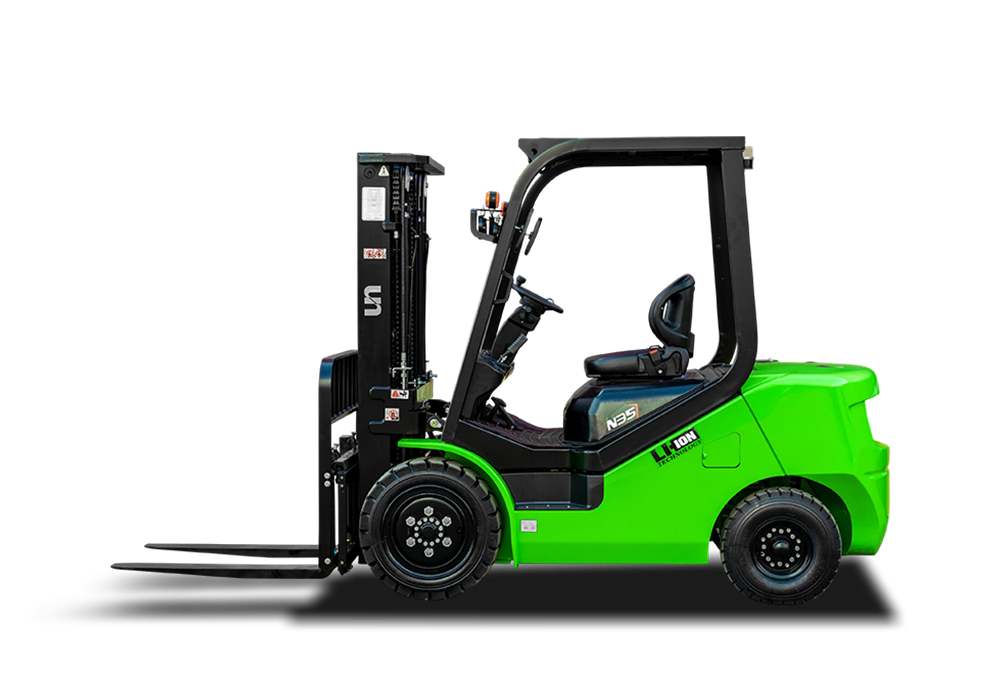
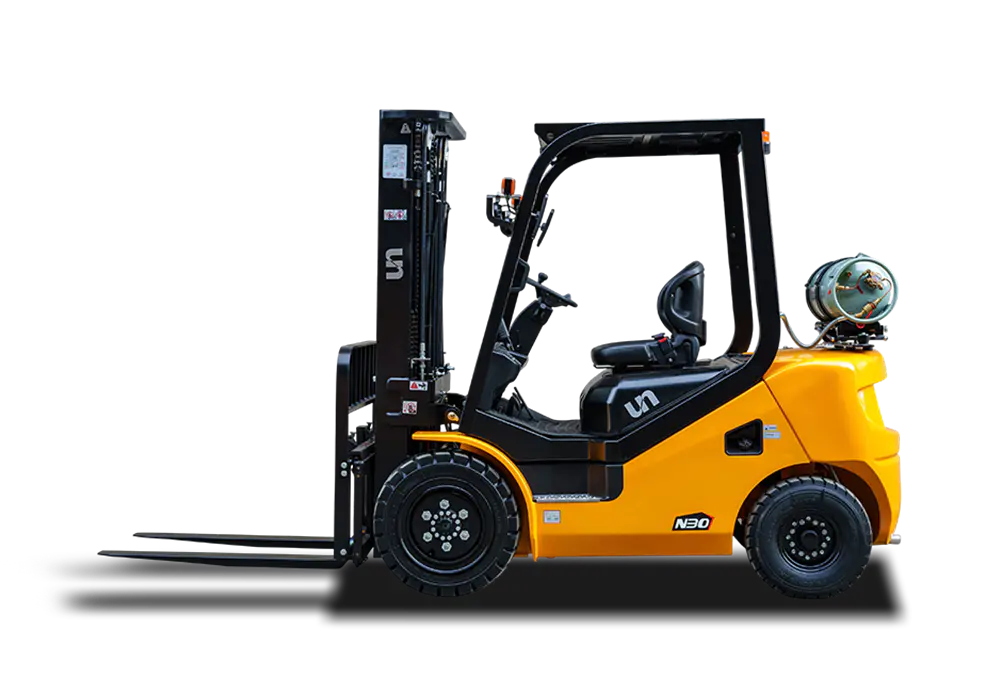
FE Series 3.0T-3.5T 4-Wheel Electric Forklift
Core Product Advantages
High Rated Capacity with Electric Efficiency
The FE Series is available for rated loads of 3,000 and 3,500 kilograms, with a standard load center of 500 millimeters. This capacity range makes the forklift suitable for heavy palletized goods and industrial products that exceed the working limits of typical light- and medium-duty electric trucks.
Electric operation offers several advantages over comparable internal combustion equipment. The forklift produces no direct exhaust emissions at the point of use, making it more appropriate for enclosed workplaces and areas where air quality is a concern. Electric drive also reduces operating noise, which can improve communication between workers and create a more comfortable environment for operators and pedestrians.
The electric powertrain is also capable of precise speed and torque control. This is especially valuable when positioning a heavy load near a rack, truck, production line, or storage location. Instead of relying on abrupt mechanical responses, the truck can deliver controlled acceleration, smooth deceleration, and accurate low-speed maneuvering.
Full AC Drive Technology
The FE Series uses full AC drive technology to improve traction performance, energy management, and control precision. AC drive systems are widely valued in industrial vehicles because they provide efficient motor operation, reduced mechanical wear, and strong performance during repeated acceleration and deceleration.
The drive motor has an 11-kilowatt rating for the 3.0–3.5 ton configuration, while the lifting motor is rated at 21 kilowatts. This combination provides the power needed for both travel and hydraulic lifting without requiring an internal combustion engine. The drive controller uses MOS/AC technology, with ZAPI control equipment specified for the platform.
AC drive technology is particularly beneficial in facilities with frequent changes in direction. A forklift may travel only a short distance during each cycle, but it may accelerate, stop, reverse, and turn dozens or hundreds of times per shift. Efficient electronic control helps reduce unnecessary energy consumption during these repeated movements.
Battery Flexibility for Different Work Patterns
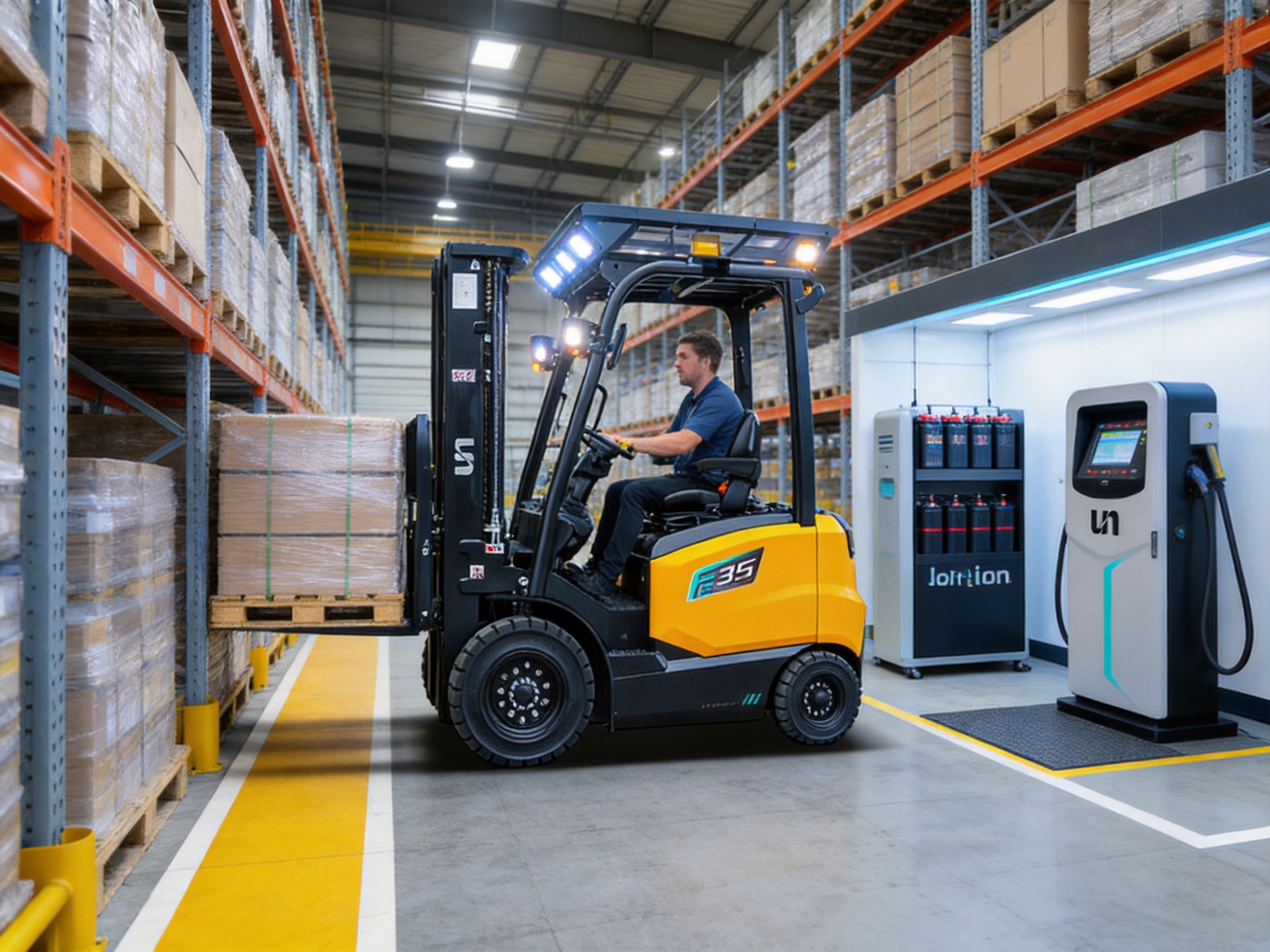
The forklift supports high-capacity lead-acid and lithium-ion battery systems. This gives users the ability to select a power configuration based on shift length, charging infrastructure, purchase budget, maintenance preferences, and operating intensity.
The published specification for the 3.0–3.5 ton configuration includes an 80-volt, 400-ampere-hour lead-acid battery option and a lithium-ion configuration rated at 76.8 volts and 280 ampere-hours. Battery availability and final specifications should be confirmed for the selected truck configuration, mast, attachments, and market.
Lead-acid batteries remain attractive for operations that have scheduled charging periods, established battery rooms, and a preference for familiar service procedures. Lithium-ion batteries can be advantageous for multi-shift applications, opportunity charging, reduced routine maintenance, and consistent voltage performance. The availability of both technologies allows the forklift to be matched more closely with the actual operating profile rather than forcing every customer into one energy-storage solution.
The lithium-ion system includes a charging heating function that permits charging at temperatures as low as minus 20 degrees Celsius, subject to the approved battery and charging system. This feature can be important for cold-storage environments, winter logistics operations, and facilities located in cold climates.
Adaptive Energy Management
Battery endurance depends on more than battery capacity. Driving style, load weight, travel distance, hydraulic activity, surface conditions, ramp operation, and idle time all influence energy consumption. The FE Series uses an adaptive energy management system to help balance performance and energy use during daily work.
Multiple speed modes allow the operator or fleet manager to select a working profile appropriate to the application. A lower-speed mode can be used in crowded warehouse aisles, near pedestrians, or during precise load placement. A higher-performance mode can be selected when the truck is traveling across an open industrial yard or moving between loading zones.
By matching the driving profile to the task, the forklift can reduce unnecessary energy use without compromising the ability to deliver full performance when required. This approach also helps control tire wear, braking demand, and operator fatigue.
Performance for Heavy Material Handling
The FE Series is engineered to provide practical performance rather than relying solely on peak figures. Its rated travel speed is approximately 14 kilometers per hour without a load and approximately 14 kilometers per hour under full-load conditions for the 3.0–3.5 ton configuration. These speeds support productive movement while maintaining a reasonable balance between travel time, load stability, and workplace safety.
The rated lifting speed is approximately 350 millimeters per second with a full load and approximately 500 millimeters per second without a load, depending on the selected model and configuration. This allows the operator to complete common stacking and retrieval cycles efficiently.
Maximum gradeability is rated at 15 percent with and without a load under the specified test conditions. This capability supports movement across moderate ramps and sloped access areas, although actual performance depends on surface condition, tire condition, load distribution, battery state, and operating practices.
The maximum drawbar pull is specified at approximately 18,500 newtons for the 3.0–3.5 ton family. Strong drawbar performance is valuable when the truck must start on a slope, travel over uneven industrial surfaces, or handle heavier loads across longer routes.
Hydraulic service brakes provide controlled stopping performance, while the mechanical parking brake helps secure the forklift when it is stationary. The combination is straightforward, durable, and suitable for industrial operating environments.
| Specification | 3.0 Ton Model | 3.5 Ton Model |
|---|---|---|
| Rated load capacity | 3,000 kg | 3,500 kg |
| Load center | 500 mm | 500 mm |
| Wheelbase | 1,660 mm | 1,660 mm |
| Total weight | 4,840 kg | 5,280 kg |
| Overall width | 1,220 mm | 1,220 mm |
| Outside turning radius | 2,210 mm | 2,250 mm |
| Travel speed, full load | 14 km/h | 14 km/h |
| Travel speed, no load | 15 km/h | 15 km/h |
| Maximum gradeability | 15% | 15% |
| Battery options | 80 V/400 Ah or lithium-ion option | 80 V/400 Ah or lithium-ion option |
Stable Four-Wheel Chassis Design
Stability is fundamental to a forklift’s performance. A truck that can lift a heavy load but feels unstable during turning, braking, or uneven travel cannot deliver dependable productivity. The FE Series uses a four-wheel chassis with a wheelbase of approximately 1,660 millimeters and a front tread of approximately 1,000 millimeters. The rear tread is approximately 960 millimeters.
The chassis is designed to support the center of gravity created by the truck, the battery, the load, and the mast. The battery itself contributes substantial counterweight and is positioned as part of the overall stability strategy. For the specified models, total vehicle weight is approximately 4,840 kilograms for the 3.0 ton version and 5,280 kilograms for the 3.5 ton version.
The steering axle uses a cast axle body with an increased strength design. Compared with a lighter axle construction, a stronger cast body can better withstand repeated steering loads, shock forces, and demanding work surfaces. Tapered roller bearings support load capacity and durability, while the high-mounted design and flexible connections contribute to steering response and stability.
The steering system uses a load-sensing steering gear. This arrangement supplies hydraulic flow according to steering demand and can help reduce energy losses when steering assistance is not being used. It also supports smooth steering control and contributes to a more responsive driving experience.
Strong Tight-Turn Performance
Although the FE Series is built for heavy loads, it is designed to remain maneuverable in practical warehouse conditions. The outside turning radius is approximately 2,210 millimeters for the 3.0 ton model and 2,250 millimeters for the 3.5 ton model. These dimensions allow the truck to work in many industrial aisles while maintaining the stability expected from a four-wheel forklift.
Good turning performance is influenced by more than turning radius. The steering axle, steering gear, tire selection, wheelbase, operator visibility, and electronic speed management all play a role. The FE Series combines these elements to help the operator complete turns with fewer corrections and less unnecessary reversing.
The result is a truck that can move heavy goods through production areas, storage aisles, and loading zones without requiring the wider operating envelope associated with some larger industrial machines.
Hydraulic Lifting and Mast Options
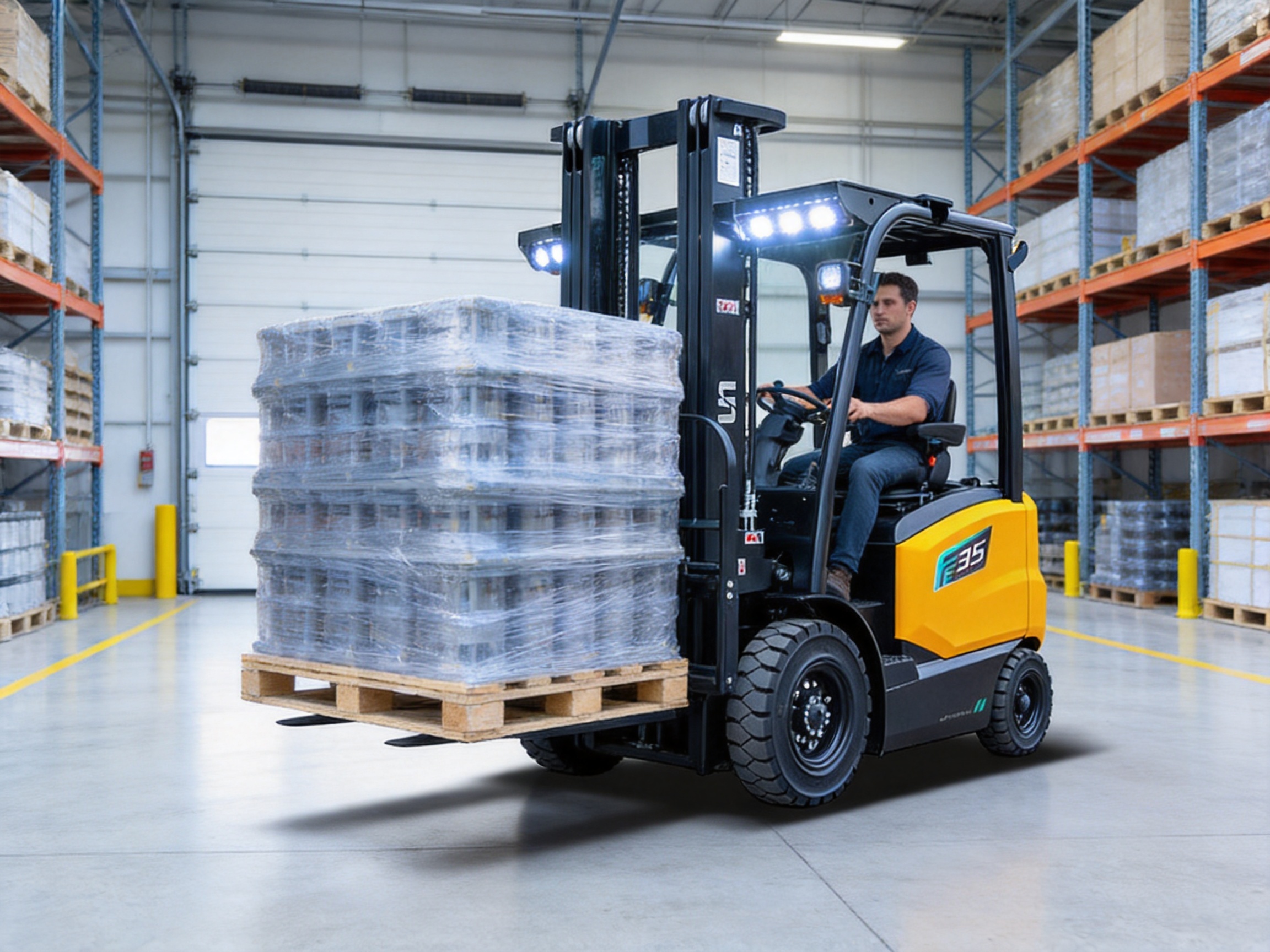
The lifting system is powered by a 21-kilowatt motor and a high-displacement, low-noise hydraulic pump. The hydraulic system is designed to provide sufficient flow for lifting, tilting, and attachment functions while maintaining smooth control.
A high-power hydraulic pump motor is particularly useful when the forklift is required to lift heavy loads repeatedly. The system must respond consistently during high-frequency pallet handling, especially when operators move between floor-level work, mid-level racking, and higher storage positions.
Proportional lifting functionality allows the operator to control lifting movement more smoothly. This can support more accurate placement, reduce sudden load movement, and improve working comfort. Controlled hydraulic action is especially important when handling fragile products, liquid containers, stacked goods, or loads that must be aligned precisely with a rack or production fixture.
The standard specification includes a rated lift height of 3,000 millimeters, with other mast configurations available for different applications. The mast lowered height is approximately 2,070 millimeters, and the overhead guard height is approximately 2,225 millimeters for the 3.0–3.5 ton models. These dimensions should be checked against doorways, container openings, low ceilings, sprinkler systems, and other overhead restrictions before equipment selection.
Available mast types can include wide-view two-stage designs, full-free-lift configurations, and three-stage full-free-lift configurations. The correct mast depends on the required fork height, ceiling clearance, free-lift requirement, and load capacity at elevation.
| Mast configuration | Typical use | Primary benefit |
|---|---|---|
| Wide-view mast | General warehouse and factory work | Balanced visibility and lifting performance |
| Two-stage full-free-lift mast | Low-clearance areas and truck loading | Useful free lift before mast extension |
| Three-stage full-free-lift mast | High racking and containerized storage | Greater lifting height within restricted spaces |
| Special attachment configuration | Paper rolls, clamps, special pallets, or industrial tooling | Adaptation to specialized loads |
Capacity is affected by lift height, load center, attachment type, and mast configuration. A side shifter, clamp, rotator, or other attachment adds weight and changes the load moment. The rated capacity chart for the exact truck and attachment must therefore be consulted before operation.
Operator Visibility and Workplace Safety
Productivity must never be separated from safety. A forklift operates around people, racks, vehicles, doors, machinery, and stored goods. The FE Series includes several design features intended to improve operator awareness and reduce avoidable risks.
Wide-View Mast
The mast is designed to provide a broad forward view through the lifting structure. Improved visibility helps the operator monitor the fork tips, pallet openings, rack beams, and load edges. It can also reduce the number of repositioning movements needed during pallet entry and placement.
Visibility is affected by load height and load shape, so operators must still follow safe driving procedures, travel with the load positioned correctly, and use a spotter when the load blocks the forward view. Nevertheless, a well-designed mast can make normal handling tasks more direct and predictable.
Stamped Overhead Guard
The robust stamped overhead guard provides protection for the operator while maintaining a structured, durable design. It is integrated with the truck’s safety architecture and helps protect the operator from falling objects within the limits of the applicable operating conditions.
The guard height should be considered during facility planning. With an approximate overhead guard height of 2,225 millimeters, the truck can fit many industrial areas, but every doorway, container, and low-clearance route should be verified before deployment.
LED Lighting
LED lights provide efficient illumination and can improve visibility in dim warehouses, loading areas, and outdoor working zones. LED technology generally offers long service life and low power consumption compared with older lighting technologies.
Lighting does not replace safe operating procedures. Operators should use the correct lighting configuration for the environment, reduce speed in low-visibility areas, and ensure that pedestrians can recognize the truck’s direction of travel.
Speed Deceleration
The speed deceleration function supports safer operation when the truck approaches a turn or enters a more restricted working area. Speed control is especially important with heavy loads because stopping distance and dynamic load movement increase as vehicle speed rises.
Multiple speed modes also allow the fleet manager to establish operating profiles for different locations. For example, a high-speed mode may be suitable for open yards, while a controlled mode may be preferred near production lines, pedestrian crossings, or narrow aisles.
Braking and Parking
The hydraulic service brake is designed for regular stopping during travel, while the mechanical parking brake secures the truck when it is parked. Operators should always lower the forks, place the controls in the neutral position, apply the parking brake, switch off the truck, and follow site-specific parking procedures before leaving the operating position.
Ergonomics and Operator Productivity
An operator may complete hundreds of lifting, reversing, steering, and positioning actions during a shift. Ergonomics therefore has a direct effect on productivity and safety. A comfortable operator is more likely to maintain consistent control and less likely to make errors caused by fatigue or awkward movement.
The seated configuration provides a stable operating position for extended work. The control layout is intended to support practical access to travel, lifting, tilting, and auxiliary functions. Proportional hydraulic control can reduce abrupt movement, while electric drive control helps the operator manage acceleration and deceleration with precision.
A compact but robust chassis can also improve operator confidence. The driver can better judge the truck’s position in relation to racks, pallets, trailers, and production equipment. Clear visibility through the mast, together with the overhead guard and lighting package, supports a more complete view of the working environment.
Different operators may require different performance settings. Multiple speed modes allow companies to align the equipment with operator experience, facility traffic, and task requirements. New operators can begin with a controlled setting, while experienced operators can use a higher-performance profile when conditions permit.
Maintenance Efficiency and Service Access
Maintenance design affects total cost of ownership. Even a reliable forklift requires regular inspection, cleaning, battery service, lubrication, tire checks, hydraulic inspection, and electrical diagnostics. If access is difficult, maintenance may take longer and routine checks may be delayed.
The FE Series includes a fully opening engine or service cover, a fully opening electrical control cover, and a tool-free removable floor plate. These features improve access to important service areas and reduce the time required for routine inspection.
The fully opening covers allow technicians to reach electrical components, hydraulic areas, connectors, and other systems more easily. A removable floor plate provides additional access to the lower compartment without requiring a lengthy disassembly process.
Improved access can deliver several benefits:
• Faster daily inspections and preventive maintenance.
• Easier checking of wiring, connectors, hydraulic lines, and fluid levels.
• Reduced downtime during troubleshooting.
• Better visibility of contamination, wear, and loose components.
• Lower labor requirements for routine service tasks.
Maintenance intervals and procedures should follow the operating manual and the conditions of use. Dust, moisture, cold temperatures, heavy loads, long shifts, and uneven surfaces can all influence service requirements.
Battery and Electrical Service
Battery service is central to electric forklift operation. Lead-acid batteries require appropriate charging, watering, cleaning, ventilation, and inspection procedures. Lithium-ion batteries require approved chargers, correct temperature management, and compliance with the battery supplier’s operating instructions.
The electrical control system should be inspected by trained technicians. Because the truck uses high-voltage battery systems and AC drive technology, unauthorized electrical repairs can create safety risks and may affect warranty coverage. Proper diagnostic procedures help maintain reliable performance and protect the life of the battery, controller, and motor.
Hydraulic and Mechanical Service
Hydraulic hoses, fittings, cylinders, mast rollers, chains, forks, steering components, and tires should be inspected at suitable intervals. Forks must be checked for cracks, bending, heel wear, and locking-pin condition. The mast should be inspected for abnormal noise, uneven movement, damaged rollers, or chain problems.
The strong steering axle and tapered roller bearings are designed for durability, but they remain wear components subject to operating conditions. Regular inspection helps identify problems before they affect steering accuracy or vehicle stability.
Manufacturing Strength and Engineering Capability
The product is supported by a manufacturer with long-term experience in material-handling equipment development. Established in 1978, the company integrates research and development, production, sales, and service. Its manufacturing operation covers approximately 53,400 square meters and has an annual production capacity of approximately 15,000 units.
This industrial scale provides important advantages for product development and quality control. A manufacturer that designs and produces multiple forklift categories can share engineering knowledge across electric forklifts, internal combustion forklifts, warehouse equipment, reach trucks, and specialized material-handling machines.
The company offers a broad product portfolio covering 17 varieties, 96 series, and more than 200 specifications. Such a range requires coordinated engineering processes, standardized component management, production planning, testing systems, and after-sales support.
Research and Development Experience
The company has contributed to the development of electric forklift technology and has participated in the formulation of Chinese electric forklift industry standards. Its engineering history includes the development of reach forklift and very-narrow-aisle truck products, demonstrating experience with applications that require precise control, compact dimensions, and advanced handling performance.
This background is relevant to the FE Series because modern electric forklift development requires more than simply replacing an internal combustion engine with a battery. The complete vehicle must be rebalanced around the battery, controller, drive motor, hydraulic system, chassis, cooling requirements, braking system, and operator interface.
Electric forklift engineering also requires careful coordination between hardware and software. Motor control, regenerative behavior, battery protection, acceleration, deceleration, lifting response, and fault monitoring all influence the user experience. A manufacturer with an established electric forklift research program is better positioned to optimize these systems as a complete package.
Integrated Production and Quality Control
Integrated manufacturing can improve consistency between design intent and production results. Engineering teams can work directly with manufacturing personnel to identify assembly issues, improve service access, standardize components, and refine production processes.
A well-managed production process normally includes incoming component inspection, structural fabrication control, welding inspection, painting and coating management, assembly verification, electrical testing, hydraulic testing, load testing, and final vehicle inspection. These controls help ensure that each forklift meets its intended performance and safety requirements before delivery.
For a heavy-duty electric forklift, structural quality is especially important. The mast, overhead guard, chassis, counterweight, steering axle, fork carriage, and fork components must work together under repeated load cycles. Consistent welding, dimensional control, alignment, and fastener management help reduce the risk of premature wear and performance variation.
International Market Experience
The manufacturer has developed a worldwide sales and service network with partners in Europe, South America, North America, Africa, and Asia. International experience exposes the company to different operating environments, regulatory expectations, climate conditions, application requirements, and customer preferences.
Forklifts supplied to international markets may need to operate in cold storage, hot outdoor yards, high-dust facilities, humid coastal locations, and highly regulated industrial sites. They may also require different battery systems, tires, lights, mast configurations, attachments, and documentation packages.
The company also supplies equipment to original equipment customers and has served well-known domestic and overseas industrial companies. OEM experience generally requires disciplined production control, reliable documentation, stable component quality, and the ability to meet specific technical requirements.
Advantages Over Conventional Alternatives
Compared with Internal Combustion Forklifts
The most visible advantage of the FE Series over an internal combustion forklift is the absence of direct exhaust emissions during operation. This is beneficial in enclosed facilities and workplaces where emissions must be controlled. Electric operation also produces less noise, which can support communication and improve the working environment.
Electric forklifts can also provide precise low-speed control. This is valuable when entering pallets, aligning forks, positioning loads, or working close to machinery. Maintenance may be simpler in some areas because there is no engine oil, fuel system, exhaust system, or conventional transmission requiring the same type of service.
Internal combustion forklifts may still be preferred for long outdoor shifts, very rough terrain, or operations without practical charging infrastructure. However, for many indoor and mixed-use applications, the FE Series can offer a cleaner, quieter, and more energy-conscious alternative.
Compared with Smaller Electric Forklifts
Smaller electric forklifts may have lower purchase prices and compact dimensions, but they may not provide sufficient capacity for heavy industrial loads. Attempting to use an undersized truck can reduce productivity, increase overload risk, accelerate component wear, and create safety concerns.
The FE Series provides a 3.0–3.5 ton capacity range while maintaining a practical four-wheel layout and controlled dimensions. This makes it suitable for businesses that require more lifting capability without moving immediately to a substantially larger vehicle.
Compared with Basic Electric Platforms
Some basic electric forklifts focus primarily on battery operation without offering a comprehensive performance and service package. The FE Series adds full AC drive control, multiple speed modes, adaptive energy management, a high-capacity hydraulic system, load-sensing steering, proportional lifting, wide-view mast options, LED lighting, and service-friendly access.
These features can help reduce the gap between purchase price and actual operating value. A forklift that is easier to control, faster to service, and more adaptable to different tasks may deliver better productivity over its working life than a lower-cost truck with fewer integrated functions.
Total Cost of Ownership Considerations
Purchase price is only one part of forklift economics. A fleet manager should also consider energy consumption, charging arrangements, maintenance labor, replacement parts, tire life, battery life, operator productivity, downtime, residual value, and application suitability.
The FE Series can support total cost of ownership through several design elements. AC drive technology can improve electrical efficiency and reduce certain types of mechanical wear. Adaptive energy management can help control energy consumption. Service covers and a removable floor plate can reduce maintenance time. The option of lead-acid or lithium-ion batteries allows the user to select a technology appropriate to the operating schedule.
High productivity also contributes to operating value. If the forklift completes each cycle more efficiently, a facility may require fewer trucks for the same material flow. Smooth lifting, quick travel response, tight-turn capability, and suitable mast options all influence the number of productive cycles completed during a shift.
However, no forklift should be selected by specification alone. The buyer should evaluate the actual route, load profile, shift pattern, charging time, floor condition, aisle width, racking height, climate, attachments, and local service support. A professional application review helps ensure that the selected configuration is neither underpowered nor unnecessarily oversized.
Recommended Applications
The FE Series is suitable for a wide range of applications where heavy loads must be moved efficiently and reliably.
Manufacturing Plants
Factories often need to transport raw materials, components, work-in-progress goods, finished products, dies, molds, and packaging materials. Electric operation is well suited to indoor production environments because it reduces exhaust emissions and noise around workers.
Warehousing and Distribution
Distribution centers require frequent pallet movement, loading, unloading, staging, and rack placement. The four-wheel chassis, multiple speed modes, wide-view mast, and available lifting configurations support these repetitive tasks.
Building Materials
Tiles, timber products, steel components, cement products, glass, and other building materials can be heavy and difficult to handle manually. The 3.0–3.5 ton capacity range provides a practical solution for moving dense loads across storage yards and indoor facilities.
Paper, Packaging, and Printing
Paper rolls and packaging materials require careful handling because they may be heavy, easily damaged, or difficult to position. Smooth hydraulic control and attachment compatibility can help improve handling accuracy when the truck is configured for the specific load.
Cold-Storage and Temperature-Controlled Operations
The lithium-ion charging-heating function can support operations in cold environments when the approved battery and charger are used. Temperature-controlled facilities should still verify the complete truck configuration, battery performance, charging location, and operating procedures before deployment.
Selection and Operating Guidance
Before ordering, users should confirm the required rated load, actual load center, maximum lifting height, mast lowered height, free-lift requirement, aisle width, turning space, floor condition, and attachment requirements. The nominal capacity of 3,000 or 3,500 kilograms does not apply under every combination of height, load center, and attachment.
The selected tire type also affects performance. The listed configuration uses pneumatic tires, which can provide cushioning and suitability for certain outdoor or uneven surfaces. Tire selection must match the floor, debris level, traction requirement, and operating environment.
Battery selection should be based on daily operating hours and charging opportunities. A lead-acid system may be appropriate where charging is scheduled and battery exchange is available. A lithium-ion system may be more suitable for intensive use, short charging windows, and operations that benefit from reduced battery maintenance.
Attachments should be selected with attention to residual capacity. A side shifter, clamp, fork positioner, rotator, or other attachment increases the load moment and may reduce the permissible load capacity. The correct capacity chart should always be supplied with the final truck configuration.
Q&A: Frequently Asked Questions
What is the rated capacity of the FE Series forklift?
The FE Series configuration discussed here is designed for rated loads of 3,000 and 3,500 kilograms. The exact capacity depends on the selected model, load center, mast, lift height, attachment, and operating conditions.
Is the forklift suitable for indoor use?
Yes. Its electric powertrain, low-noise operation, and absence of direct exhaust emissions make it suitable for many indoor applications, including factories, warehouses, distribution centers, and production facilities. Ventilation, floor condition, aisle width, and site safety requirements must still be evaluated.
What battery technologies are available?
The platform supports high-capacity lead-acid and lithium-ion battery systems. The final voltage, capacity, battery weight, charger, and operating procedures should be confirmed according to the selected model and market configuration.
Can the forklift work in cold temperatures?
The lithium-ion configuration includes a charging heating function that can permit charging at temperatures down to minus 20 degrees Celsius, subject to the approved battery and charging system. Cold-storage users should verify the complete operating and charging requirements before purchase.
What type of drive system does the forklift use?
The forklift uses full AC drive technology with MOS/AC control. The specified control manufacturer is ZAPI. AC technology supports accurate control, efficient travel, and reliable performance during repeated acceleration and deceleration.
What is the travel speed?
The published performance data lists approximately 14 kilometers per hour with no load and approximately 14 kilometers per hour under full-load conditions for the 3.0–3.5 ton configuration. Actual speed may be adjusted through operating modes and site safety settings.
What is the maximum gradeability?
The maximum gradeability is listed as 15 percent with and without a load under specified test conditions. Actual performance depends on surface, traction, battery state, load distribution, tire condition, and route design.
What mast options are available?
Available configurations can include wide-view masts, two-stage full-free-lift masts, and three-stage full-free-lift masts. The correct choice depends on lift height, ceiling clearance, free-lift requirements, and capacity at elevation.
How high can the standard forklift lift?
The main specification lists a rated lift height of approximately 3,000 millimeters. Other mast heights may be available. Capacity and overall height change according to the selected mast, so the final capacity chart should be reviewed before operation.
Is the forklift easy to maintain?
The design includes a fully opening service cover, a fully opening electrical control cover, and a tool-free removable floor plate. These features improve access for inspection, troubleshooting, and preventive maintenance.
What safety features are included?
Safety-related features include a stamped overhead guard, wide-view mast, LED lights, proportional lifting, speed deceleration, multiple speed modes, hydraulic service braking, and a mechanical parking brake. Safe operation also requires trained drivers, regular inspections, suitable attachments, and compliance with local regulations.
Can attachments be installed?
The forklift can support attachment applications subject to the correct hydraulic configuration and capacity calculation. Attachment weight and load center affect residual capacity, so the final attachment and capacity chart must be approved before use.
How should a customer choose between the 3.0 ton and 3.5 ton versions?
The choice should be based on the heaviest regular load, load center, lifting height, route conditions, and expected future demand. A 3.5 ton model may provide additional capacity for heavier loads, while a 3.0 ton model may be sufficient when most loads fall below that level. Application analysis is recommended.
Does electric operation reduce maintenance?
Electric operation eliminates several engine-related systems associated with internal combustion trucks, such as fuel, engine oil, exhaust, and certain transmission components. The forklift still requires regular maintenance of the battery, electrical system, tires, brakes, mast, forks, hydraulic system, steering axle, and safety equipment.
Where can the forklift be used?
Typical applications include manufacturing, warehousing, logistics, distribution, building materials, paper and packaging, loading operations, and selected cold-storage environments. The final application should be checked for floor conditions, temperature, ventilation, aisle requirements, and local compliance.
Conclusion
The FE Series 3.0–3.5 ton four-wheel electric forklift is designed for organizations that need more than basic electric transportation. It combines substantial lifting capacity with full AC drive technology, flexible battery options, adaptive energy management, strong hydraulic performance, stable four-wheel construction, and service-friendly access.
Its advantages are most apparent in applications that require repeated heavy handling but also value quiet operation, reduced point-of-use emissions, precise control, and predictable energy use. The forklift’s wide-view mast, stamped overhead guard, LED lights, proportional lifting, speed deceleration, and multiple operating modes support a safer and more productive workplace.
The manufacturing foundation behind the product adds further value. Long-term industry experience, integrated research and production, a broad product portfolio, international market exposure, electric forklift development capability, and OEM supply experience provide a strong basis for consistent product support.
For customers comparing electric and internal combustion equipment, the FE Series offers a practical heavy-duty electric alternative. For customers comparing different electric platforms, its combination of capacity, battery flexibility, AC control, maneuverability, hydraulic power, safety systems, and maintenance access makes it a competitive choice for modern material-handling operations.
References
1. Product technical specification sheet for the FE Series 3.0–3.5 ton four-wheel electric forklift.
2. Manufacturer product information covering battery systems, AC drive technology, safety functions, hydraulic performance, and maintenance design.
3. Manufacturer corporate profile and production capability information.
4. General principles of industrial truck capacity rating, load-center calculation, and mast selection.
5. General guidance for electric forklift battery charging, preventive maintenance, and workplace safety.
6. Technical data for four-wheel electric forklift chassis, steering axles, hydraulic systems, and industrial traction motors.
Product: FE Series 3.0T-3.5T 4-Wheel Electric Forklift
For exclusive deals and latest offers, sign up by entering your email address below.
Stay In Touch
ADDRESS : NO.1 ROAD ONE, XINDENG NEW DISTRICT, FUYANG, HANGZHOU, ZHEJIANG, CHINA 311404.
PHONE : +86-571-8688 8355 (AMERICA)
PHONE : +86-571-8886 9363 (EUROPE)
PHONE : +86-571-8688 8377 (ASIA, AFRICA, OCEANIA)
EMAIL : [email protected]
EMAIL : [email protected](PARTS INQUIRY)

