


 中文简体
中文简体 Français
 русский
 Español
 عربى
عربى Deutsch



High-Performance LPG and Gasoline Forklifts for Efficient Indoor Material Handling
Admin 2026-09-13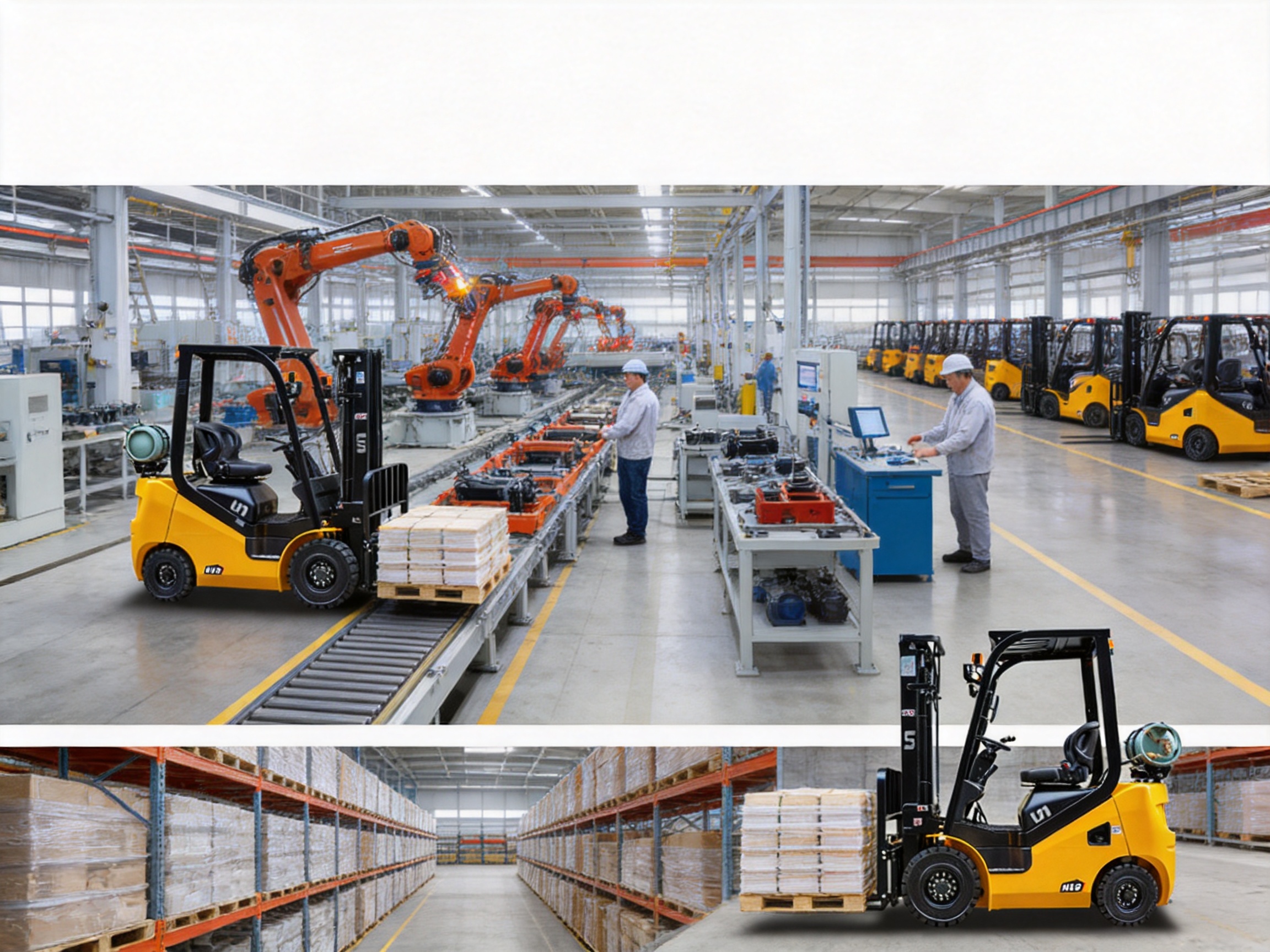
Modern warehouses, manufacturing plants, distribution centers, retail logistics facilities, and industrial workshops require lifting equipment that combines productivity, maneuverability, safety, comfort, and dependable operating costs. For many applications, an internal-combustion forklift powered by LPG or gasoline remains a practical and versatile solution. It can operate through demanding work cycles, refuel quickly, travel across mixed indoor and outdoor surfaces, and provide the lifting performance required for palletized goods, components, raw materials, and finished products.
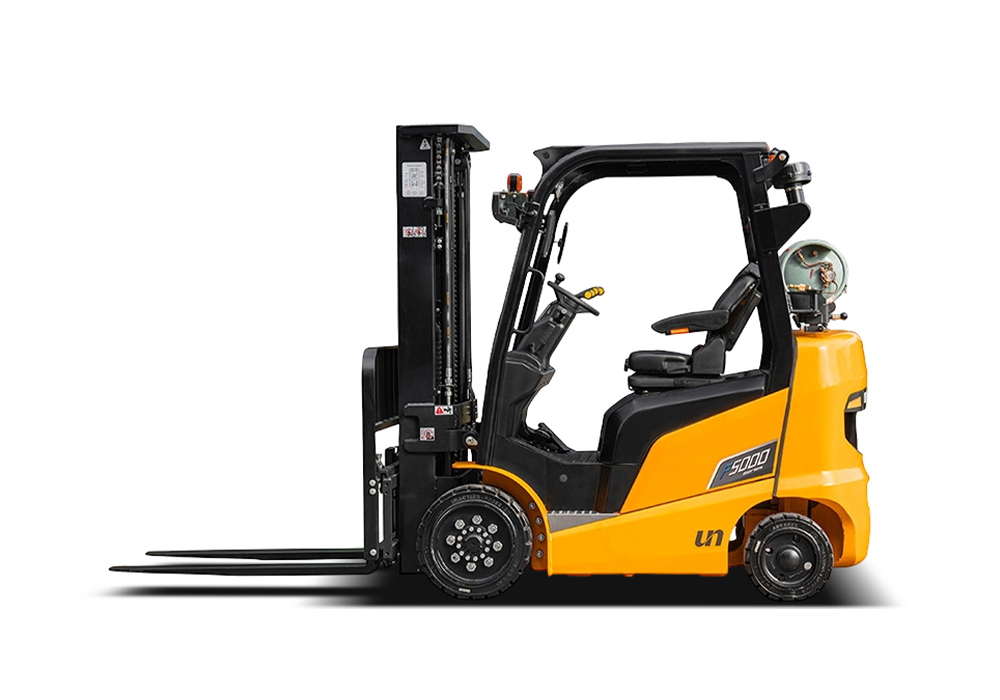
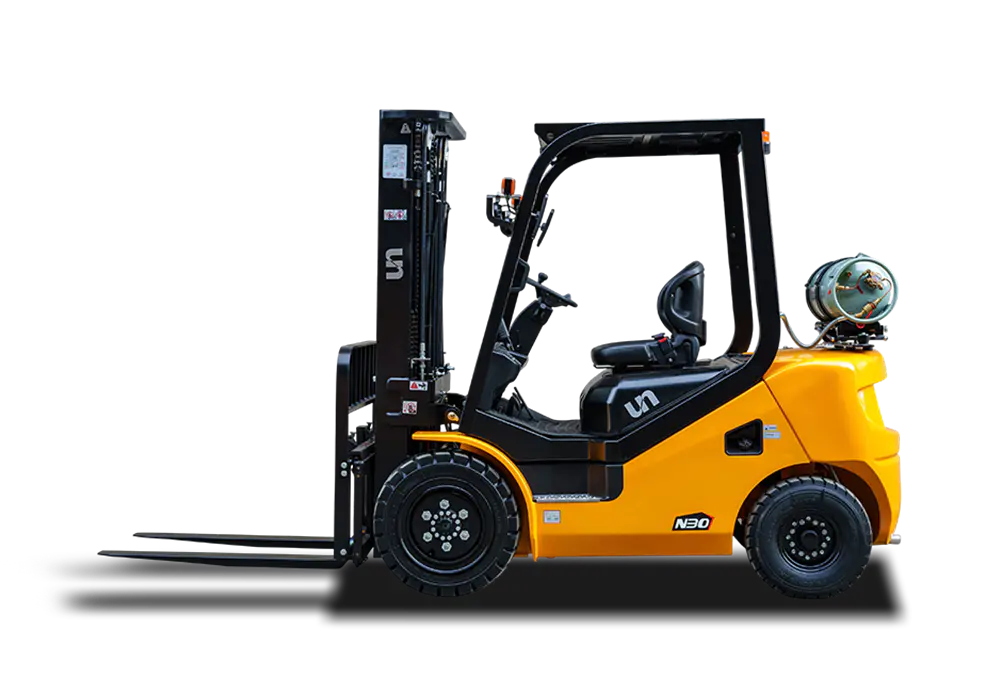
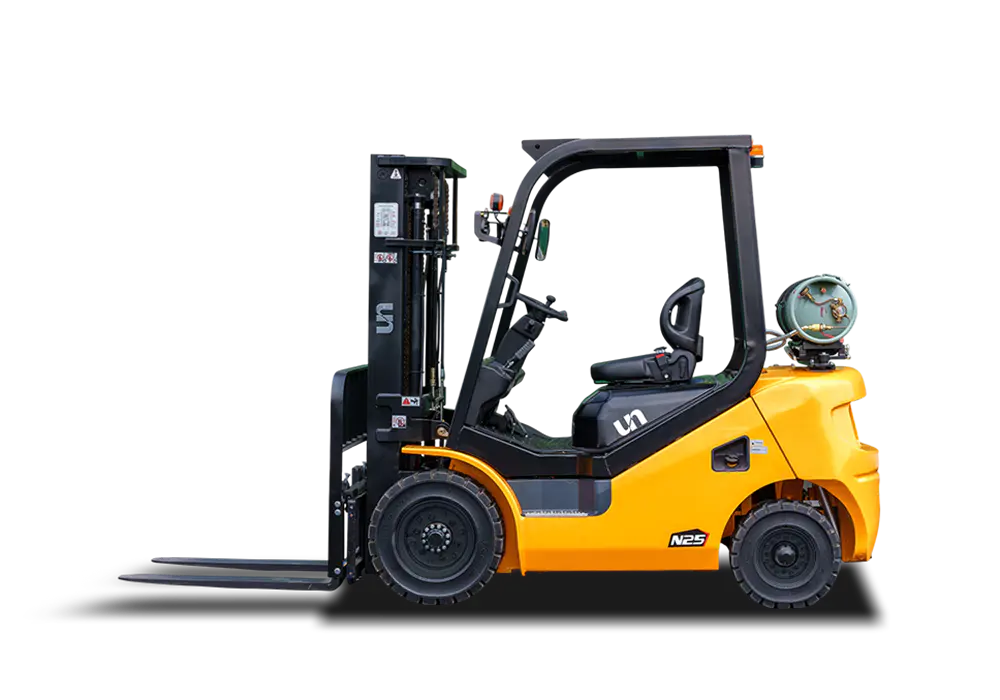
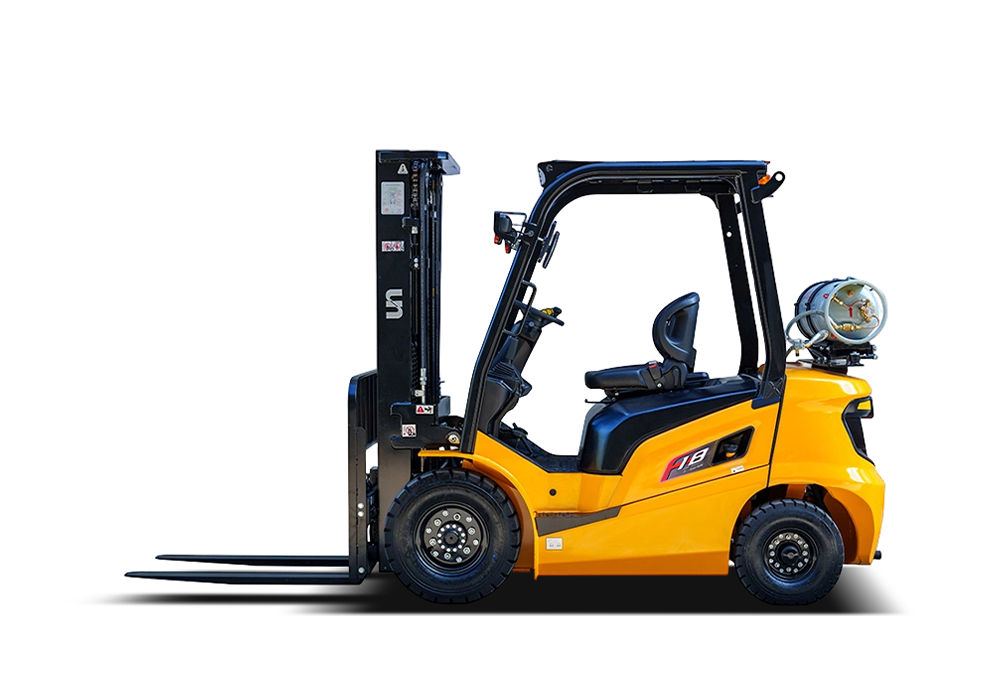
The N Series 1.5T–1.8T LPG and gasoline forklift is designed for companies seeking a compact, responsive, and economical truck for general material-handling duties. Its design emphasizes low emissions, reduced operating noise, easy maintenance, precise hydraulic control, and safe operator interaction. The forklift is particularly suitable for clean indoor environments where a conventional diesel truck may generate excessive noise or emissions, while a battery-electric forklift may not provide the desired refueling flexibility or continuous-duty convenience.
With rated capacities of 1,500 kg and 1,800 kg, a 500 mm load center, a standard 3,000 mm rated lift height, and an outside turning radius of approximately 2,100 mm, the compact models are well suited to warehouse aisles and production areas where space is limited. The range also benefits from the engineering platform used across broader capacity configurations, allowing proven chassis, hydraulic, transmission, safety, and service concepts to be adapted to different customer requirements.
This article examines the product’s operating advantages, engineering features, manufacturing strengths, maintenance characteristics, safety systems, application suitability, and technical specifications. It also explains how an experienced material-handling manufacturer can create value through integrated research and development, controlled production, quality management, and international service support.
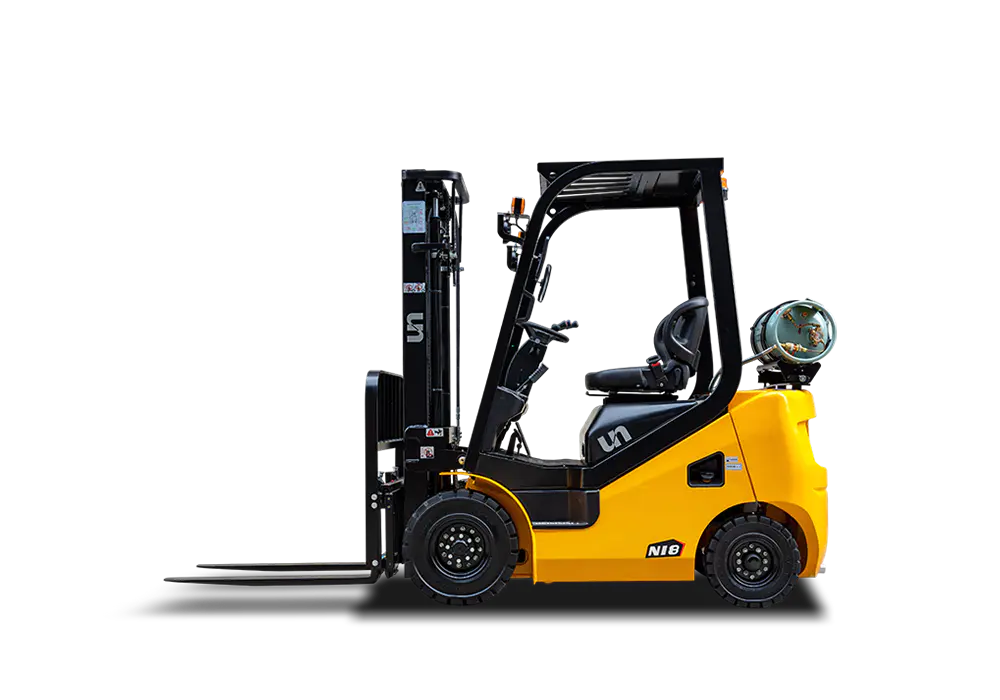
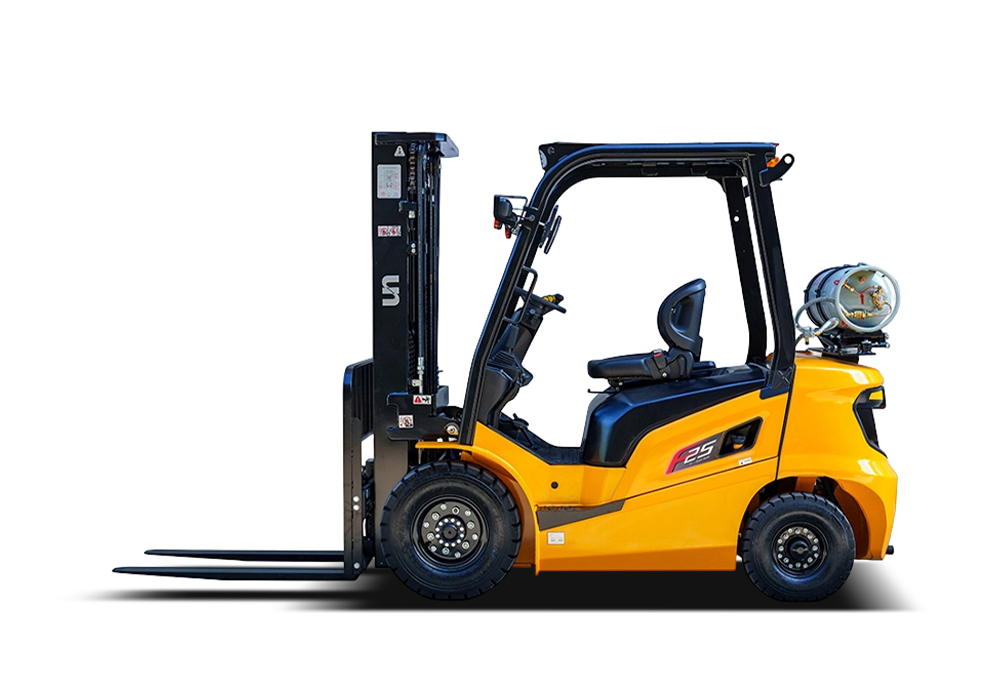
N Series 1.5T-1.8T LPG&Gasoline Forklift
1. The Role of LPG and Gasoline Forklifts in Modern Industry
Forklift selection is determined by much more than rated lifting capacity. Fleet managers must consider operating environment, duty cycle, available energy infrastructure, ventilation, floor conditions, aisle dimensions, refueling procedures, operator comfort, maintenance resources, and total cost of ownership. LPG and gasoline forklifts occupy an important position between diesel and electric equipment because they provide a flexible combination of clean operation, strong mobility, and rapid energy replenishment.
LPG-powered forklifts are frequently selected for indoor or semi-indoor work because they generally produce lower particulate emissions and less noise than diesel-powered alternatives. When correctly maintained and operated in an appropriately ventilated facility, they can serve warehouses, food and beverage support areas, packaging plants, construction-material facilities, and manufacturing workshops. Gasoline-capable configurations can offer additional fuel flexibility for operations that require internal-combustion performance and convenient access to liquid fuel.
Unlike battery-electric equipment, LPG and gasoline trucks do not require long battery charging periods. A fuel cylinder or tank can be replaced or replenished relatively quickly, helping equipment return to service with minimal interruption. This characteristic is especially valuable in multi-shift environments, peak-season distribution, and applications in which the truck must remain available for extended periods.
The N Series concept is aimed at users who need an agile forklift with practical power and a familiar operating layout. Its compact dimensions help it move through constrained workspaces, while its internal-combustion powertrain supports regular loading and unloading tasks. The result is a versatile machine for companies that require more operational flexibility than a dedicated electric truck may provide, without moving to the higher emissions and noise levels commonly associated with larger diesel equipment.
2. Product Overview and Core Operating Values
The N Series 1.5T–1.8T LPG and gasoline forklift is built around four principal values: reliable performance, safe and comfortable operation, straightforward maintenance, and efficient use of space. These values are reflected in the chassis design, engine and transmission matching, hydraulic components, visibility features, operator protection systems, and service access.
The compact 1.5-ton and 1.8-ton configurations provide rated capacities of 1,500 kg and 1,800 kg respectively at a 500 mm load center. A standard 3,000 mm lift height supports common pallet-stacking operations, truck loading, rack replenishment, and production-line feeding. The standard fork sizes are matched to the capacity class, with the lighter configuration using forks of approximately 920 × 120 × 35 mm and the 1.8-ton configuration using forks of approximately 1,070 × 120 × 40 mm.
The forklift uses a compact chassis with an overall width of approximately 1,082 mm. Its outside turning radius is about 2,100 mm, and its minimum pallet aisle width is approximately 3,700 mm under the stated configuration. These dimensions support controlled maneuvering in warehouse aisles, loading bays, and production areas where excessive truck length or width can limit productivity.
The standard mast has a lowered height of approximately 2,025 mm and an overhead guard height of about 2,160 mm. These dimensions should always be compared with the customer’s doorways, sprinkler systems, rack beams, mezzanines, and other overhead restrictions before purchase. The mast provides a rated lift height of 3,000 mm and an extended height of approximately 4,055 mm with the load backrest.
Although the product title emphasizes the 1.5T–1.8T range, the technical material also presents related models and broader capacity configurations using the same general platform. This indicates the manufacturer’s ability to support a wider internal-combustion forklift portfolio. Customers should confirm the exact model, fuel configuration, mast arrangement, tire type, capacity plate, and final dimensions with the supplier before placing an order.
3. Reliability and Performance Engineering
3.1 Integrated Chassis and Powertrain Design
A forklift’s performance depends on the interaction of its chassis, engine, transmission, axles, hydraulic system, mast, and counterweight. A powerful engine alone does not guarantee productive handling. The components must be matched so that the truck can accelerate, climb, lift, steer, and brake in a stable and predictable manner.
The N Series chassis is engineered to work in combination with a dependable internal-combustion power system. The design uses a GCT engine platform, with the technical data identifying the GK21 engine for the compact configurations. The listed engine output is approximately 31.2 kW at 2,300 rpm, with rated torque of approximately 144 N·m at 1,600 rpm. A four-cylinder layout and approximately 2,065 cc displacement provide a practical balance between usable power, smooth operation, and service familiarity.
The powertrain is matched with a hydraulic transmission system. The stated transmission stages vary according to model and capacity configuration, while the product information also identifies an IMPOCO shift system and transmission performance comparable with Japanese technology standards. In practical operation, a well-matched transmission helps the operator modulate forward and reverse travel, position the truck accurately, and maintain traction during loading tasks.
For the 1.5T and 1.8T configurations, the stated no-load travel speed is approximately 14.5 km/h. Full-load lifting speed is approximately 560 mm per second, while the full-load lowering speed is specified at approximately 450 mm per second in one technical table. The maximum gradeability under full load is approximately 20 percent. These figures provide the performance required for normal warehouse movement, loading dock approaches, short internal transport routes, and moderate ramps, subject to site conditions and safe operating procedures.
3.2 Hydraulic Precision
Hydraulic performance directly affects productivity and load control. The N Series hydraulic system uses Shimadzu pumps and valves, selected to support smooth lifting, lowering, and steering. High-quality hydraulic components can help reduce unwanted movement, improve response at the control levers, and provide a more predictable feel when positioning a load.
Precise hydraulic control is especially valuable when handling fragile products, stacking goods at height, entering pallets, or placing loads onto racks. Smooth operation reduces sudden movements that may destabilize a load or cause unnecessary stress on the mast and carriage. It also helps the operator complete repetitive tasks with less effort.
The listed operating pressure for attachments is approximately 14.5 MPa in the compact specification data. Attachment requirements can vary considerably, however. Rotators, clamps, paper-roll handlers, side shifters, fork positioners, and specialized equipment may require different oil flow, pressure, mounting, or residual-capacity calculations. Any attachment should therefore be specified and approved together with the forklift rather than added without engineering review.
3.3 Cooling Capacity for Demanding Conditions
Internal-combustion forklifts often operate in environments where ambient temperature, dust, long working cycles, and restricted airflow can place additional demands on the cooling system. The N Series incorporates a large-capacity radiator and efficient cooling technology intended to help maintain stable operation under high-temperature conditions.
Effective cooling supports consistent engine performance and reduces the risk of heat-related interruptions. It is particularly important in hot warehouses, outdoor loading areas, foundries, building-material plants, and facilities where the forklift works for long periods with limited idle time. Regular cleaning of the radiator, inspection of coolant levels, and maintenance of airflow paths remain essential to achieving the intended performance.
4. Advantages Over Alternative Forklift Solutions
4.1 Compared with Diesel Forklifts
Compared with a diesel forklift of a similar capacity, an LPG or gasoline model can offer lower operating noise and a cleaner operating profile in suitable indoor applications. The N Series is specifically described as being designed for clean indoor environments, where low emission and low noise are important considerations.
Lower noise can improve communication between pedestrians and operators, reduce workplace disturbance, and create a more comfortable environment during long shifts. Lower visible exhaust and reduced particulate output compared with traditional diesel equipment can also be advantageous in facilities where products, packaging, or indoor air quality require greater attention.
Diesel forklifts may remain preferable for very heavy outdoor work, rough terrain, or particularly severe duty cycles. The advantage of the N Series is not that it replaces every diesel truck, but that it provides a compelling alternative for indoor and mixed-use applications where diesel power may be excessive.
4.2 Compared with Battery-Electric Forklifts
Battery-electric forklifts are valuable for low-emission indoor operation, but they require a suitable charging strategy, battery management procedures, and planned downtime or battery exchange. LPG and gasoline forklifts offer rapid refueling and can continue working through multiple shifts when fuel supply is properly managed.
The N Series can therefore be attractive to users who need high equipment availability but do not yet have the electrical infrastructure, charging space, spare batteries, or charging personnel required for a full electric fleet. Its internal-combustion powertrain also provides familiar refueling procedures for companies already operating fuel-powered material-handling equipment.
Electric trucks may be the best choice where zero tailpipe emissions, very low noise, or strict indoor air-quality requirements are the highest priorities. LPG models should always be used with appropriate ventilation, fuel-cylinder controls, gas-leak inspection, and operator training. The practical advantage of the N Series lies in its balance of clean indoor suitability, rapid energy replenishment, mobility, and continuous-duty flexibility.
4.3 Compared with Larger or Less Compact Forklifts
A larger forklift may provide a higher rated capacity, but it can also require wider aisles, more turning space, and greater operating room. The N Series 1.5T–1.8T models are designed for applications where compact maneuverability is more valuable than maximum lifting capacity.
The approximately 2,100 mm outside turning radius and approximately 1,082 mm overall width support efficient movement through confined spaces. A compact truck can reduce the number of corrective maneuvers required at racks and loading points, helping operators complete more handling cycles during a shift. Reduced dimensions can also make it easier to plan warehouse layouts around existing columns, doors, production equipment, and pedestrian routes.
5. Operator Safety and Ergonomics
Operator performance is strongly influenced by the design of the work station. A forklift that provides good visibility, intuitive controls, stable seating, and sufficient foot space can reduce fatigue and support safer decision-making. The N Series incorporates several features intended to improve both protection and comfort.
5.1 Operator Presence and Protection Systems
The product information identifies an operator presence system and seat-switch protection. These systems are designed to help prevent certain truck functions from being activated when the operator is not correctly seated or present in the operating position. Such features complement, but do not replace, operator training, site traffic controls, pre-shift inspection, and safe load-handling practices.
The overhead guard provides protection from falling objects within the limits of its design and certification. It should not be used as a substitute for proper load securing, rack inspection, exclusion zones, or personal protective equipment. Operators must also remain aware of the forklift’s capacity plate, mast limitations, load center, and attachment effects.
5.2 Wide-Visibility Mast
Visibility is a core safety requirement for every forklift. The N Series uses a wide-vision mast intended to maintain a clear line of sight toward the load, forks, travel path, and surrounding workers. Improved visibility can help the operator align with pallets more accurately and reduce unnecessary repositioning.
Visibility can still be restricted by tall loads, stacked cartons, mast components, overhead guards, rear counterweights, and poor lighting. Operators should travel with the load in the recommended position, use a spotter where necessary, sound warning devices at blind intersections, and follow the site’s pedestrian-management plan.
5.3 Adjustable Operator Workstation
The suspended frame provides additional foot space, while adjustable steering and a comfortable seat help the operator maintain a natural working position. These features matter in applications involving frequent reversing, repeated pallet entry, and long operating periods.
A more comfortable workstation may reduce unnecessary physical strain and help the operator maintain concentration. Seat adjustment, steering-column positioning, clear control placement, and adequate foot clearance are particularly important for fleets with multiple operators of different body sizes.
An optional suspended powertrain is also identified in the product information. Depending on the final configuration, suspension-related features can help reduce vibration transmitted to the operator and improve the perceived smoothness of travel over normal industrial surfaces. Customers should confirm the availability and performance of this option for the selected model.
6. Maintenance Efficiency and Serviceability
Maintenance design has a direct effect on fleet availability. Every minute spent accessing an engine compartment, replacing a filter, checking fluids, or diagnosing a system contributes to the total cost of ownership. A forklift that is easier to inspect and service can help maintenance teams complete routine work efficiently and return the truck to operation sooner.
6.1 Wide-Opening Engine Hood
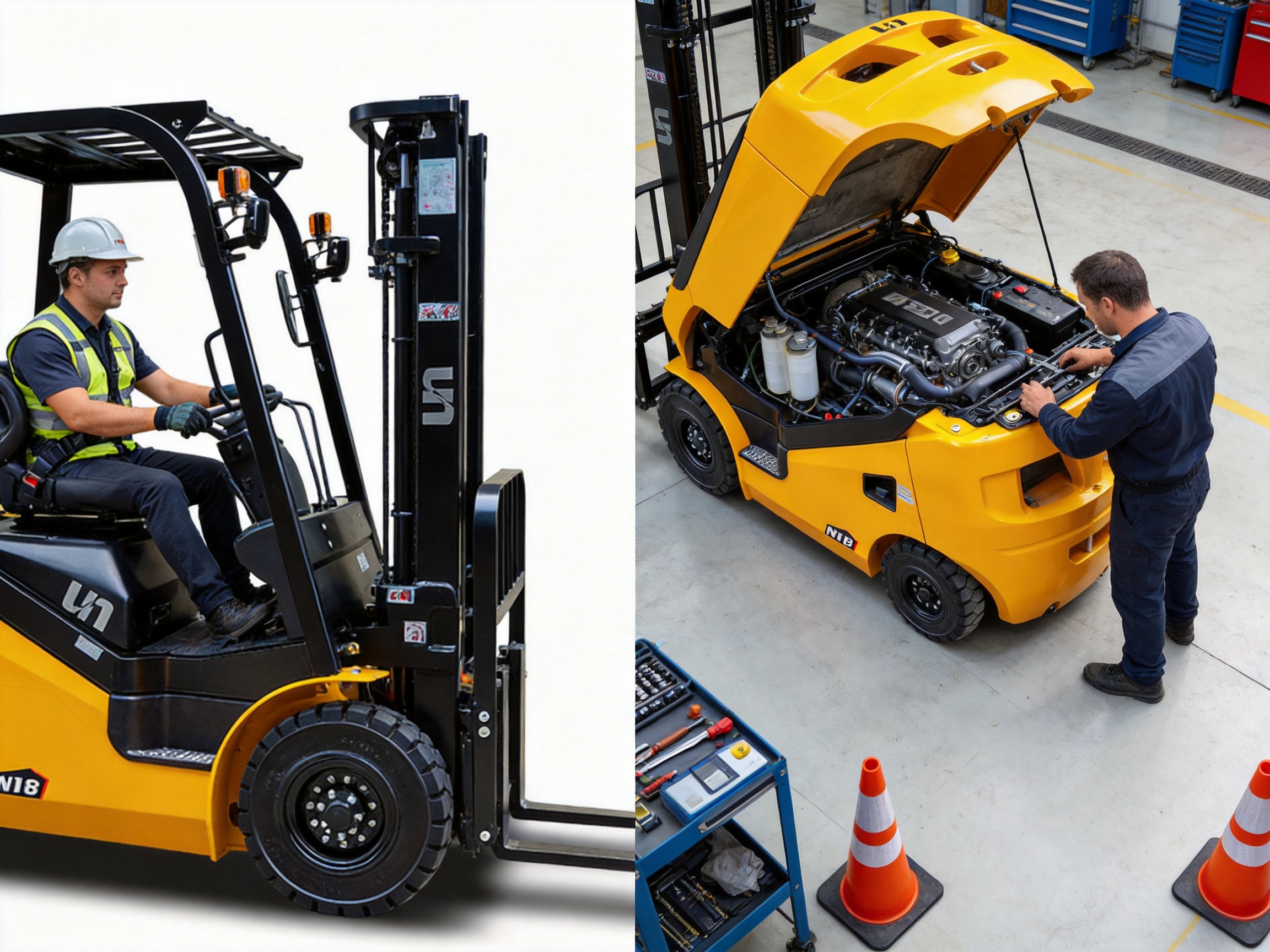
The N Series engine hood opens to nearly 90 degrees, providing broad access to the engine compartment. This arrangement is useful for daily inspections, fluid checks, belt inspection, hose examination, filter replacement, electrical diagnosis, and general cleaning.
Wide access can also reduce the need for awkward working positions. Technicians can see more of the powertrain and reach service points with less obstruction. Over time, this can make preventive maintenance more practical and encourage earlier identification of wear, leaks, loose connections, and contamination.
6.2 Simplified Transmission Filter Replacement
The design also emphasizes easier replacement of the transmission oil filter. Transmission filtration is important because contamination can accelerate wear in hydraulic and transmission components. A service-friendly filter arrangement helps technicians follow recommended replacement intervals and reduces the risk that maintenance will be postponed because access is inconvenient.
Maintenance personnel should use the correct lubricants, filters, seals, and replacement parts for the selected model. Service intervals should be adjusted where the forklift operates in dusty, humid, high-temperature, or unusually intensive conditions. Routine checks should include tires, forks, chains, mast rollers, hydraulic hoses, coolant, engine oil, transmission oil, brakes, steering, lights, warning devices, and fuel-system components.
6.3 Practical Fleet Support
Serviceability is strengthened when a manufacturer provides technical documentation, parts support, trained service personnel, and clear diagnostic procedures. The manufacturer’s international sales and service network is intended to support customers in multiple regions, including Europe, North America, South America, Africa, and Asia.
For fleet operators, service planning should begin before delivery. A purchasing specification should identify expected daily hours, working environment, fuel type, mast height, attachments, tire selection, emission requirements, operator numbers, and local service expectations. This information enables the supplier to recommend the correct configuration and prepare an appropriate parts and maintenance plan.
7. Manufacturing Strengths and Engineering Capability
A forklift’s quality is influenced not only by its visible features but also by the manufacturing system behind it. Consistent welds, accurate machining, controlled assembly, correct hydraulic routing, reliable paint preparation, and final inspection all contribute to performance in the field.
The manufacturer behind this product is a long-established material-handling equipment producer with roots extending back to 1978. Its operations integrate research and development, production, sales, and service. The company occupies approximately 53,400 square meters and reports an annual production capacity of approximately 15,000 units.
This combination of history, manufacturing scale, and product specialization provides several potential advantages. A larger production base can support dedicated engineering teams, repeatable assembly processes, supplier coordination, product testing, spare-parts planning, and continuous improvement. Experience across multiple forklift types also allows design knowledge from electric, internal-combustion, reach, and warehouse trucks to inform future product development.
7.1 Research and Development
Research and development is particularly important in modern forklift manufacturing because customers increasingly require lower emissions, improved ergonomics, better energy efficiency, higher reliability, digital fleet functions, and broader compliance with regional regulations.
The manufacturer has developed a portfolio covering numerous forklift categories, with the company reporting 17 varieties, 96 series, and more than 200 specifications. It has also contributed to the development of electric forklift technologies and participated in the formulation of Chinese electric forklift industry standards. This background indicates experience in adapting products to changing energy and regulatory requirements.
The company’s development history includes the creation of early reach forklift and very-narrow-aisle forklift products in China. Experience with specialized warehouse equipment is relevant to the N Series because it demonstrates an understanding of maneuverability, load control, operator visibility, and space-efficient material flow.
7.2 Integrated Production Control
Integrated production allows engineering, purchasing, assembly, quality control, and service feedback to communicate more effectively. When a manufacturer controls or coordinates these functions, design modifications can be evaluated against real production conditions rather than considered only on paper.
For a forklift, production control should cover frame fabrication, welding, surface treatment, machining, axle and transmission assembly, hydraulic installation, mast assembly, electrical routing, engine installation, tire mounting, calibration, and final inspection. Critical dimensions and torque values should be controlled throughout the process, while finished trucks should be tested for lifting, lowering, steering, braking, travel, leakage, and overall function.
A mature factory environment also supports process repeatability. Repeatability is important for fleet buyers because trucks ordered at different times should maintain consistent dimensions, control behavior, component compatibility, and service requirements. It can also simplify operator training and spare-parts inventory management.
7.3 International Market Experience
Serving international markets requires more than exporting a standard product. Different regions may require specific emission levels, safety features, documentation, lighting, warning systems, tires, fuel-system components, or certification procedures. The manufacturer reports supplying products to international markets and acting as an original-equipment supplier for recognized domestic and overseas companies.
This experience can help customers manage regional compliance and configuration requirements. However, the final buyer remains responsible for confirming that the selected forklift meets all local regulations, workplace rules, emissions requirements, operator-certification requirements, and site-specific safety standards.
8. Technical Specifications
The following table summarizes principal specifications for the compact LPG and gasoline forklift configurations described in the supplied technical information. Values may vary according to mast, fuel system, tires, attachments, options, and final model. The capacity plate and approved technical documentation supplied with the actual truck take precedence.
| Specification | 1.5T Configuration | 1.8T Configuration |
|---|---|---|
| Rated load capacity | 1,500 kg | 1,800 kg |
| Load center | 500 mm | 500 mm |
| Power type | LPG or gasoline/LPG configuration, subject to model | LPG or gasoline/LPG configuration, subject to model |
| Rated lift height | 3,000 mm | 3,000 mm |
| Free lift height | Approximately 100–135 mm, depending on specification | Approximately 100–140 mm, depending on specification |
| Fork size | Approximately 920 × 120 × 35 mm | Approximately 1,070 × 120 × 40 mm |
| Mast tilt angle | 6 degrees forward / 12 degrees backward | 6 degrees forward / 12 degrees backward |
| Fork overhang | Approximately 409 mm | Approximately 414 mm in the compact table |
| Rear overhang | Approximately 470 mm | Approximately 470 mm |
| Ground clearance below mast | Approximately 110 mm | Approximately 110 mm |
| Length to fork face without forks | Approximately 2,285–2,289 mm | Approximately 2,294 mm |
| Overall width | Approximately 1,082 mm | Approximately 1,082 mm |
| Mast lowered height | Approximately 2,025 mm | Approximately 2,025 mm |
| Mast extended height with backrest | Approximately 4,055 mm | Approximately 4,055 mm |
| Overhead guard height | Approximately 2,160 mm | Approximately 2,160 mm |
| Outside turning radius | Approximately 2,100 mm | Approximately 2,100 mm |
| Minimum pallet aisle width | Approximately 3,700 mm | Approximately 3,700 mm |
| Travel speed without load | Approximately 14.5 km/h | Approximately 14.5 km/h |
| Lifting speed at full load | Approximately 560 mm/s | Approximately 560 mm/s |
| Maximum gradeability at full load | Approximately 20 percent | Approximately 20 percent |
| Engine model listed in technical data | GK21 | GK21 |
| Engine output | Approximately 31.2 kW at 2,300 rpm | Approximately 31.2 kW at 2,300 rpm |
| Engine torque | Approximately 144 N·m at 1,600 rpm | Approximately 144 N·m at 1,600 rpm |
| Engine displacement | Approximately 2,065 cc | Approximately 2,065 cc |
| Fuel tank capacity | Approximately 50 L in the listed specification | Approximately 50 L in the listed specification |
| Battery | 12 V / 60 Ah or 12 V / 90 Ah, depending on specification | 12 V / 60 Ah or 12 V / 90 Ah, depending on specification |
| Transmission | Hydraulic | Hydraulic |
| Operating pressure for attachments | Approximately 14.5 MPa | Approximately 14.5 MPa |
| Total weight | Approximately 2,860 kg | Approximately 2,990 kg |
The technical material includes additional 2.0T, 2.5T, 3.0T, and 3.5T configurations with different dimensions, tires, speeds, weights, and hydraulic pressures. These broader specifications demonstrate the scalability of the platform but should not be assumed to apply to the 1.5T or 1.8T truck without confirmation.
9. Application Suitability
9.1 Warehousing and Distribution
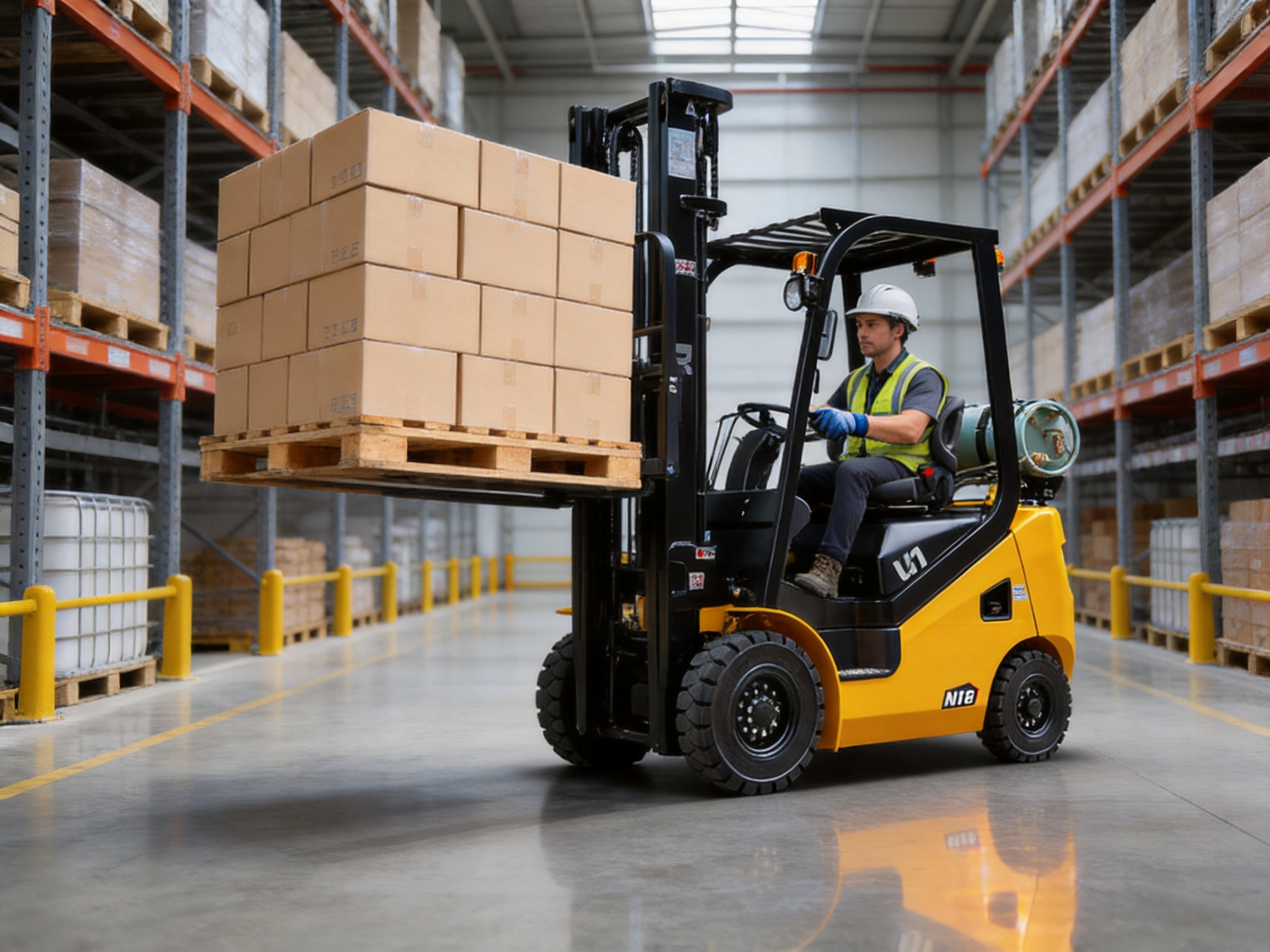
The compact dimensions, 500 mm load center, standard 3,000 mm lift height, and 2,100 mm turning radius make the forklift suitable for pallet handling in distribution centers and general warehouses. Typical duties include unloading delivery vehicles, transferring goods between staging areas, replenishing pallet racks, and preparing outbound shipments.
In distribution environments, quick refueling can support high utilization. The operator presence system, wide-vision mast, and adjustable workstation can also help maintain consistent handling quality during repetitive shifts.
9.2 Manufacturing and Assembly Plants
Manufacturing operations often require frequent movement of components, tooling, packaging, and finished goods between storage areas and production lines. LPG and gasoline forklifts can provide flexible operation where indoor ventilation is appropriate and where the truck must also travel outdoors between buildings.
The hydraulic system’s smooth response is useful when positioning loads near machinery, conveyors, workstations, and racks. Compact maneuverability can reduce interference with production equipment and help maintain orderly material flow.
9.3 Retail, Packaging, and Building Materials
Retail distribution, packaging facilities, and building-material operations can benefit from a truck capable of handling standard pallets while operating in constrained loading and storage areas. The forklift’s capacity range is appropriate for many common packaged products, although the actual load weight, dimensions, stability, and center of gravity must always be checked.
For heavier construction materials, outdoor yards, rough surfaces, or loads with unusual dimensions, customers should evaluate tire selection, ground clearance, attachment requirements, mast configuration, and residual capacity before selecting the product.
10. Selecting the Correct Configuration
Productivity and safety depend on selecting a configuration that matches the application. Buyers should begin by recording the heaviest and most frequent loads, load dimensions, pallet type, load center, required lift height, available aisle width, door clearance, floor condition, operating hours, and indoor ventilation characteristics.
The rated capacity must be evaluated at the actual load center and lift height, not only by the nominal capacity printed in a product title. Attachments can add weight and move the center of gravity forward, reducing residual capacity. High-lift masts, side shifters, clamps, rotators, fork positioners, and other options may change the truck’s capacity plate and stability characteristics.
Fuel selection should reflect site infrastructure and environmental requirements. LPG cylinder storage, replacement, inspection, and ventilation must be managed according to applicable regulations. Gasoline use requires suitable storage and fire-prevention procedures. Mixed-fuel or dual-fuel configurations should be confirmed with the supplier so that the correct engine, fuel-system components, and operating instructions are provided.
Tire selection should match the floor and travel environment. Cushion tires may be appropriate for smooth indoor floors, while pneumatic or solid pneumatic tires may be preferred for mixed indoor and outdoor surfaces. The supplied compact specification lists industrial pneumatic tire sizes such as 6.50-10 at the front and 5.00-8 at the rear for certain models. The actual tire package should be confirmed before ordering.
11. Total Cost of Ownership Considerations
The purchase price is only one component of forklift cost. Total cost of ownership includes fuel, scheduled maintenance, tires, filters, lubricants, operator training, downtime, repairs, attachment costs, financing, insurance, and eventual resale or replacement value.
The N Series can support cost control through a practical internal-combustion design, a recognized engine platform, serviceable hydraulic and transmission systems, accessible engine components, and rapid refueling. The lower noise and cleaner operating profile of LPG operation may also reduce the need for separate equipment in certain indoor applications, provided that ventilation and safety requirements are met.
Preventive maintenance remains the most important factor in protecting long-term operating cost. A forklift that receives regular inspections is more likely to avoid major failures, unsafe conditions, and unexpected downtime. Fleet managers should track engine hours, fuel consumption, maintenance actions, tire wear, damage incidents, and operator feedback to identify trends early.
Manufacturing quality also contributes to ownership cost. Consistent assembly, reliable components, accurate hydraulic installation, and effective final inspection can reduce early-life defects and improve fleet predictability. The manufacturer’s experience in producing a broad range of forklift models can support parts commonality and service familiarity, although component compatibility must always be confirmed by model and serial number.
12. Recommended Operating Practices
Operators should complete a pre-shift inspection before using the forklift. The inspection should cover tires, forks, mast chains, hydraulic hoses, fluid levels, steering, brakes, seat belt, operator presence system, warning lights, horn, overhead guard, fuel system, and visible leaks or damage.
Loads should be centered on the forks and carried as low as practical while maintaining adequate visibility. Operators should not exceed the rated capacity or use damaged forks. Loads should be secured when necessary, and the mast should be tilted according to the load and operating instructions.
Travel speed should be adapted to floor conditions, visibility, traffic, load stability, pedestrian activity, and intersections. Operators should slow down at corners, maintain a safe distance from pedestrians, avoid abrupt steering, and keep all body parts inside the operator compartment.
LPG cylinders and fuel systems should be handled only by trained personnel. Cylinders should be inspected for damage, correctly secured, and replaced in designated areas with appropriate ventilation and ignition-control procedures. Any suspected fuel leak requires immediate shutdown and reporting according to site emergency procedures.
When the forklift is parked, the forks should be lowered, the mast should be placed in a stable position, the parking brake should be applied, and the power system should be turned off. The truck should not be left in a location that blocks emergency exits, fire equipment, pedestrian routes, or loading access.
13. Why the N Series Represents a Balanced Investment
The N Series 1.5T–1.8T LPG and gasoline forklift is not defined by a single specification. Its value comes from the way multiple features work together. The compact chassis supports maneuverability. The internal-combustion powertrain supports continuous operation and fast refueling. The hydraulic system supports smooth handling. The large radiator supports stable operation in demanding temperatures. The wide-vision mast supports load positioning. The operator presence system supports safer control. The accessible engine hood supports maintenance efficiency.
For companies comparing equipment from different suppliers, this integrated balance is an important consideration. A truck with a high travel speed but poor visibility may not improve real productivity. A low-cost forklift with difficult maintenance access may become expensive during years of service. A powerful forklift that is too large for the facility may create inefficient aisle traffic. The N Series is designed to address these practical trade-offs through a compact and serviceable configuration.
The manufacturer’s broader strengths reinforce the product proposition. Decades of industry experience, integrated research and development, substantial production capacity, international market exposure, and a wide product portfolio provide a foundation for continued improvement and customer support. The company’s work in electric, reach, very-narrow-aisle, internal-combustion, lithium-ion, and other forklift technologies also reflects an ability to respond to changing material-handling requirements.
At the same time, buyers should make decisions based on verified application data rather than general product claims. The final specification must match the actual load, lift height, attachment, environment, fuel arrangement, local regulation, and service plan. When correctly configured and maintained, the N Series can provide a practical balance of productivity, comfort, safety, and operating flexibility.
14. Frequently Asked Questions
Q1: What is the rated capacity of the compact N Series forklift?
The compact configurations are rated at 1,500 kg and 1,800 kg. These ratings are based on the specified load center and configuration. The actual allowable capacity must be confirmed from the capacity plate, especially when using attachments, elevated lift heights, or loads with unusual dimensions.
Q2: Is the forklift powered by LPG, gasoline, or both?
The supplied product information describes LPG and gasoline/LPG configurations. The exact fuel arrangement depends on the selected model and specification. Customers should confirm the engine, fuel system, cylinder or tank arrangement, and regional compliance requirements before ordering.
Q3: Can the forklift be used indoors?
Yes. The product is designed for clean indoor environments with low emission and low noise operation. Indoor use still requires adequate ventilation, correct fuel-system management, appropriate emissions control, and compliance with local workplace regulations.
Q4: What is the standard lift height?
The listed standard rated lift height is approximately 3,000 mm. Other mast heights may be available. Buyers should check lowered mast height, extended mast height, free lift, overhead guard height, and building clearance before selecting a mast.
Q5: What is the forklift’s turning radius?
The outside turning radius for the compact configurations is approximately 2,100 mm. Actual maneuvering space also depends on load length, attachment type, operator technique, floor conditions, and the required clearance from racks or obstacles.
Q6: Is the forklift suitable for multi-shift operation?
Its LPG or gasoline powertrain and rapid refueling capability make it suitable for many multi-shift applications. Suitability depends on duty intensity, fuel availability, ventilation, maintenance planning, operator scheduling, and the selected configuration.
Q7: What engine is listed for the compact models?
The technical data identifies the GK21 engine, manufactured by GCT, with approximately 31.2 kW output at 2,300 rpm, approximately 144 N·m torque at 1,600 rpm, four cylinders, and approximately 2,065 cc displacement.
Q8: How does the forklift support maintenance work?
The engine hood opens to nearly 90 degrees for broad access to the engine compartment. The design also simplifies transmission oil filter replacement. Routine maintenance should still be performed according to the approved service schedule and operating conditions.
Q9: Does the forklift include operator safety features?
The product information identifies operator presence and seat-switch protection, a wide-vision mast, an overhead guard, adjustable steering, and a comfortable seat. These features support safer operation but do not replace operator training, pre-shift inspection, traffic management, or safe load-handling procedures.
Q10: Can attachments be installed?
Attachments may be available, subject to compatibility with the carriage, hydraulic system, capacity plate, and intended application. Attachment weight, load center, oil flow, and operating pressure must be evaluated before installation.
Q11: What should buyers verify before placing an order?
Buyers should verify the exact model, fuel type, rated capacity, load center, mast height, free lift, lowered height, tire type, attachment requirements, overall width, turning radius, operating pressure, engine specification, battery specification, local compliance, warranty terms, parts availability, and service support.
Q12: Is the product appropriate for rough outdoor terrain?
The compact N Series is primarily positioned for indoor and general industrial applications. Customers requiring regular operation on rough terrain should evaluate tire type, ground clearance, chassis protection, ramp conditions, weather exposure, and whether a rough-terrain or specialized outdoor forklift would be more appropriate.
15. Conclusion
The N Series 1.5T–1.8T LPG and gasoline forklift provides a versatile solution for businesses that need dependable internal-combustion performance in clean indoor and mixed-use environments. Its compact dimensions, 1,500 kg and 1,800 kg capacity options, 3,000 mm standard lift height, 2,100 mm turning radius, hydraulic transmission, smooth hydraulic control, and low-noise operating concept make it well suited to warehouses, manufacturing plants, distribution centers, and loading operations.
Its advantages are strengthened by practical service features, including a nearly 90-degree opening engine hood and accessible transmission filter replacement. Operator-focused elements such as the wide-vision mast, seat-switch protection, overhead guard, suspended frame, adjustable steering, and comfortable seat support productive and controlled operation.
Behind the product is a manufacturer with a long history in material-handling equipment, integrated research and development, significant production capacity, international market experience, and a broad portfolio of forklift technologies. These strengths support the development of equipment that addresses current demands for efficiency, safety, environmental responsibility, and cost control.
For the best result, the forklift should be selected as part of a complete material-handling plan. Correct capacity selection, fuel management, ventilation, attachment evaluation, operator training, preventive maintenance, and local regulatory compliance are essential. When these factors are properly managed, the N Series can deliver a balanced combination of productivity, maneuverability, serviceability, and long-term operating value.
References
Manufacturer technical product dossier for N Series LPG and gasoline forklifts.
Manufacturer specifications for compact internal-combustion forklift models and related capacity configurations.
International standard guidance for industrial trucks, including stability, operation, and safety principles.
Industrial forklift operator-training and workplace traffic-management guidance.
Material-handling equipment maintenance and preventive-service practices.
Internal-combustion engine and hydraulic transmission service documentation.
Product: N Series 1.5T-1.8T LPG&Gasoline Forklift

For exclusive deals and latest offers, sign up by entering your email address below.
Stay In Touch
ADDRESS : NO.1 ROAD ONE, XINDENG NEW DISTRICT, FUYANG, HANGZHOU, ZHEJIANG, CHINA 311404.
PHONE : +86-571-8688 8355 (AMERICA)
PHONE : +86-571-8886 9363 (EUROPE)
PHONE : +86-571-8688 8377 (ASIA, AFRICA, OCEANIA)
EMAIL : [email protected]
EMAIL : [email protected](PARTS INQUIRY)

