


 中文简体
中文简体 Français
 русский
 Español
 عربى
عربى Deutsch



8.0–10.0-Ton Heavy-Duty Diesel Forklifts for Demanding Material Handling
Admin 2026-09-17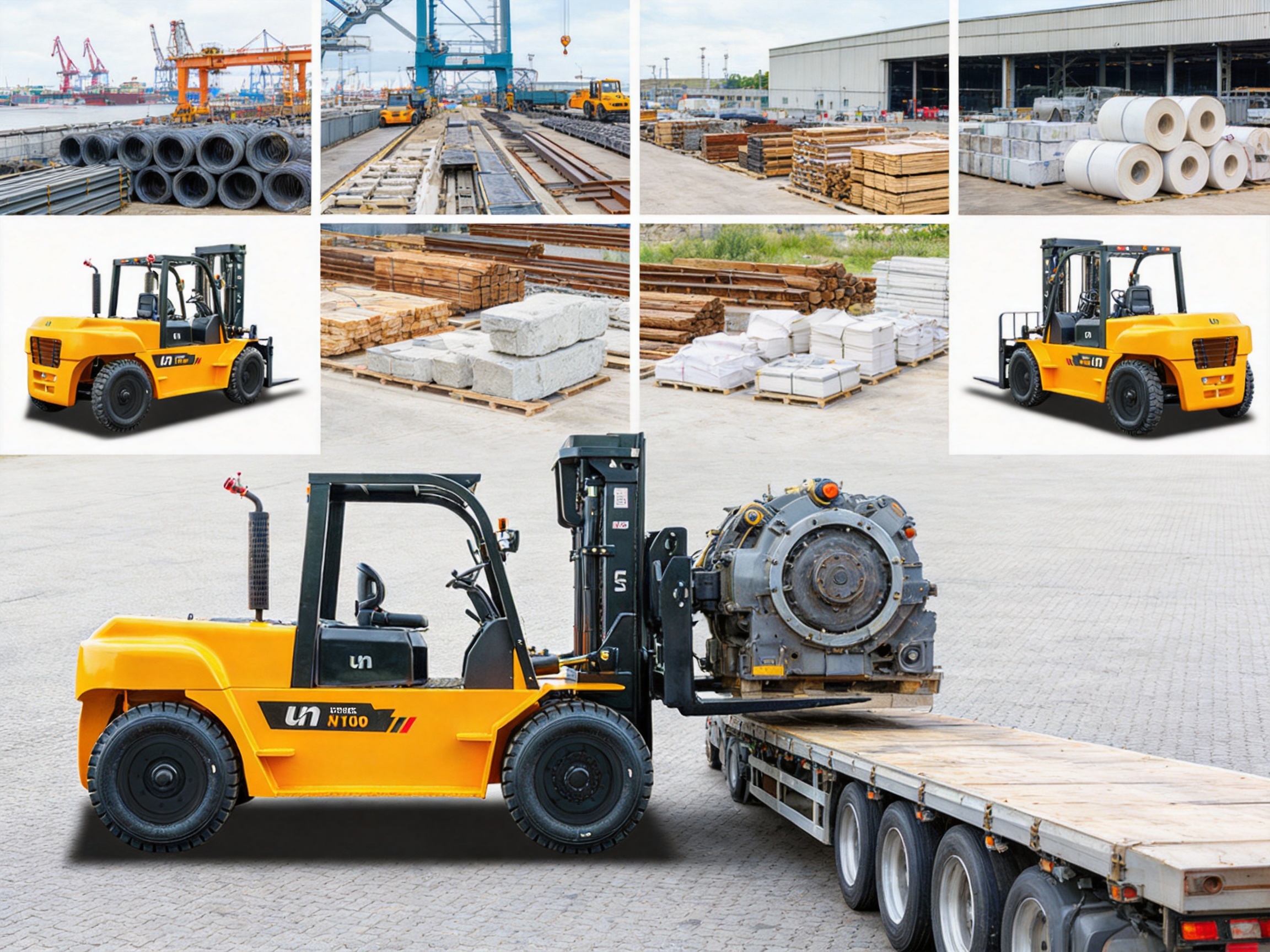
Heavy-duty material handling requires more than a high rated capacity. A forklift working in ports, docks, construction material yards, steel facilities, manufacturing plants, and other demanding outdoor environments must combine structural strength, dependable power, controllable hydraulics, stable handling, operator protection, and easy maintenance. The N Series 8.0–10.0-ton heavy-duty diesel forklift is engineered around these requirements.
Designed for intensive lifting and transport operations, this forklift series provides rated capacities of 8,000 kg and 10,000 kg with a 600 mm load centre. Its reinforced chassis, large-capacity cooling system, powershift or hydraulic transmission options, high-output diesel engines, and heavy-duty axles are intended to support long periods of high-load operation. Rather than focusing only on maximum lifting capacity, the series is developed as a complete working platform in which the frame, mast, drivetrain, hydraulic system, braking system, tyres, and operator compartment work together.
The result is a machine suited to applications where ordinary warehouse forklifts may lack the necessary stability, ground clearance, cooling capacity, or structural durability. The N Series also offers multiple engine configurations and model variations, allowing users to select equipment according to operating conditions, emissions requirements, service preferences, and regional availability.
Built for High-Capacity Outdoor Handling
Loads weighing between eight and ten tonnes place exceptional forces on a forklift’s mast, carriage, forks, front axle, chassis, and counterweight. These forces increase further when the machine operates on uneven ground, travels over ramps, works in hot weather, or performs repeated loading cycles. The N Series addresses these conditions through a heavy-duty design intended for continuous industrial use.
The series includes FD80T and FD100T models, representing nominal capacities of 8,000 kg and 10,000 kg. A 600 mm load centre is specified for the main configurations. This capacity range is appropriate for handling heavy metal products, stone, timber, concrete components, industrial machinery, large moulds, heavy coils, containers, and other concentrated loads.
Unlike a light-duty forklift adapted for occasional heavy lifting, a purpose-built heavy-duty forklift must preserve stability and drivability throughout the work cycle. The N Series therefore uses a broad chassis, large tyres, substantial axle dimensions, and long wheelbase options. The 8-ton configuration has a 2,500 mm wheelbase, while the 10-ton configuration has a 2,800 mm wheelbase. This difference helps provide a suitable balance between manoeuvrability and longitudinal stability for each capacity class.
Overall width is approximately 2,165 mm for the 8-ton and 10-ton configurations. The wide stance supports stability when handling large or unevenly distributed loads. It also creates a solid foundation for operations in open yards and industrial areas where aisle width is less restrictive than in conventional warehouse applications.
Ground clearance at the bottom of the mast is approximately 245 mm in the newer heavy-duty configurations. This clearance helps the truck travel over yard surfaces, thresholds, expansion joints, compacted gravel, and other minor obstacles with reduced risk of contact between the lower mast area and the ground.
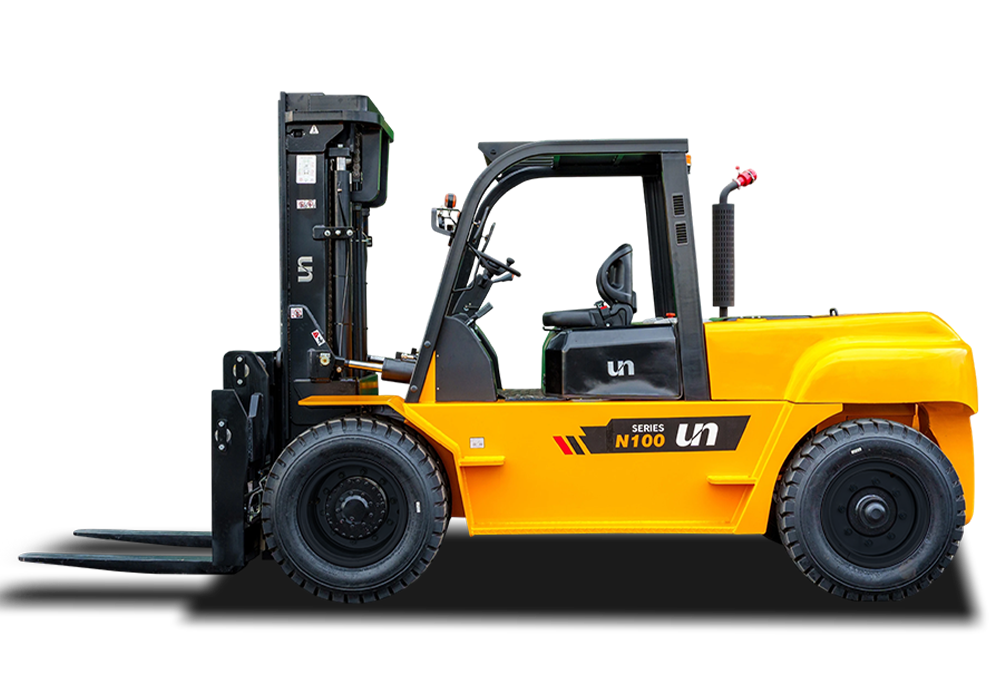
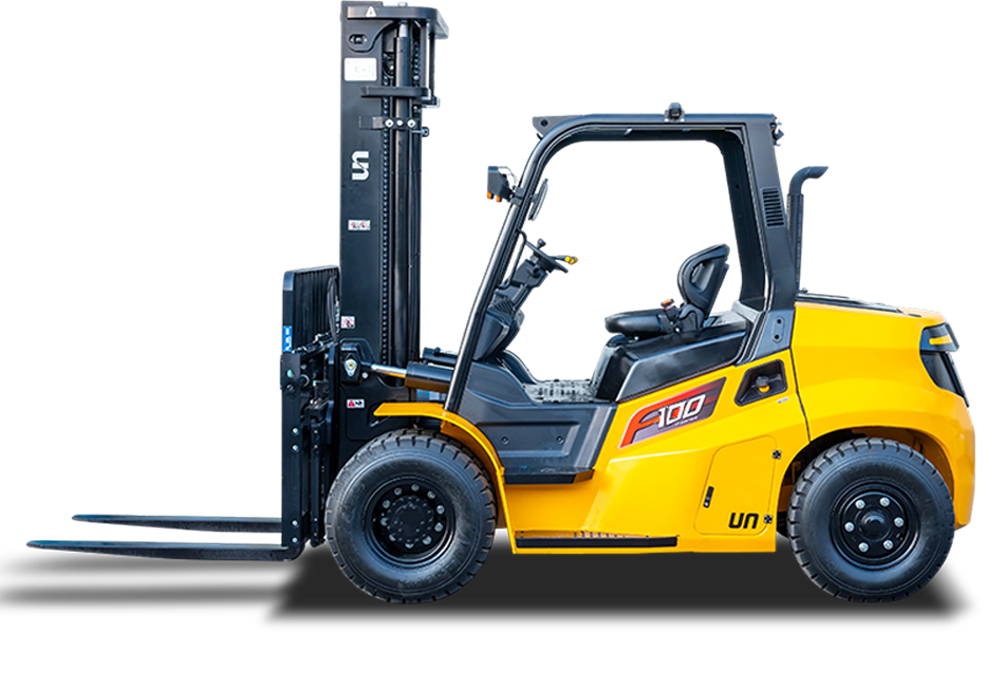
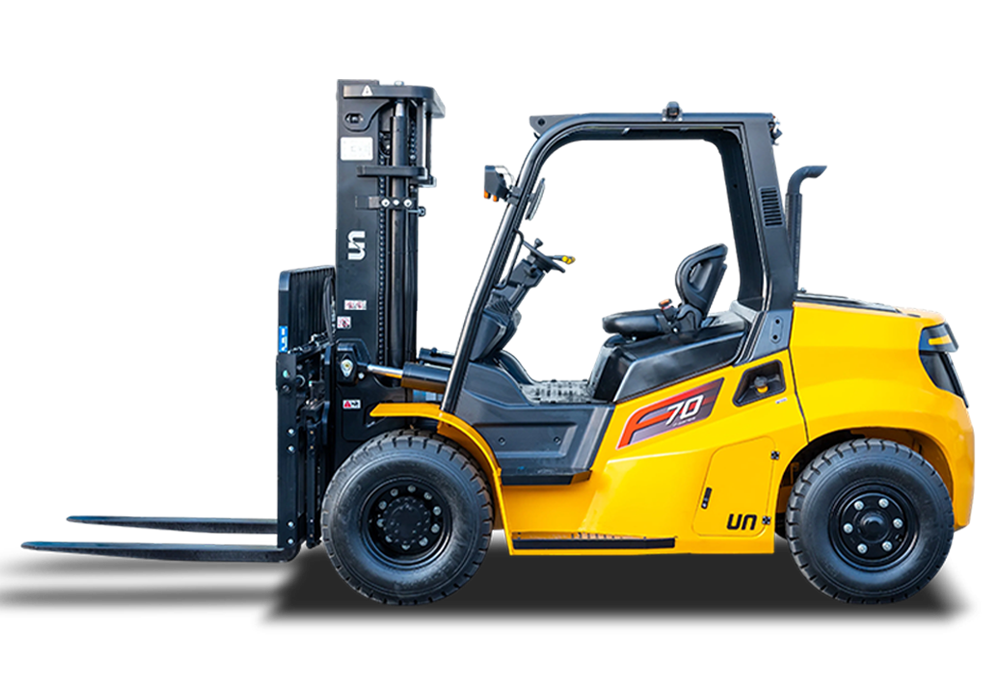
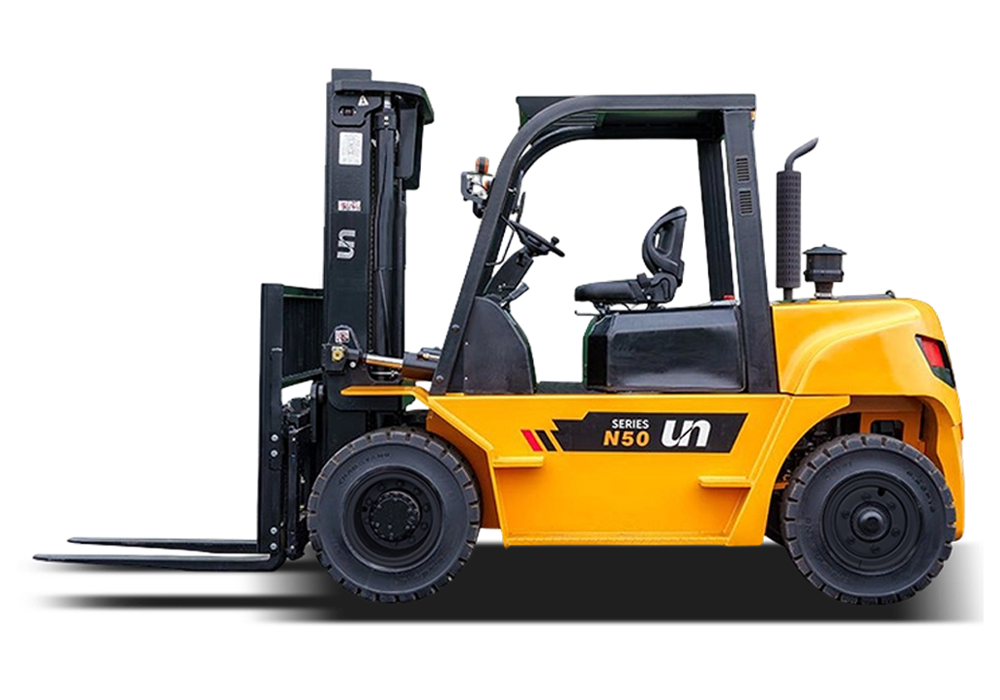
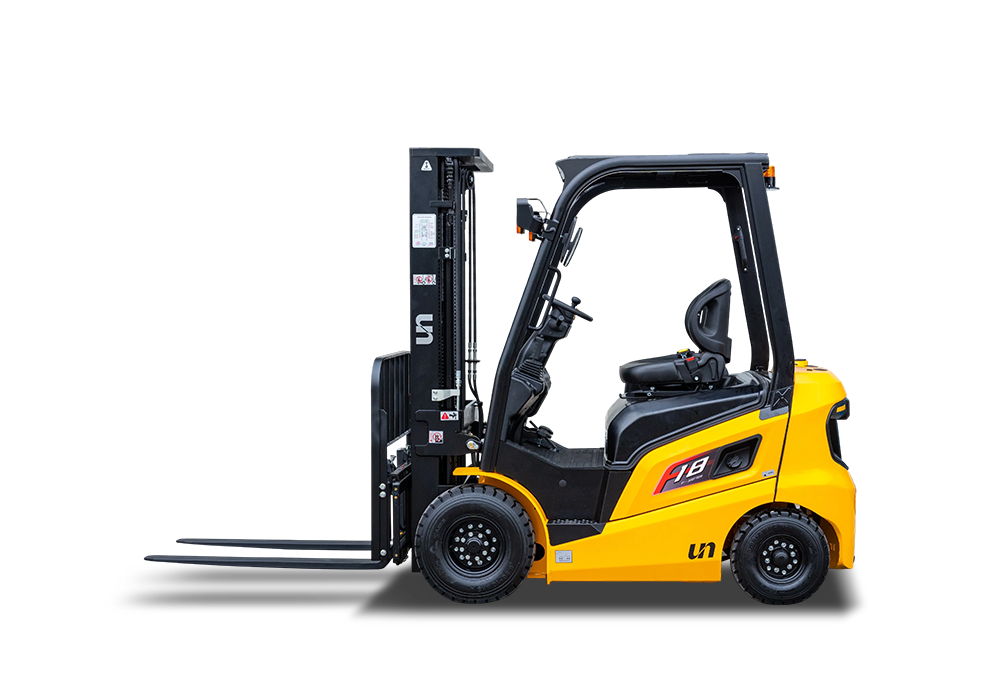
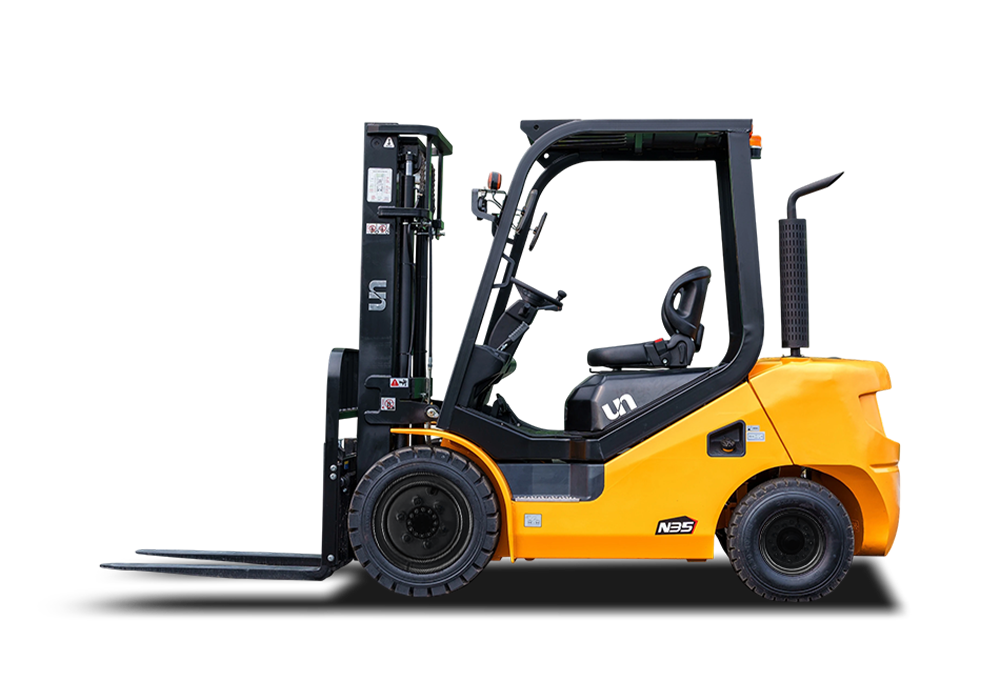
N Series 8.0T-10.0T Heavy Duty Diesel Forklift
Structural Engineering for Long-Term Durability
A heavy-duty forklift’s performance begins with its chassis. The chassis must withstand repeated dynamic loading, torsional stress, vibration, braking forces, and the impact associated with outdoor handling. The N Series uses a reinforced high-load chassis developed to support large capacity loads during extended operating cycles.
The design philosophy is based on matching the frame to the drivetrain and load-handling system instead of treating the chassis as an isolated component. The mast, front axle, counterweight, transmission, and hydraulic system must function as one load-bearing structure. This approach helps maintain stability and predictable handling when the truck is carrying a load close to its rated capacity.
The chassis is manufactured according to a precision-oriented process. Scientific structural calculation, controlled fabrication, accurate component positioning, and high-standard assembly are essential to ensure that load forces are distributed correctly. Consistent manufacturing accuracy also supports alignment between the mast, drive axle, steering system, and hydraulic components.
For industrial customers, durability has a direct effect on operating cost. A stronger chassis can reduce premature wear, unplanned stoppages, and the frequency of structural repairs. It also helps maintain the forklift’s performance over a longer service life, especially in applications involving repeated full-load cycles.
The large counterweight and extended wheelbase contribute to stability during lifting and travelling. The counterweight balances the load carried at the front, while the wheelbase influences longitudinal stability and ride behaviour. The longer wheelbase of the FD100T supports the higher rated capacity and helps control weight transfer during acceleration, braking, and lifting.
Forks and Load Interface
The fork dimensions are matched to the capacity of each truck. The heavy-duty 8-ton and 10-ton versions use forks approximately 1,220 mm long, 175 mm wide, and 80 mm thick. These dimensions provide a substantial load interface for large industrial loads and help reduce excessive fork deflection when the truck is operated within its rated capacity and load-centre limits.
Fork selection must always be based on the actual load shape, centre of gravity, attachment configuration, and application environment. The rated capacity of a forklift is not unlimited under every operating condition. As the load centre increases or an attachment is added, the available capacity may change. Operators and fleet managers should therefore verify the correct load chart before using the machine for unusual or oversized loads.
Power Systems for Continuous Heavy-Duty Work
High-capacity lifting and outdoor transport require a power system that can deliver both torque and thermal endurance. The N Series is offered with diesel engines from established manufacturers, including Isuzu, Xichai, and Cummins. Depending on the selected configuration, the range includes the 6BG1, CA4DF3-12GCG3U, and QSF3.8 engine models.
The listed engine outputs are approximately 82 kW at 2,000 rpm for the 6BG1, 85 kW at 2,200 rpm for the Xichai engine, and 86 kW at 2,200 rpm for the Cummins engine. Listed torque values range from approximately 416 N·m to 470 N·m, depending on engine selection. These power levels are intended to provide the traction and hydraulic performance required for lifting heavy loads, climbing gradients, and moving across industrial yards.
| Configuration | Rated Capacity | Engine Model | Engine Manufacturer | Rated Output |
| FD80T-NJB3 | 8,000 kg | 6BG1 | Isuzu | 82 kW at 2,000 rpm |
| FD100T-NJB3 | 10,000 kg | 6BG1 | Isuzu | 82 kW at 2,000 rpm |
| FD80T-NGP1 | 8,000 kg | CA4DF3-12GCG3U | Xichai | 85 kW at 2,200 rpm |
| FD100T-NGP1 | 10,000 kg | CA4DF3-12GCG3U | Xichai | 85 kW at 2,200 rpm |
| FD80T-NGR1 | 8,000 kg | QSF3.8 | Cummins | 86 kW at 2,200 rpm |
| FD100T-NGR1 | 10,000 kg | QSF3.8 | Cummins | 86 kW at 2,200 rpm |
The availability of several engine families is an advantage for international buyers. Different regions may have different preferences for engine brands, parts supply, emissions certification, fuel quality, and service capability. A choice of engines can make it easier for fleet operators to standardize equipment with existing maintenance systems or local technician expertise.
The engines are supported by a 120-litre fuel tank. This capacity is suitable for extended working periods and helps reduce the frequency of refuelling interruptions. Actual fuel consumption will depend on load, duty cycle, travel distance, idle time, operating technique, tyre condition, and ambient temperature.
Cooling Performance in Hot and Intensive Operating Conditions
Heat management is one of the most important factors in the reliability of a heavy-duty diesel forklift. High-load lifting and continuous travel generate heat in the engine, transmission, hydraulic system, and braking components. When the truck operates in a hot climate or a poorly ventilated area, the cooling system becomes even more important.
The N Series incorporates a high-capacity radiator and an enlarged cooling design intended to maintain stable operating temperatures during demanding work. The cooling system is designed for conditions in which the forklift may operate near full capacity for long periods, including port handling, outdoor storage yards, steel service centres, and industrial production sites.
A large radiator alone does not guarantee reliable cooling. Airflow, radiator cleanliness, fan performance, coolant quality, engine condition, and maintenance intervals all influence thermal performance. The N Series supports maintenance access through a redesigned rear cover that makes radiator inspection more convenient. This design feature helps technicians identify dust accumulation, debris blockage, damaged fins, or leakage before these conditions develop into serious overheating problems.
For operations in dusty or hot environments, daily inspection remains essential. Operators should check the radiator area, coolant level, fan belt condition, warning indicators, and engine compartment before beginning a shift. Preventive maintenance is particularly valuable for heavy-duty trucks because thermal stress can affect multiple systems at the same time.
Transmission and Drivetrain Control
The N Series is equipped with a heavy-duty transmission system designed to transfer engine power to the drive axle while supporting smooth directional changes and controlled travel. The configurations include powershift or hydraulic transmission specifications, depending on the model and equipment package.
The listed transmission stages for the newer configurations are 2 forward and 1 reverse. This arrangement provides practical control for heavy industrial work, where the operator frequently moves between forward travel, positioning, load engagement, and reverse travel. A well-matched transmission allows the operator to use engine power efficiently without unnecessary clutch abuse.
A full-floating or dependable floating power system is used in the overall drivetrain concept. This helps accommodate movement and load transfer within the powertrain while reducing the effect of shock loading on key components. Smooth power delivery is especially important when the truck is moving a heavy load across uneven ground or starting on a gradient.
Under full load, the heavy-duty configurations provide a maximum drawbar pull of approximately 58 kN and a maximum gradeability of approximately 20 percent. These figures indicate the truck’s ability to generate traction and climb slopes under specified test conditions. Actual performance depends on surface grip, tyre condition, load distribution, gradient length, ambient conditions, and operator technique.
The travel speed without load is listed at approximately 20 km/h for the FD80T and FD100T heavy-duty configurations. This speed is appropriate for industrial yards where stability, braking distance, and controlled positioning are more important than high-speed transport.
Hydraulic Lifting and Attachment Capability
The hydraulic system is responsible for lifting, lowering, mast tilting, and operating compatible attachments. In heavy-duty applications, the hydraulic system must provide sufficient pressure and flow while maintaining controllability. Excessively abrupt movement can create load swing, impact forces, and operator discomfort, while insufficient flow can reduce productivity.
The N Series uses hydraulic components such as Shimadzu pumps and valves or equivalent components. The system is designed to support efficient lifting and responsive steering. Listed operating pressure for attachments is approximately 19.5 MPa in the newer configurations, while the broader specification information indicates attachment pressure around 20 MPa depending on the configuration.
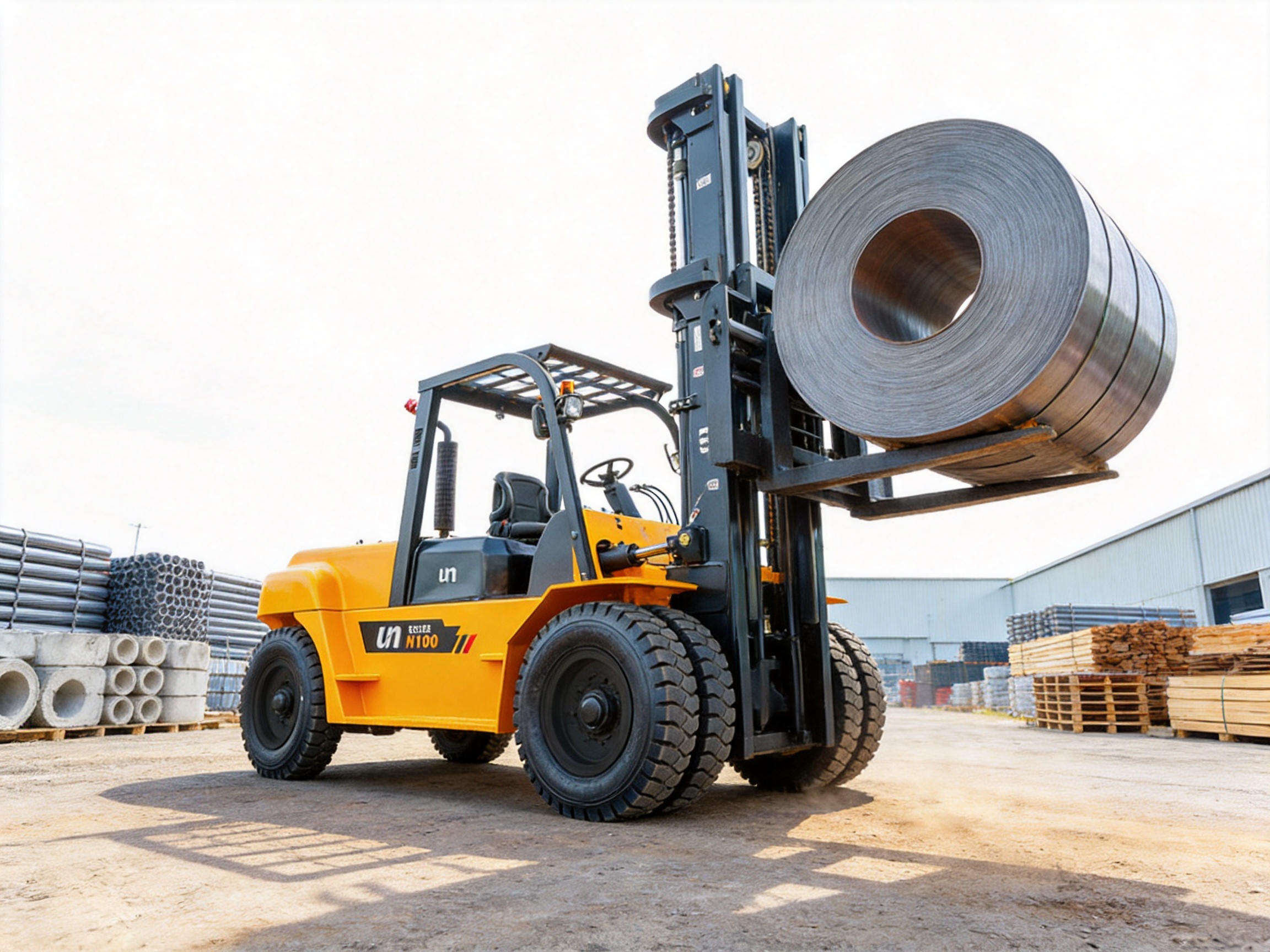
The rated lift height in the main configurations is 3,000 mm. Free lift height is approximately 220 mm in the newer 8-ton and 10-ton models. Mast tilt is specified at approximately 6 degrees forward and 12 degrees backward. These figures provide a practical operating range for engaging loads, stabilizing them against the load backrest, and positioning material on platforms or transport vehicles.
Full-load lifting speed is listed at approximately 380 mm per second for the 8-ton configuration and 310 mm per second for the 10-ton configuration. The difference reflects the higher capacity and heavier load requirement of the FD100T. Lowering speed is controlled through the hydraulic system, with the published specification indicating no-load lowering of at least 300 mm per second and full-load lowering of no more than 600 mm per second.
The forklift can be configured with a side-shift function. The listed side-shift ranges vary by capacity, with approximately 340–2,000 mm for the 8-ton configuration and 440–2,140 mm for the 10-ton configuration. Side shift can simplify load alignment and reduce the need for repeated repositioning of the complete truck. It is particularly useful where the forklift must place large loads accurately within limited clearance.
Stability, Tyres, and Outdoor Mobility
Stability is influenced by the relationship between the load centre, wheelbase, tyre footprint, axle design, mast geometry, counterweight, and operating surface. The N Series uses large pneumatic tyres with heavy-duty ply ratings. The 8-ton configuration is listed with 8.25-20-14PR tyres, while the 10-ton configuration uses 9.00-20-14PR tyres.
These tyres provide a broad and robust contact area for outdoor applications. Pneumatic tyres can help absorb surface irregularities and improve ride comfort compared with smaller solid tyres on uneven ground. The exact tyre selection should be matched to the operating surface, puncture risk, temperature, speed, and load cycle.
The front tread is approximately 1,600 mm and the rear tread is approximately 1,700 mm. This wide stance supports lateral stability when the truck is carrying large loads or operating on surfaces that are not perfectly level. The steering axle is designed to provide controlled manoeuvrability despite the truck’s large dimensions.
The outside turning radius is approximately 3,700 mm for the 8-ton version and 3,900 mm for the 10-ton version. Minimum pallet aisle width is approximately 5,845 mm and 6,045 mm respectively. These dimensions should be considered during site planning. The forklift is most effective in spacious industrial environments rather than narrow warehouse aisles designed for compact lift trucks.
In comparison with smaller forklifts, the N Series may require more operating space, but that space supports a much greater handling capacity. For companies moving exceptionally heavy loads, selecting the correct machine is more efficient than attempting to use several undersized forklifts or repeatedly exceeding the duty limits of lighter equipment.
Operator Safety and Ergonomic Design
Heavy-duty lifting places greater demands on operator awareness and machine control. The N Series includes safety and ergonomic features designed to support confident operation during long shifts.
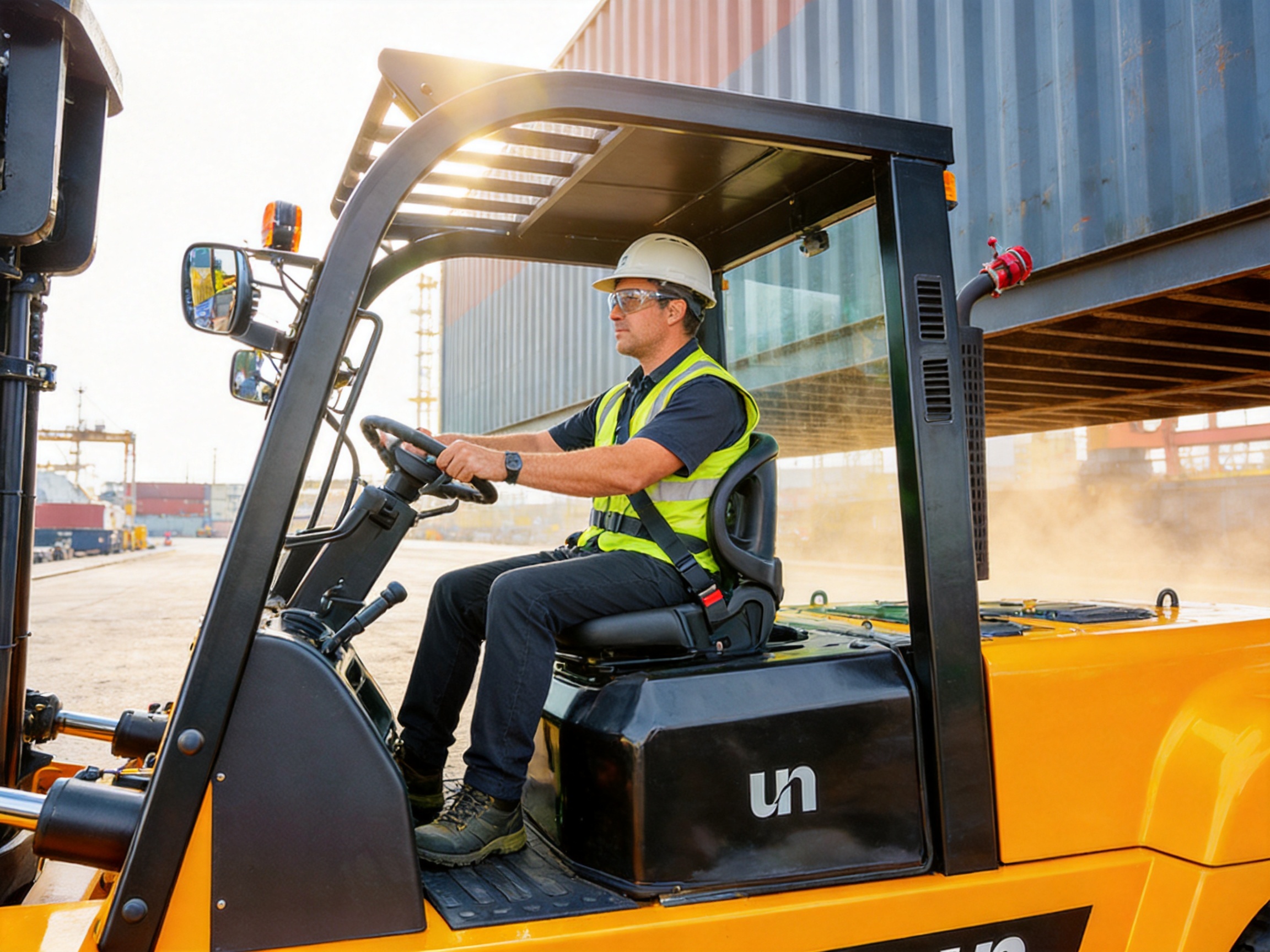
An operator presence system and seat switch system help ensure that the truck is operated only when the operator is correctly positioned. These systems are important safeguards against unintended movement. They should complement, rather than replace, operator training, site rules, load inspection, and safe driving practices.
The wide-view mast is designed to improve forward visibility. Visibility is especially important when handling oversized loads, entering trailers, approaching storage locations, or working around pedestrians and other equipment. A wide field of view allows the operator to align forks more accurately and monitor the surrounding environment.
The overhead guard provides protection against falling objects from above. In heavy industrial environments, overhead protection is a key part of the operator compartment. The listed overhead guard height is approximately 2,520 mm for the 8-ton model and 2,540 mm for the 10-ton model, although the actual height may vary according to configuration and optional equipment.
The operator’s compartment is designed with space for the legs and head, an adjustable steering wheel, and a cushioned seat. Ergonomics directly affect productivity because fatigue can reduce precision and increase the likelihood of operating errors. A comfortable position enables the operator to maintain control during repeated lifting, reversing, steering, and load placement cycles.
Controls should be arranged so that the operator can use them without excessive reaching or awkward movement. Clear instrumentation, accessible levers, and a comfortable seating position can help reduce unnecessary physical strain. The machine’s braking system also uses an accumulator to support faster response and smoother operation.
Safety Practices for Heavy Loads
Even a highly stable forklift can become unsafe if the load is not correctly secured or if the capacity chart is ignored. Operators should confirm the load weight, load centre, fork spacing, attachment rating, overhead clearance, and travel path before beginning a lift.
Loads should be carried as low as practical while travelling, with the mast tilted appropriately to help retain the load. Sudden turns, harsh braking, excessive speed, and travelling with elevated loads should be avoided. On gradients, the load should be positioned according to established forklift safety procedures and local regulations.
Managers should also separate pedestrian routes from forklift routes wherever possible. Heavy-duty forklifts have substantial stopping distances, especially when fully loaded. Warning lights, audible alarms, mirrors, cameras, barriers, and controlled access areas may be appropriate depending on the site.
Maintenance Accessibility and Reduced Downtime
Maintenance access is a major factor in the total cost of ownership of heavy equipment. A forklift that is difficult to inspect may receive less frequent servicing, increasing the risk of avoidable failures. The N Series is designed to make routine maintenance and inspection more convenient.
The engine hood can open to almost 90 degrees, creating a wide access area for routine checks, filter replacement, belt inspection, fluid servicing, and component replacement. Better access reduces the time technicians spend working in confined positions and makes it easier to identify small problems before they become major failures.
The redesigned rear cover improves access to the radiator. This is particularly valuable in dusty or outdoor operations where radiator inspection and cleaning are frequent requirements. Internal components are arranged strategically to simplify servicing and help reduce maintenance time.
A practical maintenance program should include daily, weekly, and scheduled inspections. Daily checks commonly include engine oil, coolant, hydraulic oil, fuel level, tyre condition, fork condition, mast chains, hoses, warning devices, lights, brakes, steering, and visible leaks. Scheduled service should follow the engine, transmission, hydraulic, and forklift maintenance requirements supplied for the specific configuration.
Keeping maintenance records provides additional benefits. Records can reveal patterns such as repeated hose damage, excessive tyre wear, overheating, abnormal fuel use, or brake deterioration. Fleet managers can then adjust operator training, route design, load handling procedures, or service intervals.
Manufacturing Capability and Product Development Strength
The forklift is produced by Zhejiang UN Forklift Co., Ltd., a material handling equipment manufacturer integrating research and development, production, sales, and service. The company was established in 1978 and operates a manufacturing site covering approximately 53,400 square metres, with an annual production capacity of approximately 15,000 units.
This manufacturing scale is important for customers seeking more than a single machine. A producer with an established product platform, dedicated engineering resources, production capacity, and an international service network can support fleet development and long-term parts planning.
The company offers a broad product portfolio covering internal combustion forklifts, electric forklifts, warehouse equipment, reach trucks, and other material handling solutions. Its range is described as including 17 varieties, 96 series, and more than 200 specifications. This breadth allows customers to select equipment according to load capacity, energy type, operating environment, aisle requirement, and emissions standard.
The company’s product development history includes work on reach forklifts, very narrow aisle trucks, electric forklift technologies, lithium-ion models, and internal combustion forklifts for international markets. This combination of conventional industrial equipment and new-energy development indicates an engineering approach that responds to different customer requirements rather than relying on a single technology.
For the N Series, manufacturing strengths are reflected in the integration of structural design, component selection, assembly, testing, and after-sales support. The use of recognized engine suppliers and Japanese-level transmission quality supports consistency in critical powertrain components. Hydraulic components from established suppliers or equivalent sources provide a foundation for dependable lifting and steering performance.
Advanced manufacturing is not limited to automated machinery. It also includes process control, dimensional accuracy, welding quality, surface treatment, assembly discipline, inspection standards, and traceability. In a heavy-duty forklift, small deviations in alignment or assembly can influence mast operation, tyre wear, steering behaviour, or load stability. A controlled production process helps ensure that these systems function together as intended.
The manufacturer’s international network includes partners and customers in Europe, South America, North America, Africa, and Asia. This global orientation is useful for companies that operate across multiple regions or require equipment suitable for international working conditions. Support for higher-emission-standard markets also reflects the need to adapt products to regional regulatory requirements.
Advantages Over Conventional Competitors
The N Series competes in a segment where many products appear similar on the basis of rated capacity alone. Its advantages become clearer when the complete machine is evaluated.
First, the series is designed specifically for heavy-duty operation rather than simply offering an increased capacity rating on a lighter platform. Its reinforced chassis, large tyres, wide stance, long wheelbase, and heavy-duty mast components are appropriate for demanding industrial applications.
Second, the cooling system is designed for sustained operation in hot and harsh environments. A high-capacity radiator and accessible rear cover can improve thermal reliability and simplify maintenance compared with machines that are difficult to clean or inspect.
Third, customers have access to several established engine options. This provides flexibility in relation to power, local parts availability, service experience, and market requirements. A single engine choice may be sufficient for a standard application, but a range of options is valuable for international fleets.
Fourth, the hydraulic and braking systems are designed with control and operator comfort in mind. Efficient lifting, responsive steering, accumulator-assisted braking, and controlled lowering contribute to both productivity and safety.
Fifth, the forklift offers meaningful maintenance advantages. The nearly 90-degree engine hood opening, redesigned rear cover, and organized internal component layout can reduce inspection and repair time. Reduced service time is particularly valuable in operations where the truck is expected to work multiple shifts.
Sixth, the product is supported by a manufacturer with a long operating history, broad product coverage, international partnerships, and experience in both internal combustion and electric forklift development. This makes the N Series a practical choice for businesses that may later require a broader fleet solution.
Competitor comparisons should always consider the complete specification. Important factors include rated capacity at the real load centre, full-load lifting speed, gradeability, drawbar pull, turning radius, tyre type, cooling design, engine support, warranty conditions, spare parts availability, service response, and expected residual value. A lower purchase price may not represent a lower lifetime cost if the machine requires more downtime or has limited parts support.
Applications Across Industrial Sectors
Ports and Docks
Ports and docks require equipment that can handle heavy cargo, operate outdoors, and withstand long working cycles. The N Series offers the capacity, ground clearance, traction, and cooling performance needed for moving dense cargo, machinery components, steel products, pallets, and container-related materials.
Its wide tyres and stable chassis are suitable for paved yards and other industrial surfaces. Operators should select the correct forks or attachment for the cargo and confirm that the rated capacity remains adequate at the actual load centre.
Steel and Metal Processing
Steel service centres, foundries, fabrication plants, and metal warehouses often handle products that are compact but extremely heavy. The 8-ton and 10-ton capacities allow a single truck to move loads that would be impractical for smaller forklifts.
In these environments, heat, dust, sharp edges, and uneven load shapes may be present. Heavy-duty tyres, structural durability, operator protection, and cooling performance are especially important. Special attachments may be required for coils, beams, plates, or other non-palletized products.
Construction Materials
Concrete components, stone, brick, timber packs, prefabricated structures, and construction machinery can exceed the capacity of conventional warehouse forklifts. The N Series can support material transfer in construction supply yards and production facilities where large loads must be positioned accurately.
The machine’s side-shift capability can assist with alignment when loads must be placed in stacks, on trailers, or within production areas. Ground clearance and pneumatic tyres also support movement across outdoor industrial surfaces.
Manufacturing Plants
Large manufacturing facilities may require forklifts to move dies, moulds, motors, generators, fabricated frames, and production equipment. The N Series provides the load capacity and hydraulic control needed for these tasks while allowing users to choose among several engine configurations.
Where indoor operation is required, ventilation, emissions, noise, and local safety requirements must be evaluated carefully. Diesel forklifts are generally most appropriate for well-ventilated industrial spaces or outdoor applications.
Timber and Paper Industries
Timber packs, pulp bales, paper rolls, and related products can be heavy, bulky, and difficult to centre. The long forks, wide chassis, and high capacity of the N Series provide a suitable platform for these products when the correct attachment and load configuration are used.
Specification Overview
| Item | FD80T Configuration | FD100T Configuration |
| Rated load capacity | 8,000 kg | 10,000 kg |
| Load centre | 600 mm | 600 mm |
| Rated lift height | 3,000 mm | 3,000 mm |
| Fork size | 1,220 × 175 × 80 mm | 1,220 × 175 × 80 mm |
| Free lift height | 220 mm | 220 mm |
| Mast tilt angle | 6 degrees forward / 12 degrees backward | 6 degrees forward / 12 degrees backward |
| Overall width | 2,165 mm | 2,165 mm |
| Wheelbase | 2,500 mm | 2,800 mm |
| Outside turning radius | 3,700 mm | 3,900 mm |
| Travel speed without load | 20 km/h | 20 km/h |
| Full-load gradeability | 20 percent | 20 percent |
| Approximate total weight | 11,850 kg | 12,900 kg |
| Fuel tank capacity | 120 litres | 120 litres |
| Tyres | 8.25-20-14PR | 9.00-20-14PR |
| Attachment operating pressure | Approximately 19.5 MPa | Approximately 19.5 MPa |
Specifications may vary according to engine, mast, transmission, attachment, regional configuration, and customer requirements. Buyers should request the final technical datasheet for the exact model and optional equipment package.
Choosing Between the 8-Ton and 10-Ton Models
The FD80T is suitable for customers whose regular loads are close to, but generally below, eight tonnes and who value a somewhat smaller turning radius and shorter wheelbase. It offers a strong balance between high capacity, outdoor mobility, and industrial productivity.
The FD100T is intended for loads up to ten tonnes and uses a longer wheelbase, larger tyres, and a higher total operating weight. It is appropriate where load weights are consistently high or where additional stability is important. Its larger dimensions require more space for manoeuvring, so the site layout should be checked before purchase.
Neither model should be selected solely according to the heaviest occasional load. The buyer should review the normal load range, load centre, attachment weight, operating surface, travel distance, available aisle width, duty cycle, slope, temperature, and service conditions. Correct sizing improves both safety and operating economy.
Q&A
What is the rated capacity of the N Series heavy-duty forklift?
The N Series configurations discussed here provide rated capacities of 8,000 kg and 10,000 kg. The rated capacity is specified at a 600 mm load centre for the main configurations.
What industries can use this forklift?
The forklift is suitable for ports, docks, steel and metal processing, construction materials, machinery manufacturing, timber, paper, industrial warehouses, and other applications involving large or concentrated loads.
Which engines are available?
The listed configurations use Isuzu 6BG1, Xichai CA4DF3-12GCG3U, or Cummins QSF3.8 engines. Engine availability may depend on the selected model, market, emissions requirement, and customer specification.
How does the forklift perform in hot weather?
The N Series uses a high-capacity radiator and cooling design intended for demanding operating conditions. Proper maintenance remains essential, including radiator cleaning, coolant inspection, fan inspection, and regular service.
Does the forklift support attachments?
Yes. The hydraulic system supports compatible attachments, and the listed attachment operating pressure is approximately 19.5 MPa in the newer heavy-duty configurations. The attachment’s weight and load centre must be included when calculating residual capacity.
Is side shift available?
Side-shift configurations are available. The listed movement range is approximately 340–2,000 mm for the 8-ton configuration and 440–2,140 mm for the 10-ton configuration.
What is the rated lift height?
The main heavy-duty configurations specify a rated lift height of 3,000 mm. Different mast options may be available for applications requiring alternative lift heights.
How does the forklift support maintenance?
The engine hood opens to almost 90 degrees, the rear cover provides improved radiator access, and internal components are arranged to simplify inspection and servicing. These features can help reduce routine maintenance time.
What should be checked before ordering?
Customers should confirm the actual load weight, load centre, attachment requirements, mast height, aisle width, floor conditions, tyre type, engine configuration, emissions regulations, service coverage, spare parts availability, and optional safety equipment.
Can the forklift operate indoors?
Diesel forklifts may operate indoors only where ventilation, emissions, noise, and local safety requirements are suitable. For enclosed or low-emission environments, an electric or alternative-energy forklift may be more appropriate.
How does the N Series compare with smaller forklifts?
It offers substantially greater capacity, structural strength, traction, and outdoor capability. However, it also requires more operating space and has a higher operating weight. The correct comparison should consider total application requirements rather than rated capacity alone.
Conclusion
The N Series 8.0–10.0-ton heavy-duty diesel forklift is designed for companies that require dependable high-capacity handling in demanding industrial environments. Its reinforced chassis, large tyres, high-capacity cooling system, heavy-duty drivetrain, hydraulic attachment capability, operator protection, and maintenance-friendly design form a complete solution for intensive material handling.
The availability of Isuzu, Xichai, and Cummins engine configurations provides flexibility for different markets and service networks. The FD80T and FD100T models offer a practical choice between eight-ton and ten-ton capacity classes, while side-shift options and attachment support allow the forklift to be adapted to specialized work.
Its main competitive strength is the combination of structural durability, powertrain flexibility, cooling performance, ergonomic operation, and manufacturing support. Backed by a manufacturer with decades of experience, broad product development capability, international market exposure, and established production capacity, the series is positioned as a long-term industrial asset rather than a short-term lifting solution.
For final selection, users should evaluate the exact duty cycle and request the final configuration data. When correctly matched to the load, environment, operator training program, and maintenance plan, the N Series can provide the stability, productivity, and serviceability required for heavy-duty material handling.
References
1. Manufacturer-provided N Series 8.0–10.0-ton heavy-duty diesel forklift product specifications.
2. Manufacturer-provided FD80T and FD100T engine, chassis, performance, and dimensional data.
3. Manufacturer-provided information on hydraulic systems, operator safety features, cooling design, and maintenance access.
4. Manufacturer corporate information regarding research and development, production capacity, product portfolio, and international service coverage.
5. General principles of industrial forklift capacity evaluation, load-centre calculation, stability assessment, and operator safety practice.
6. General maintenance principles for diesel engines, hydraulic systems, industrial transmissions, pneumatic tyres, and heavy-duty material handling equipment.
Product: N Series 8.0T-10.0T Heavy Duty Diesel Forklift

For exclusive deals and latest offers, sign up by entering your email address below.
Stay In Touch
ADDRESS : NO.1 ROAD ONE, XINDENG NEW DISTRICT, FUYANG, HANGZHOU, ZHEJIANG, CHINA 311404.
PHONE : +86-571-8688 8355 (AMERICA)
PHONE : +86-571-8886 9363 (EUROPE)
PHONE : +86-571-8688 8377 (ASIA, AFRICA, OCEANIA)
EMAIL : [email protected]
EMAIL : [email protected](PARTS INQUIRY)

