


 中文简体
中文简体 Français
 русский
 Español
 عربى
عربى Deutsch



F Series 3.0T–3.5T Diesel Forklift: Heavy-Duty Performance, Operator Safety, and Efficient Material Handling
Admin 2026-09-05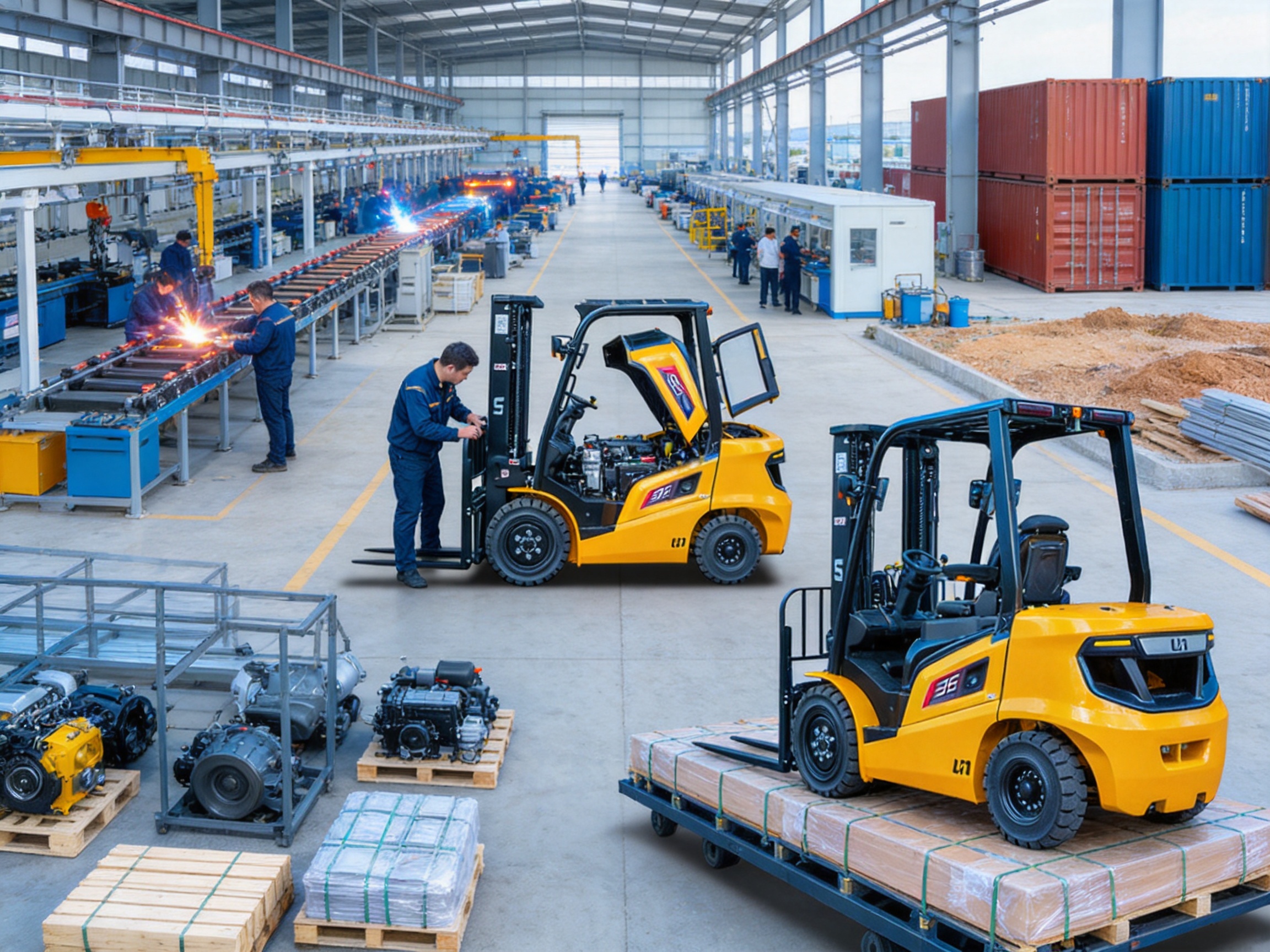
Modern material-handling operations require more than lifting capacity alone. A productive forklift must combine dependable power, precise control, operator comfort, low maintenance requirements, and strong performance in demanding working environments. The F Series 3.0T–3.5T diesel forklift has been developed around these requirements, offering a balanced solution for warehouses, manufacturing plants, logistics centers, construction supply yards, ports, distribution facilities, and other industrial applications.
With rated load capacities from 3,000 to 3,500 kilograms, a 500-millimeter load center, hydraulic transmission, robust chassis, and a choice of recognized diesel engine configurations, the forklift is designed for intensive daily use. Its redesigned exterior is supported by practical engineering improvements, including a narrow-groove steel mast, interactive dashboard, LED lighting, load-sensing steering, stamped overhead guard, waterproof electrical connections, and an operator-focused cabin layout.
The F Series is not simply a lifting machine. It is a complete work platform intended to help businesses move materials faster, operate more safely, and control long-term ownership costs. Its combination of high operating speed, durable construction, stable handling, ergonomic design, and straightforward maintenance gives it a strong position among conventional internal-combustion forklifts in the 3.0T–3.5T class.
1. A Practical Heavy-Duty Forklift for Industrial Applications
Forklifts in the 3.0-ton and 3.5-ton categories are often used where smaller warehouse trucks are not sufficient. Typical loads may include steel products, machinery components, timber, construction materials, packaged goods, industrial equipment, paper rolls, palletized raw materials, and finished products. These applications place considerable demands on the powertrain, mast, axles, frame, hydraulic system, and operator controls.
The F Series has been designed to provide reliable performance across these demanding conditions. The 3,000-kilogram and 3,500-kilogram versions share a common engineering philosophy while offering different capacity levels for customers with varying load requirements. Both versions use a 500-millimeter load center and are specified with a 3,000-millimeter rated lift height in the standard configuration.
A diesel powertrain makes the forklift particularly suitable for outdoor and semi-outdoor operations. Compared with battery-dependent equipment, a diesel forklift can be refueled quickly and returned to work with minimal interruption. This can be valuable in multi-shift operations, loading yards, construction environments, and facilities where long operating cycles are required.
The forklift’s hydraulic transmission provides controlled power delivery and practical operating simplicity. A one-forward, one-reverse transmission arrangement supports straightforward directional changes, while the diesel engine provides the torque needed for starting, ramp work, and heavy-load travel. The maximum travel speed without load is specified at 19 kilometers per hour, giving the machine strong mobility between loading and unloading points.
2. Product Design Focused on Visibility and Durability
The latest F Series design introduces a smooth, streamlined body with a more powerful visual profile. The shape is not merely cosmetic. Carefully arranged body panels, counterweight proportions, and mast geometry help create a coherent machine layout while preserving service access and operator visibility.
The counterweight uses sharp edges and contrasting color treatment to create a distinctive appearance. At the same time, the rear structure performs an essential functional role by balancing the rated load carried at the front of the machine. Proper counterweight design is fundamental to forklift stability, particularly when the truck is transporting heavy loads or working on uneven surfaces.
Dynamic LED taillights contribute to visibility and give the forklift a modern appearance. LED lighting generally offers long service life, low energy consumption, and quick illumination. In busy yards and industrial facilities, clear rear lighting can help other workers and vehicles recognize the forklift’s direction of travel.
The F Series also incorporates a new generation LED lighting system. Depending on the selected configuration, LED lighting can support improved visibility during night work, low-light warehouse operations, loading-bay activity, and outdoor material movement. The lower energy demand of LED components can also reduce replacement frequency compared with conventional lighting systems.
The overhead guard is produced using a stamped construction. This approach helps create a rigid protective structure while maintaining a clean roof profile. The guard is designed to provide protection from falling objects and to support the general durability expected in industrial environments. Its form also works with the mast and operator compartment to preserve a clear forward view.
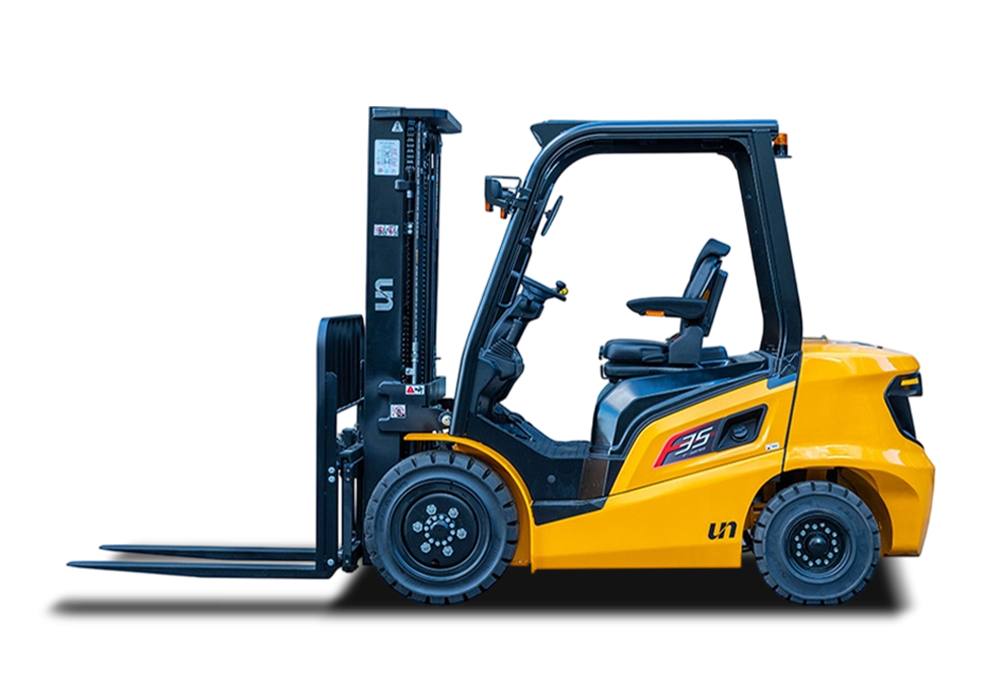
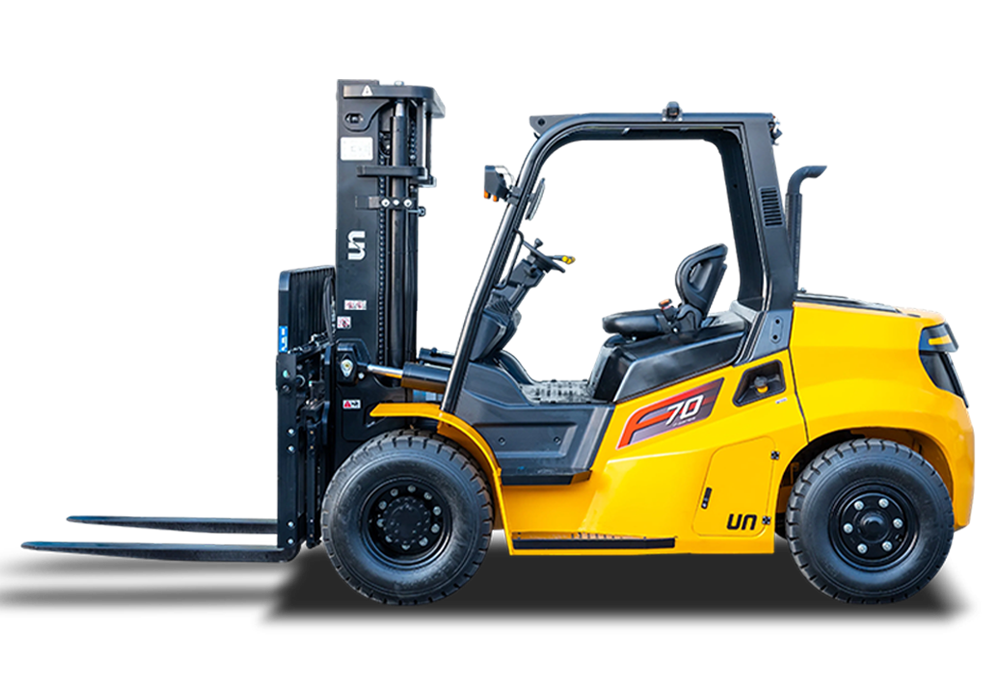
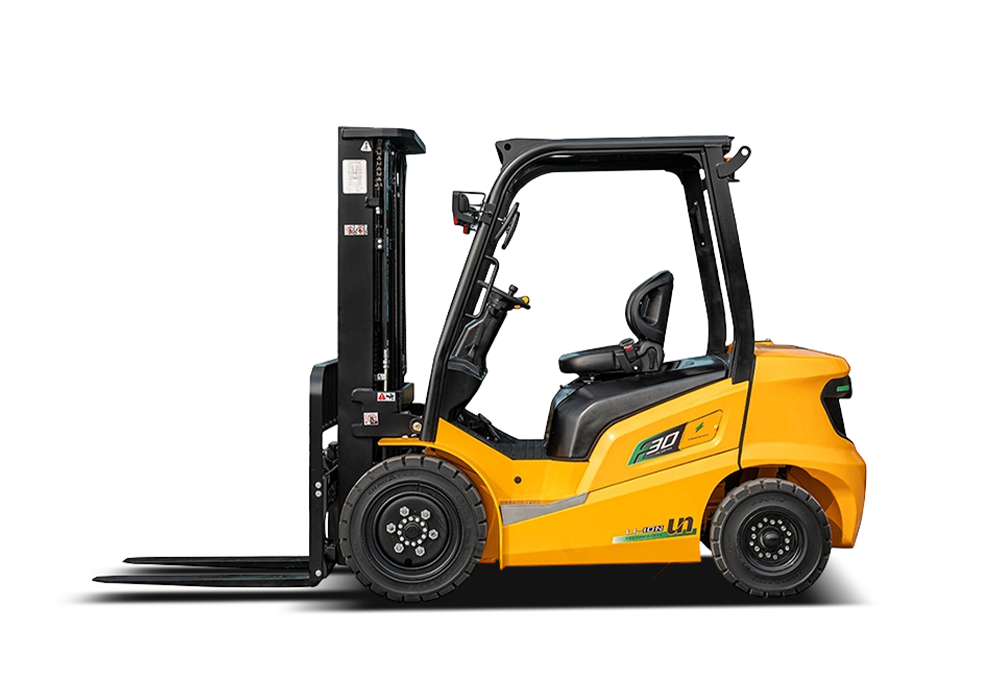
F Series 3.0T-3.5T Diesel Forklift
3. Powertrain Options for Demanding Workloads
Power is one of the most important factors in a heavy-duty forklift. The F Series can be configured with internationally recognized engine options, including Mitsubishi and Kubota engines, as well as other market-specific choices depending on emission regulations and customer requirements. The supplied specifications identify Mitsubishi D04EG and Kubota V2403 configurations for the main model range.
The Mitsubishi D04EG engine is listed with a rated output of 36 kilowatts at 2,250 revolutions per minute and rated torque of 177 newton-meters at 1,800 revolutions per minute. The Kubota V2403 configuration is listed with a rated output of 42.6 kilowatts at 2,400 revolutions per minute and rated torque of 195.6 newton-meters at 1,500 revolutions per minute.
These power levels provide a useful balance between lifting performance, travel capability, fuel economy, and working reliability. The engine choices also allow the forklift to be adapted to different regional regulations and operating preferences. Depending on the market, available specifications may include Stage V, Tier 4 Final, EPA-compliant, European emission, and other approved engine configurations.
Four-cylinder diesel engines are used in the listed configurations. Engine displacement varies according to the selected engine, with the supplied data identifying approximately 3,331 cubic centimeters for the Mitsubishi D04EG and approximately 2,434 cubic centimeters for the Kubota V2403. The different engine options allow buyers to select a configuration that best matches local emissions requirements, fuel availability, service support, and application demands.
The powertrain is supported by a 50-liter or 60-liter fuel tank depending on the specification set and model configuration. A relatively large tank helps extend operating time between refueling stops. This is especially useful for fleet operators who need to maintain productivity during long shifts or who operate equipment at locations where refueling facilities are not immediately adjacent to the work area.
Engine and Powertrain Advantages
The F Series powertrain offers several practical advantages over less capable or less specialized alternatives:
● Diesel torque supports heavy-load acceleration and ramp operation.
● Multiple engine options allow compliance with different regional emission regulations.
● Recognized engine manufacturers support serviceability and parts availability.
● Hydraulic transmission provides familiar operation for experienced forklift drivers.
● A dedicated fuel tank supports extended work cycles.
● The combination of power and chassis balance supports both indoor and outdoor industrial duties.
In comparison with smaller-capacity forklifts, the F Series offers greater reserve capacity for heavy loads. Compared with larger machines, the 3.0T–3.5T format can provide a more practical balance between lifting ability, maneuverability, aisle requirements, purchase cost, and operating space.
4. Strong Lifting Performance and Mast Visibility
The mast is central to forklift productivity and safety. It must lift loads smoothly, maintain structural stability, provide sufficient visibility, and withstand repeated cycles under demanding conditions. The F Series uses a new narrow-groove steel mast designed to reduce overall vehicle weight while improving the operator’s forward view.
A narrower mast profile can help the driver see the load, fork tips, pallet openings, and surrounding traffic more clearly. Better visibility reduces the need for repeated repositioning and can make it easier to align the forks accurately. In busy storage areas, clear sightlines can contribute to more efficient pallet handling and lower the risk of contact with racking, products, or other equipment.
The standard rated lift height is 3,000 millimeters. The supplied specifications also identify free lift heights generally ranging from approximately 120 to 150 millimeters, depending on the model and mast configuration. Mast lowered height is approximately 2,055 to 2,115 millimeters in the listed specifications, while overhead guard height is approximately 2,190 to 2,235 millimeters.
These dimensions allow the forklift to work in many standard industrial environments while maintaining a relatively compact overall profile. Buyers should always verify the exact mast height, overhead guard height, fork dimensions, and residual capacity before placing a machine in a facility with doorway, container, rack, or ceiling restrictions.
The standard fork dimensions vary with capacity and configuration. Listed examples include fork lengths of approximately 1,070 millimeters and widths and thicknesses suitable for the relevant 2.0T through 3.5T model range. For specialized loads, attachment requirements, or non-standard pallets, the fork specification should be confirmed during the ordering process.
Lifting and Handling Characteristics
The F Series 3.0T model is listed with a lifting speed of approximately 485 millimeters per second under full load in one specification set, while the 3.5T model is listed at approximately 468 millimeters per second. Other configuration data may identify different lifting speeds, reflecting engine, mast, hydraulic, or specification variations.
Lowering speed is controlled within a specified range, with the supplied information identifying full-load lowering performance of no more than 600 millimeters per second and no-load performance of at least 300 millimeters per second. Controlled lowering is important for load stability and operator confidence, particularly when handling fragile or high-value materials.
Maximum gradeability varies according to model and configuration. The supplied specifications identify ranges of approximately 19–30 percent for the 3.0T model and 17–26 percent for the 3.5T model under full load. Actual performance depends on tire selection, surface condition, load position, engine configuration, gradient length, and operating practice.
5. Stability, Chassis Strength, and Industrial Mobility
A forklift’s ability to carry a heavy load safely depends on the complete vehicle system rather than lifting capacity alone. The chassis, wheelbase, counterweight, steering axle, tires, mast, hydraulic system, and operator behavior all influence stability. The F Series is engineered as a balanced industrial truck with a wheelbase of approximately 1,700 millimeters for the 3.0T and 3.5T models.
The listed outside turning radius is approximately 2,450 to 2,500 millimeters, depending on the model and configuration. This allows the forklift to operate in many industrial work areas while retaining the structure and counterweight required for heavy loads. The minimum aisle width for pallets is listed at approximately 4,120 to 4,255 millimeters, with the exact requirement determined by the truck configuration, load size, rack layout, and operating method.
Front tread is generally listed at approximately 1,000 millimeters for the 3.0T and 3.5T versions, while rear tread is approximately 980 millimeters. These dimensions help establish a stable working platform and contribute to predictable handling during travel and turning.
Front tires listed for the range include 28 × 9–15 options, while rear tires include 6.50–10 options. Tire selection can be adapted to specific operating conditions. Solid or cushion-style tires may be suitable for certain smooth indoor environments, while pneumatic or heavy-duty tire configurations may be preferred for outdoor yards and uneven surfaces. Customers should choose the final tire specification according to floor condition, debris exposure, traction needs, and operating temperature.
The forklift’s total operating weight is listed at approximately 4,479 kilograms for the 3.0T version and approximately 4,839 kilograms for the 3.5T version in one main specification set. The actual weight can change with engine type, mast, tires, attachments, and optional equipment. This information should be considered when planning transport, floor loading, ramps, and work-area access.
| Specification | 3.0T Model | 3.5T Model |
|---|---|---|
| Rated load capacity | 3,000 kg | 3,500 kg |
| Load center | 500 mm | 500 mm |
| Rated lift height | 3,000 mm | 3,000 mm |
| Overall width | Approximately 1,220 mm | Approximately 1,220 mm |
| Wheelbase | Approximately 1,700 mm | Approximately 1,700 mm |
| Travel speed without load | Up to 19 km/h | Up to 19 km/h |
| Outside turning radius | Approximately 2,450–2,425 mm | Approximately 2,500 mm |
| Total weight | Approximately 4,479 kg | Approximately 4,839 kg |
| Transmission | Hydraulic, 1 forward/1 reverse | Hydraulic, 1 forward/1 reverse |
The table presents representative values from the supplied product information. Final values should be confirmed against the selected model, engine, mast, tire, and attachment configuration.
6. Operator Ergonomics for Long Working Shifts
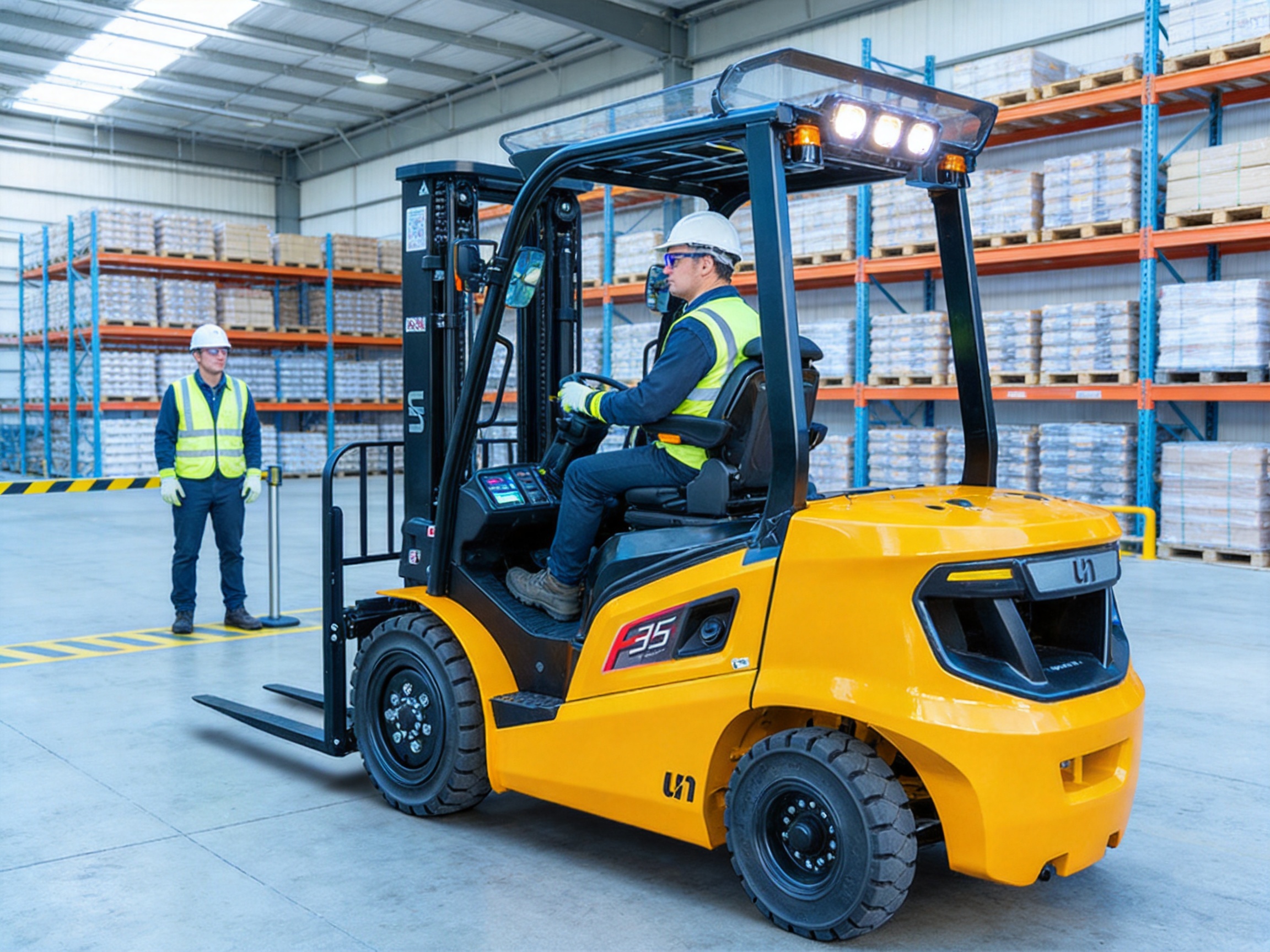
Forklift productivity is strongly influenced by the operator. A machine that is powerful but tiring to use may experience slower cycle times, more handling errors, and greater driver fatigue. The F Series therefore places significant emphasis on the operator’s workspace.
The wide-view mast supports a broader forward field of vision. This is useful when approaching pallets, positioning forks, stacking materials, and traveling with a raised or partially raised load. Better visibility can reduce unnecessary body movement and minimize the need for the driver to repeatedly lean or look around structural components.
A suspended seat helps reduce vibration transmitted from the chassis to the operator. This feature is especially valuable when the forklift travels over yard surfaces, loading ramps, expansion joints, or uneven industrial floors. The seat can be adjusted to suit different operators, supporting a more natural driving position.
The spacious foot area makes it easier for operators to enter and exit the vehicle. It also provides room for comfortable pedal operation during long shifts. Convenient access is important in applications where drivers frequently leave the truck to inspect loads, attach equipment, communicate with warehouse personnel, or complete safety checks.
The steering column is adjustable, allowing operators to select a suitable steering position. A compact steering wheel reduces the amount of arm movement required during steering input and can make repeated maneuvering less demanding. This is particularly beneficial in applications involving frequent reversing, tight turns, or repeated pallet alignment.
The new ratchet handbrake is designed to reduce operating force. A handbrake that is easy to engage and release can improve convenience during frequent stops while still providing a positive parking function. Every control improvement can contribute to reduced fatigue when multiplied across hundreds of operating cycles.
The interactive dashboard provides real-time monitoring of operating information. The dashboard can help the operator observe machine status and identify important indicators during operation. Clear information supports preventive attention to temperature, warning signals, service requirements, and other operating conditions.
7. Safety and Reliability Features
Safety is a fundamental requirement for every industrial truck. The F Series incorporates several features intended to support safe operation, protect critical components, and reduce the likelihood of unintended machine activity.
The stamped overhead guard provides a durable protective structure above the operator. It is designed to help shield the operator from falling objects while maintaining an open and practical viewing area. The overhead guard must be used together with correct operating procedures, appropriate load handling, and facility-specific safety rules.
Key electrical connectors and joints are waterproof. Protection from moisture, dust, and contamination can help improve electrical reliability in outdoor yards, humid facilities, wash-down areas, and changing weather conditions. Waterproofing also supports longer service life for electrical components by reducing the possibility of corrosion or moisture-related faults.
The OPS system is designed to prevent unintended forklift startup. Such an operator-presence system can help prevent movement when the operator is not correctly positioned in the seat or when specified operating conditions are not met. It is an additional protective measure and does not replace training, supervision, inspection, or safe operating procedures.
Load-sensing steering is another important feature. The system adjusts hydraulic flow according to steering demand, which can contribute to smoother steering response and improved energy efficiency. It may also help maintain more consistent steering performance across different operating conditions.
LED lighting contributes to visibility around the truck. The lighting system can help the operator see work areas more clearly and can make the forklift more visible to pedestrians and other vehicles. Worksites should still use adequate general lighting, marked traffic routes, warning systems, and pedestrian separation where required.
Safety Through Design and Process Control
Safety does not result from one component alone. It depends on the integration of structural design, hydraulic control, visibility, operator ergonomics, electrical protection, manufacturing quality, and user training. The F Series reflects this integrated approach by combining a protective overhead guard, wide-view mast, interactive dashboard, waterproof connectors, OPS system, controlled hydraulic functions, and stable chassis geometry.
Fleet owners can further improve safety by establishing daily inspection procedures. These should include checking tires, forks, mast chains, hydraulic hoses, steering, brakes, warning lights, seat condition, overhead guard integrity, fluid levels, and any visible leaks or damage. Operators should not use a forklift if a condition could compromise safe performance.
8. Easy Maintenance and Lower Downtime
Maintenance access has a direct influence on fleet availability. If routine inspections and service tasks are difficult, they may take longer or be postponed. The F Series addresses this concern with detachable side panels and a large-opening engine hood.
Detachable side panels make cleaning and inspection more convenient. They can provide improved access to components located along the sides of the machine, allowing technicians to identify dust buildup, fluid leaks, damaged wiring, loose fasteners, and other conditions more quickly.
The large opening angle of the engine hood gives service personnel improved access to the engine compartment. This can simplify routine checks of oil, coolant, belts, filters, battery connections, hoses, and other components. Easier access may reduce service time and help technicians complete preventive maintenance more thoroughly.
Preventive maintenance is particularly important for diesel forklifts used in intensive applications. Regular oil and filter replacement, cooling-system inspection, fuel-system maintenance, hydraulic-fluid checks, transmission service, tire inspection, and mast lubrication can help preserve performance and extend machine life.
The recognized engine options also contribute to service practicality. Mitsubishi and Kubota engines are widely known in industrial equipment markets, and their use can help customers access trained technicians and replacement parts in many regions. Availability depends on the local market and the final engine configuration, so service support should be confirmed before purchase.
Maintenance planning should consider the operating environment. A forklift used outdoors in dusty conditions may require more frequent air-filter cleaning than a truck used in a clean indoor facility. A truck working near salt, fertilizer, chemicals, or moisture may require additional attention to corrosion prevention and electrical protection. The F Series provides a strong base, but correct maintenance intervals remain essential.
9. Manufacturing Strength and Engineering Capability
The F Series is produced by Zhejiang UN Forklift Co., Ltd., a material-handling equipment manufacturer integrating research and development, production, sales, and service. The company was founded in 1978 and operates a production base covering approximately 53,400 square meters, with an annual production capacity identified as approximately 15,000 units.
Long-term experience in forklift production provides an important foundation for product development. A manufacturer with decades of industry participation can accumulate knowledge across chassis design, mast engineering, hydraulic systems, powertrains, electrical controls, operator ergonomics, manufacturing quality, and field service.
The company’s product portfolio includes internal-combustion forklifts, electric forklifts, warehouse equipment, rough-terrain forklifts, and other material-handling solutions. This broad range can support customers that require several types of equipment across one facility or multiple locations.
The manufacturing process behind a heavy-duty forklift requires coordinated control of many stages. These may include engineering design, steel preparation, frame fabrication, welding, machining, surface treatment, painting, component assembly, hydraulic installation, electrical integration, engine installation, testing, and final inspection.
Structural Fabrication and Welding
The frame and counterweight must maintain dimensional accuracy and structural strength under repeated load cycles. Controlled fabrication and welding processes help ensure that major components are assembled according to engineering specifications. Consistent weld quality is essential because the chassis carries dynamic loads during lifting, braking, turning, and travel over uneven surfaces.
The mast also requires careful fabrication and alignment. Rail straightness, roller adjustment, chain installation, carriage alignment, and hydraulic-cylinder positioning all influence lifting smoothness and load stability. A narrow-groove mast must be manufactured precisely because reduced structural width places greater importance on dimensional consistency and component fit.
Hydraulic and Electrical Integration
The hydraulic system must deliver lifting, lowering, tilting, steering, and attachment functions in a controlled manner. Proper assembly cleanliness is important because contamination can damage valves, pumps, cylinders, and other components. Pressure testing and operational testing help confirm that the system performs correctly before the forklift leaves the factory.
Electrical integration includes the dashboard, lighting system, sensors, OPS controls, wiring harnesses, connectors, switches, and battery connections. Waterproof connectors and protected routing can help reduce the risk of moisture-related failures. Functional testing verifies that indicators, lighting, starting controls, safety systems, and warning functions operate as intended.
Testing and Quality Assurance
Industrial forklifts should undergo inspection and testing before delivery. Typical quality-control activities may include checking dimensions, fastener torque, weld appearance, hydraulic pressure, mast movement, fork alignment, steering response, braking performance, travel speed, engine operation, lighting, warning indicators, and safety-system behavior.
Testing is especially important for a forklift offered with multiple model, engine, mast, and tire configurations. Each configuration can affect overall weight, balance, performance, and dimensions. A controlled production and inspection process helps ensure that the delivered truck corresponds to the ordered specification.
The company’s international sales and service network, with partners in Europe, South America, North America, Africa, and Asia, supports the goal of serving customers across different markets. International distribution also requires attention to regional safety standards, emission requirements, documentation, spare parts, and technical support.
10. Competitive Advantages in the 3.0T–3.5T Class
The F Series competes in a segment where customers often compare several diesel forklift brands based on price, rated capacity, reliability, serviceability, fuel consumption, operator comfort, and resale value. Its competitive position is based on the combination of features rather than a single headline specification.
Balanced Capacity and Maneuverability
A 3.0T–3.5T forklift offers a useful middle ground. It can handle significantly heavier loads than compact warehouse trucks while remaining more maneuverable and space-efficient than larger 4.0T–5.0T machines. This balance is attractive to companies that handle heavy pallets but still need to work within established aisle and loading-bay dimensions.
Choice of Recognized Engines
Offering Mitsubishi and Kubota engine options gives customers flexibility. Buyers can select a power unit according to emission regulations, local service capability, fuel characteristics, and operating preferences. This is a practical advantage over equipment that is available with only one engine configuration or an engine with limited service support in the customer’s region.
Improved Operator Environment
The suspended seat, adjustable steering column, small steering wheel, spacious foot area, wide-view mast, interactive dashboard, and low-force ratchet handbrake create a more comfortable working environment. These details are important because operators spend many hours in the truck and directly influence productivity, safety, and equipment care.
Practical Safety Package
The combination of stamped overhead guard, waterproof electrical connections, OPS system, load-sensing steering, LED lighting, and broad mast visibility provides a comprehensive safety-oriented design. Competing products may offer some of these features, but the value of the F Series lies in bringing them together in a standard industrial truck platform.
Maintenance Accessibility
Detachable side panels and a large engine-hood opening help reduce the inconvenience of daily maintenance. Easier service access can support more regular inspections and reduce avoidable downtime. This is particularly valuable for fleets that operate across several shifts or in locations where technical labor is costly.
International Application Potential
The availability of different engine and emission configurations makes the F Series suitable for a wide range of markets. The manufacturer’s experience with overseas customers and international service networks further supports its use in global supply chains, export-oriented factories, and multinational industrial operations.
11. Recommended Applications
The F Series 3.0T–3.5T diesel forklift is suitable for a broad range of material-handling tasks.
In manufacturing plants, it can transport raw materials, production components, molds, finished goods, and packaging materials. Its lifting capacity is suitable for many industrial pallets and fabricated products, while its relatively compact dimensions support movement through production and storage zones.
In logistics and distribution centers, the forklift can load and unload trucks, reposition palletized goods, and transfer materials between docks and storage areas. The 19-kilometer-per-hour no-load travel speed supports efficient movement across larger yards, while the hydraulic transmission provides familiar directional control.
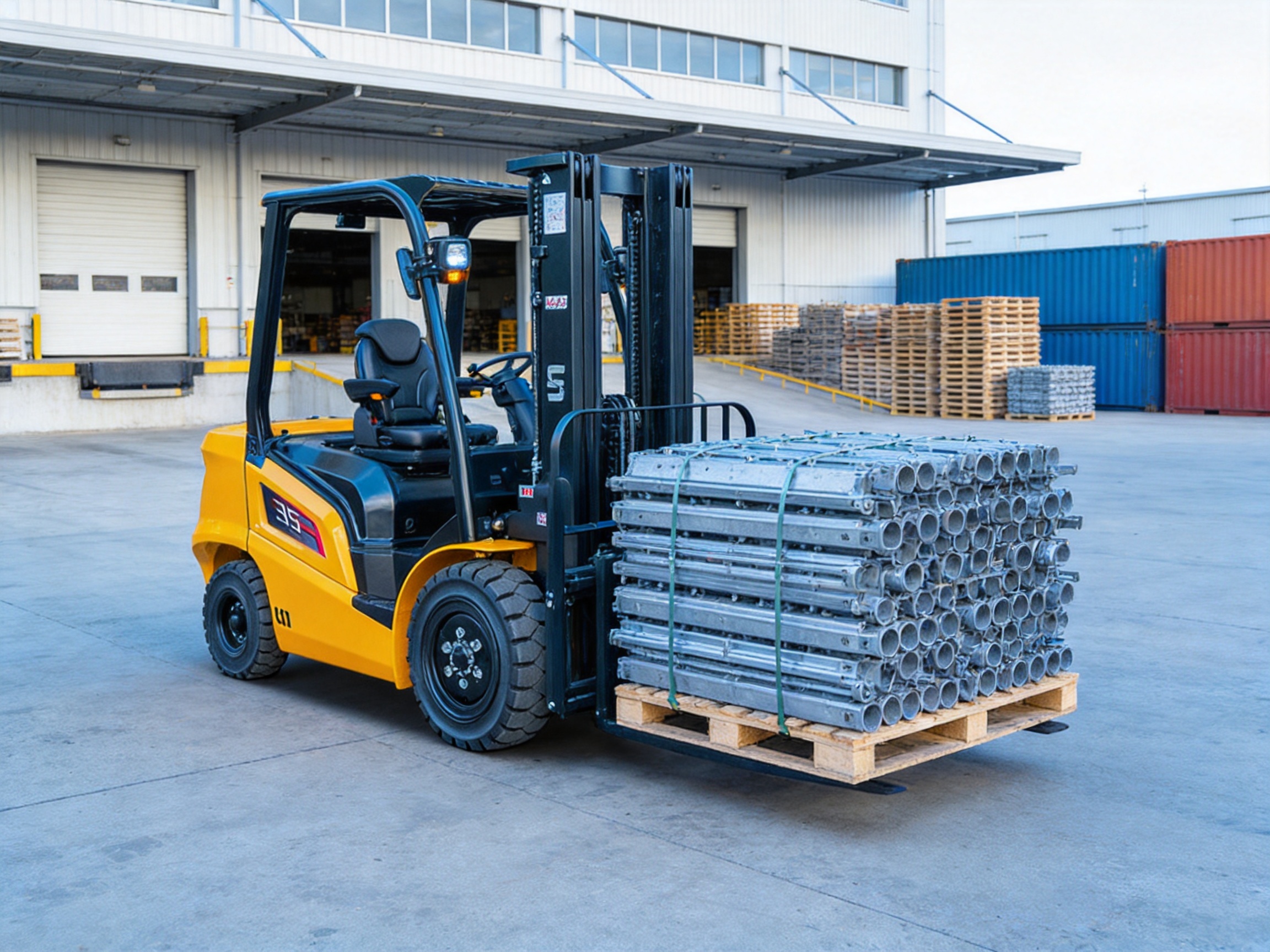
In construction-material yards, the diesel powertrain and robust chassis make the forklift suitable for outdoor work involving concrete products, steel, timber, blocks, pipes, and building materials. Tire selection should be matched to the surface and the expected level of debris.
In metalworking and machinery factories, the 3.0T and 3.5T capacities can support the handling of components and equipment that exceed the capability of smaller electric warehouse trucks. Fork protection, load stability, and attachment compatibility should be evaluated for specialized loads.
In agricultural and food-processing supply operations, the forklift can move packaged materials, pallets, feed, fertilizer, containers, and equipment. Where the operating environment is wet, dusty, or corrosive, the maintenance program should be adapted accordingly.
For container yards, ports, and outdoor distribution areas, diesel operation provides long working cycles and quick refueling. However, operators should verify height limitations, ground conditions, emission rules, and the required attachment or fork configuration before deployment.
12. Selecting the Correct Configuration
Customers should select the forklift according to the actual load profile rather than rated capacity alone. Important considerations include maximum load weight, load dimensions, load center, lift height, pallet design, floor condition, travel distance, operating hours, temperature, gradient, and required attachments.
A 3.0T forklift may be appropriate when the normal load is below 3,000 kilograms and the application benefits from a slightly lower operating weight or more economical configuration. A 3.5T forklift may be preferred when heavier loads are common or when the operation requires greater capacity reserve.
Load center is critical. The stated capacity is based on a 500-millimeter load center. If the load center is greater than 500 millimeters, the effective capacity may be lower. Long, uneven, or liquid loads can shift the center of gravity and must be assessed carefully.
Mast selection should be based on the highest required lift height and the available overhead clearance. The standard 3,000-millimeter lift height may suit many applications, but higher or specialized mast arrangements may be needed for high-rack storage or container work. The lowered mast and overhead guard dimensions must be checked against doorways, mezzanines, trailers, and building entrances.
Fork length and size should correspond to pallet dimensions and load support requirements. Forks that are too short may not support a load safely, while forks that are unnecessarily long may reduce maneuverability or create clearance issues.
Attachments can change the truck’s weight, load center, visibility, hydraulic demand, and residual capacity. Attachment requirements should therefore be specified before purchase. The supplied information identifies operating pressures of approximately 18.5 megapascals for attachments in many configurations, with some specifications identifying approximately 20.5 megapascals. Final attachment compatibility should be confirmed with the manufacturer.
13. Operating Cost and Total Ownership Considerations
The purchase price is only one part of forklift ownership cost. Fuel, maintenance, tires, downtime, operator productivity, parts, training, and resale value all influence the total cost over the machine’s working life.
The F Series is designed to support cost control through durable construction, recognized engine options, practical access panels, efficient LED lighting, load-sensing steering, and a serviceable hydraulic and mechanical layout. These features can help reduce avoidable delays and make routine maintenance more manageable.
Fuel consumption depends on engine specification, load, travel distance, idle time, tire condition, operator technique, surface quality, and maintenance status. Operators who avoid unnecessary idling, maintain steady travel, plan routes, and use the correct lifting technique can often improve fuel efficiency and reduce component wear.
Downtime can be more expensive than fuel consumption in a high-throughput operation. A forklift that is unavailable during a loading window may delay trucks, production lines, or warehouse dispatches. Preventive maintenance, daily inspections, genuine replacement parts, and trained technicians are therefore central to controlling operating cost.
Ergonomics also influence total ownership cost. A comfortable operator environment can support better concentration, fewer handling errors, and more consistent productivity. Features such as the suspended seat, adjustable steering column, clear dashboard, and easy-access foot space may provide benefits that are not immediately visible in a simple purchase-price comparison.
14. Recommended Maintenance Program
A daily pre-operation inspection should be completed before the forklift enters service. The operator should examine the forks, carriage, mast, chains, hydraulic hoses, tires, wheels, steering, brakes, lights, horn, seat, overhead guard, warning indicators, and visible fluid levels.
Engine oil, coolant, hydraulic oil, fuel, battery condition, and transmission fluid should be checked according to the maintenance schedule. Any unusual noise, vibration, smell, leak, warning light, or change in operating behavior should be reported immediately.
Weekly or periodic checks should include lubrication points, mast rollers, chain condition, tire pressure where applicable, fasteners, steering components, brake adjustment, radiator cleanliness, air-filter condition, and electrical connections.
Scheduled service should be completed at the intervals specified for the exact engine and truck configuration. Emission-controlled engines may require particular attention to filters, sensors, exhaust components, and approved lubricants. Service records should be retained to support reliability analysis, warranty administration, and future resale.
Cleaning is also important. Dust, metal particles, packaging debris, mud, and oil contamination can affect cooling, braking, visibility, and electrical reliability. The detachable side panels make it easier to clean and inspect areas that may otherwise be difficult to reach.
15. Environmental and Regulatory Considerations
Diesel forklifts remain valuable for heavy-duty applications, especially where long operating hours, outdoor mobility, and quick refueling are important. At the same time, customers must consider local emissions requirements, indoor air quality, noise limits, and environmental policies.
The F Series can be specified with engine options designed for different emission markets, including high-emission-standard configurations identified in the supplied product information. Customers should confirm that the selected engine meets the regulations applicable at the intended operating location.
Indoor use requires careful assessment of ventilation and emissions. In some facilities, electric or lithium-ion forklifts may be preferred for indoor work, while diesel trucks remain suitable for outdoor yards or well-ventilated areas. A mixed fleet can be an effective strategy when a business has both indoor warehouse and outdoor heavy-duty requirements.
Responsible operation also includes minimizing unnecessary idling, maintaining the engine correctly, preventing oil and fuel leaks, and disposing of filters and used fluids through approved channels.
16. Company Capabilities and Product Development
Zhejiang UN Forklift Co., Ltd. has developed a broad material-handling portfolio supported by research and development, production, sales, and service capabilities. The company’s history includes the development of reach forklift and very-narrow-aisle truck products in China, as well as participation in electric forklift technology and industry standards.
The company has also expanded its new-energy product development in response to global attention toward carbon emissions. Its portfolio includes diesel-to-lithium-ion forklift concepts and standard lithium-ion battery forklifts, alongside internal-combustion models that meet higher emission requirements.
This broader development capability is relevant to customers planning long-term fleet strategies. A business may begin with diesel forklifts for outdoor heavy-duty work and later add electric or lithium-ion equipment for indoor applications. Working with a manufacturer that supplies different power types can simplify fleet expansion and technical coordination.
The company’s reported international network includes partners across Europe, South America, North America, Africa, and Asia. For export customers, regional support is an important consideration because it affects parts supply, service response, operator training, warranty handling, and technical communication.
17. Frequently Asked Questions
Q1: What is the rated capacity of the F Series 3.0T–3.5T forklift?
The range includes models with rated load capacities of 3,000 kilograms and 3,500 kilograms. The standard load center identified in the supplied specifications is 500 millimeters. Actual capacity must be evaluated according to the load center, mast height, attachment, and configuration.
Q2: What type of powertrain does the forklift use?
The forklift uses a diesel engine with hydraulic transmission. Mitsubishi D04EG and Kubota V2403 engine configurations are identified in the main specifications, while additional engine options may be available for specific emission markets and customer requirements.
Q3: What is the standard lift height?
The standard rated lift height listed for the range is 3,000 millimeters. Other mast options may be available. Customers should confirm the required lift height, free lift, lowered height, extended height, and overhead clearance before ordering.
Q4: Is the forklift suitable for outdoor use?
Yes. The diesel powertrain, industrial chassis, hydraulic transmission, and available heavy-duty tire configurations make it suitable for many outdoor applications. Surface conditions, weather exposure, tire selection, emission regulations, and maintenance requirements should be evaluated for each site.
Q5: What features improve operator comfort?
The forklift includes a suspended seat, spacious foot area, adjustable steering column, compact steering wheel, wide-view mast, interactive dashboard, and a ratchet handbrake designed to reduce operating force. These features are intended to reduce fatigue and support more efficient operation during long shifts.
Q6: How does the forklift support safety?
Safety-oriented features include a stamped overhead guard, waterproof key connectors and joints, OPS operator-presence protection, load-sensing steering, LED lighting, broad mast visibility, controlled hydraulic functions, and a stable chassis design. These features must be combined with operator training and proper workplace procedures.
Q7: Is maintenance access convenient?
The F Series uses detachable side panels and a large-opening engine hood to make inspection, cleaning, and service access easier. Routine maintenance should still be performed according to the exact engine and forklift service schedule.
Q8: What are the main advantages over smaller forklifts?
The F Series provides greater lifting capacity, stronger diesel torque, higher load-handling capability, and improved suitability for outdoor or heavy industrial work. It remains more compact and maneuverable than many higher-capacity forklifts in the 4.0T–5.0T class.
Q9: Can attachments be installed?
Attachments may be available, with the supplied specifications identifying hydraulic operating pressures of approximately 18.5 megapascals in many configurations. Attachment selection must account for hydraulic flow, pressure, weight, load center, visibility, and residual capacity.
Q10: How should buyers choose between the 3.0T and 3.5T models?
The decision should be based on the heaviest regular load, load center, required lift height, operating conditions, and desired capacity reserve. The 3.0T model may be suitable for loads up to 3,000 kilograms, while the 3.5T model provides additional rated capacity for heavier applications.
Q11: Can the forklift be used inside a warehouse?
It can be used in suitable, well-ventilated indoor environments, but customers should consider emissions, ventilation, noise, aisle width, floor condition, and local regulations. For enclosed warehouses with strict air-quality requirements, electric or lithium-ion equipment may be more appropriate.
Q12: What should be confirmed before placing an order?
Customers should confirm the exact model, engine, emission standard, mast, lift height, fork size, tire type, attachment requirements, overall dimensions, overhead guard height, operating weight, delivery configuration, warranty terms, spare-parts support, and local service arrangements.
18. Conclusion
The F Series 3.0T–3.5T diesel forklift is designed for businesses that need dependable heavy-duty handling without moving to a much larger and less maneuverable truck. Its main strengths include 3,000- to 3,500-kilogram rated capacity, diesel torque, hydraulic transmission, recognized engine options, narrow-groove mast design, strong visibility, practical dimensions, operator-focused ergonomics, safety systems, and accessible maintenance points.
Its competitive value comes from the integration of these features. The forklift combines performance and durability with a modern exterior, improved operator environment, controlled hydraulic functions, and international configuration flexibility. It can serve manufacturing, logistics, construction, outdoor distribution, machinery, agricultural, and general industrial applications.
Behind the product is a manufacturer with decades of forklift experience, integrated research and development, production and service capabilities, a broad product range, international partners, and ongoing investment in both internal-combustion and new-energy equipment. This provides customers with more than a single forklift model; it provides access to a wider material-handling platform.
For buyers comparing heavy-duty forklifts, the final selection should be based on verified application data and the exact truck configuration. When correctly specified, operated, and maintained, the F Series can provide a practical combination of productivity, safety, serviceability, and long-term industrial value.
References
1. Product specification and feature information supplied for the F Series 3.0T–3.5T diesel forklift.
2. Manufacturer-provided technical data covering rated capacity, dimensions, performance, chassis, powertrain, and transmission.
3. Manufacturer company profile and corporate capability information supplied for Zhejiang UN Forklift Co., Ltd.
4. General industrial forklift safety and operator training principles.
5. General preventive-maintenance practices for diesel-powered material-handling equipment.
6. General engineering principles for forklift load centers, mast capacity, stability, and attachment selection.
Product: F Series 3.0T-3.5T Diesel Forklift

For exclusive deals and latest offers, sign up by entering your email address below.
Stay In Touch
ADDRESS : NO.1 ROAD ONE, XINDENG NEW DISTRICT, FUYANG, HANGZHOU, ZHEJIANG, CHINA 311404.
PHONE : +86-571-8688 8355 (AMERICA)
PHONE : +86-571-8886 9363 (EUROPE)
PHONE : +86-571-8688 8377 (ASIA, AFRICA, OCEANIA)
EMAIL : [email protected]
EMAIL : [email protected](PARTS INQUIRY)

