


 中文简体
中文简体 Français
 русский
 Español
 عربى
عربى Deutsch



SL130 Skid Steer Loader: Compact Power, Multi-Task Versatility, and Confident Operation
Admin 2026-09-25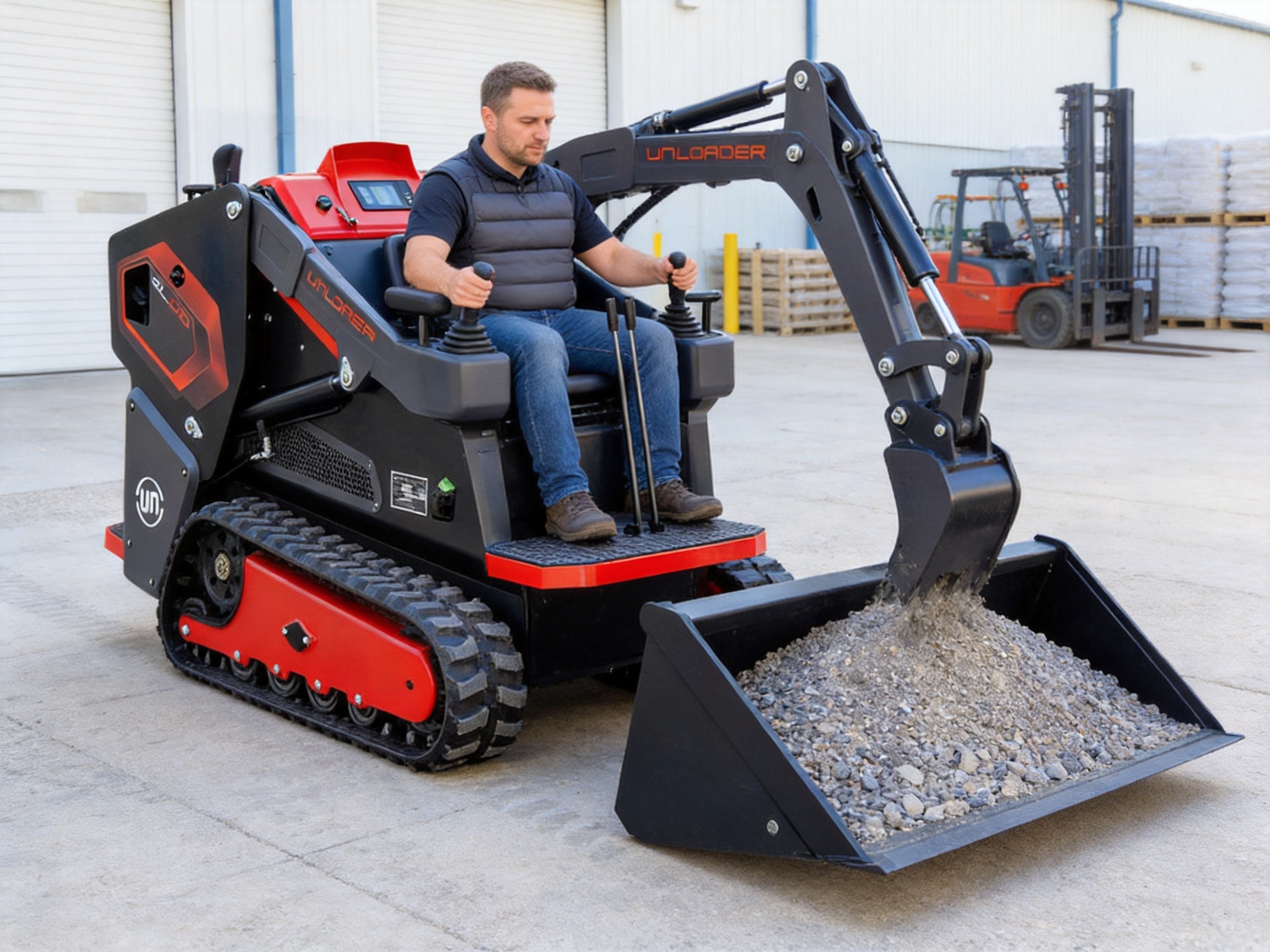
Modern construction, agricultural, municipal, and material-handling operations increasingly require equipment that can perform many tasks without occupying a large amount of space. A machine may need to move soil in one work area, handle pallets in another, clear snow during winter, and support maintenance or landscaping work later in the day. Purchasing a separate machine for every application can increase capital costs, storage requirements, maintenance obligations, and operator training demands.
The SL130 skid steer loader is designed to address these challenges with a compact tracked platform, a diesel engine, high maneuverability, and compatibility with a broad selection of attachments. It is intended for loading and short-distance transportation of bulk materials such as grain, soil, sand, aggregates, coal, waste, and similar materials. Its compact dimensions allow it to work in areas where a conventional loader or larger construction machine may be difficult to position.
With a rated operating capacity of 1,300 pounds, a Kubota D1105 diesel engine, a 200 mm-wide rubber track system, and a zero-radius turning capability, the SL130 combines the access advantages of a compact machine with the practical functionality expected from a working loader. Its design also places emphasis on attachment flexibility, operator comfort, control stability, visibility of key operating information, and essential safety controls.
A Compact Loader for Demanding Work Environments
A skid steer loader is valuable because it can combine lifting, carrying, grading, sweeping, clearing, and material-handling functions on one compact chassis. Unlike larger wheel loaders, compact skid steer loaders can enter narrow passages, confined yards, small construction sites, warehouse areas, agricultural buildings, and landscaping projects with fewer access limitations.
The SL130 is particularly suited to applications where maneuverability is as important as lifting performance. Its overall width is approximately 42 inches, or 1,057 mm, while its height is approximately 51 inches, or 1,307 mm. These dimensions make it suitable for work in restricted areas and allow operators to approach stockpiles, walls, racks, gateways, and other obstacles with greater confidence.
The machine’s compact format also simplifies transport and storage. A smaller loader can often be moved between work areas with less logistical effort than a full-size loader. It can be stored in a workshop, equipment shed, warehouse service area, or other location where larger machines may not fit. For contractors, farms, rental companies, and facility operators, this can help reduce downtime between jobs.
Compact size does not mean the machine is limited to light-duty applications. The SL130 has a rated operating capacity of 1,300 pounds, or 590 kg. This provides practical lifting capability for many common tasks, including handling loose materials, moving bagged products, carrying tools and supplies, transporting snow, and loading or unloading smaller quantities of bulk material.
Zero-Radius Maneuverability in Restricted Spaces
One of the most important advantages of a skid steer loader is its ability to turn within its own footprint. The SL130 uses a skid-steer drive layout that enables zero-radius 360-degree turning. Instead of requiring a wide turning arc, the machine can pivot in place by varying the speed and direction of the tracks on each side.
This capability is especially useful in narrow work zones. Operators can reposition the loader beside a wall, turn between stored materials, approach a pile from different angles, and change direction without making repeated forward-and-reverse corrections. In a warehouse yard, agricultural building, or small construction site, the ability to turn in place can improve productivity while reducing unnecessary travel.
The published turning radius is approximately 61 inches, or 1,537 mm, with the standard bucket and approximately 32 inches, or 804 mm, without the standard bucket. These figures illustrate how the attachment selected for the job affects operating geometry. When the bucket is removed or replaced with a compact attachment, the machine can operate even closer to obstacles and in tighter spaces.
Compared with conventional loaders that rely on a larger steering arc, the SL130 can offer a significant access advantage in compact work areas. It is not necessary to claim that every job will be completed faster, because productivity depends on the operator, material, attachment, and site conditions. However, the machine’s turning design reduces the physical space required for repositioning and can reduce non-productive maneuvering time.
The quick response of the tracked drive system also supports smooth transitions between loading, reversing, turning, and placing operations. For experienced operators, this makes the machine responsive during repetitive work cycles. For new operators, the compact footprint can make it easier to understand the relationship between the machine, its attachment, and nearby objects.
Tracked Stability and Ground Contact
The SL130 is equipped with 200 mm-wide rubber tracks. Tracks provide a different operating profile from conventional tires. They distribute the machine’s weight over a longer ground-contact area, which can support stability and traction on suitable surfaces. Rubber tracks are also useful where reduced ground disturbance is preferred compared with narrower or harder-wearing wheel arrangements.
The machine’s ground contact length is approximately 38 inches, or 963 mm. Combined with the tracked undercarriage, this contact length helps provide a stable base during loading and short-distance transport. Stability is important when the operator is carrying material, working near a pile, approaching a ramp, or maneuvering on uneven ground.
Tracked equipment can be particularly useful in agriculture, landscaping, construction preparation, and grounds maintenance, where the working surface may vary from compacted soil to gravel, grass, or unfinished ground. Actual performance will always depend on soil conditions, slope, moisture, load distribution, and track condition. Operators should follow the applicable safety instructions and avoid using the machine beyond its rated capacity or operating limits.
The rubber-track configuration also complements the SL130’s compact geometry. The machine can combine low-speed traction, stable positioning, and tight turning in a package that is easier to place in a narrow work area than many larger loaders. This balance is one of the principal reasons compact skid steer loaders are used across such a broad range of industries.
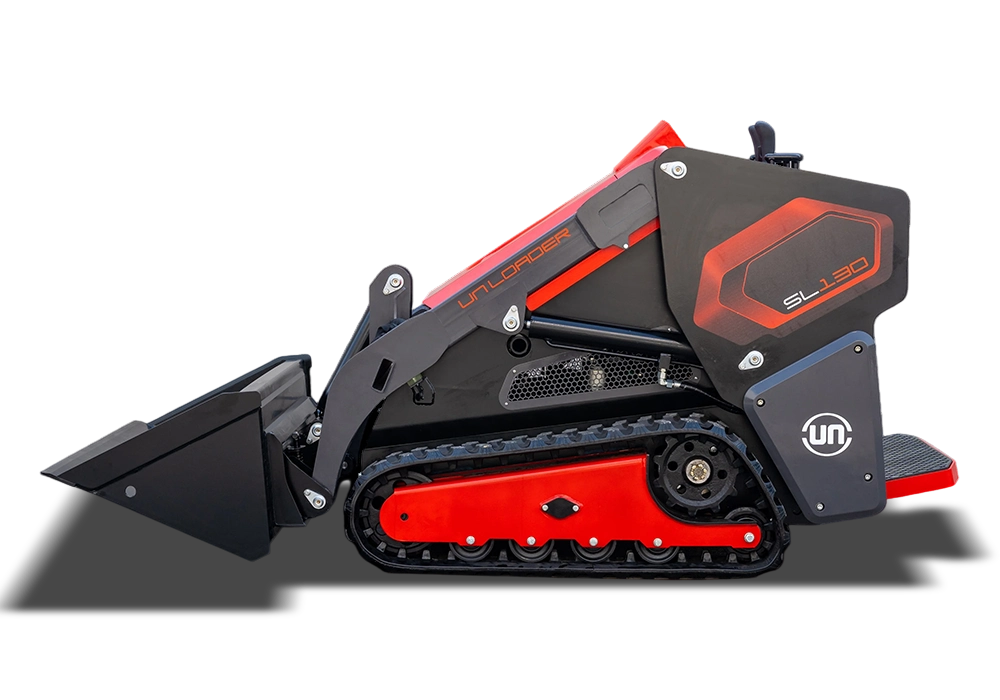
SL130 Skid Steer Loader
Box-Type Boom Strength and Load Support
The SL130 uses a box-type boom structure. A boom must support the attachment and the carried load while also managing the forces created during lifting, dumping, pushing, and travel. A box-type structural arrangement is intended to provide enhanced strength and load-bearing capability within the compact machine design.
The boom is central to the loader’s usefulness. Whether the attachment is a bucket, fork, sweeper, snow blower, or grapple bucket, the boom transfers hydraulic and mechanical forces between the machine and the working tool. A robust boom structure can contribute to confidence during repetitive loading cycles and help the machine maintain a practical balance between compact dimensions and working capability.
The rated operating capacity of 1,300 pounds should be treated as an important operating limit rather than a target to exceed. The actual safe load depends on attachment weight, load position, terrain, boom position, travel conditions, and the machine’s stability. Operators should keep loads controlled and follow the manufacturer’s operating guidance when handling materials at height or on uneven ground.
In comparison with improvised or lightly constructed compact equipment, a purpose-designed box-type boom offers a more suitable foundation for regular material-handling work. It supports the machine’s role as a genuine loader rather than a basic transport platform. This is especially relevant for users who expect to change attachments and perform different tasks throughout the day.
Versatility Through Attachment Compatibility
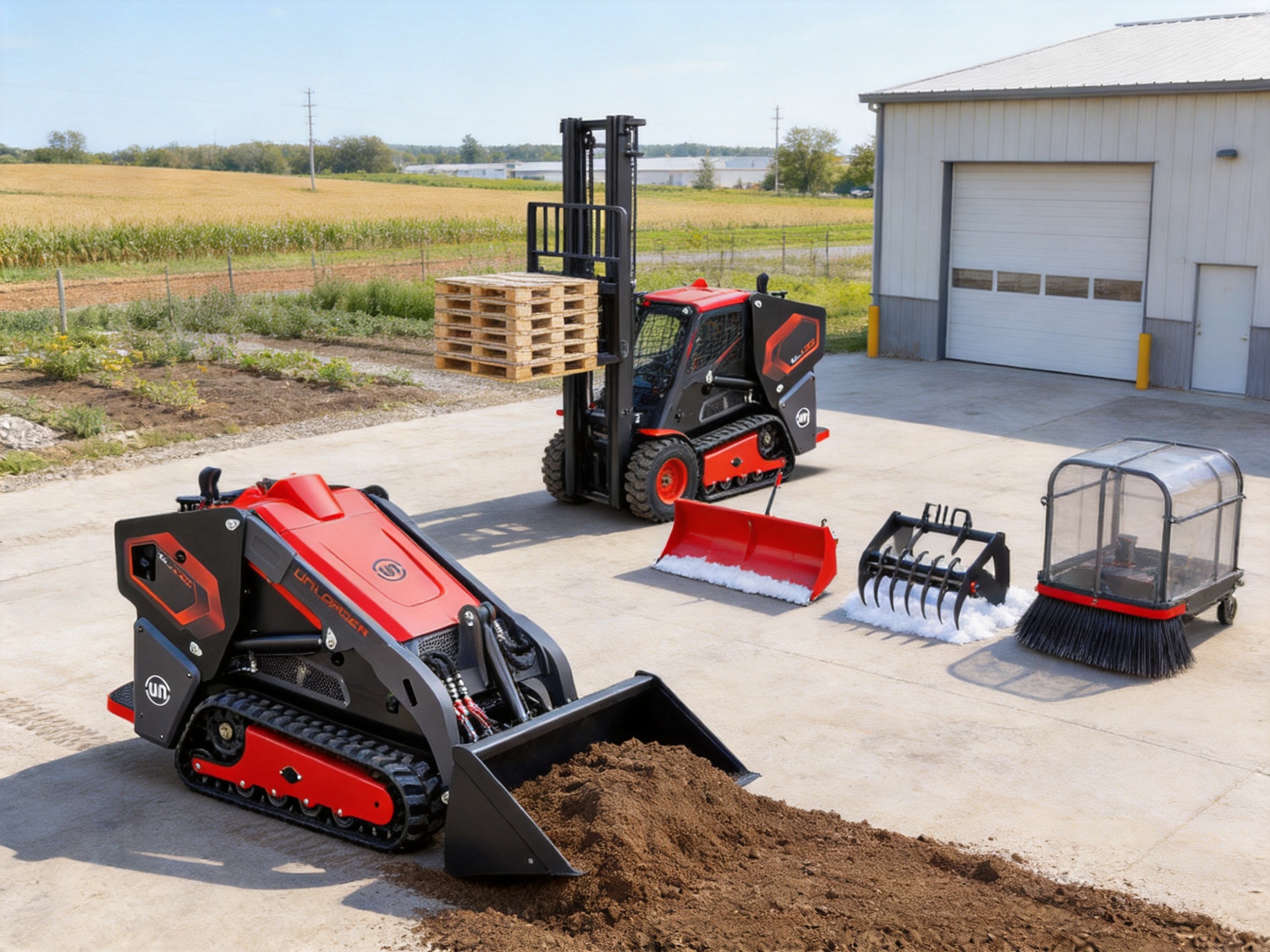
The SL130 is designed to work with multiple attachments, including buckets, forks, snow plows, enclosed sweepers, snow blowers, grapple buckets, and other compatible tools. Attachment compatibility changes the loader from a single-purpose machine into a flexible work platform.
A standard bucket can be used for soil, sand, grain, aggregates, snow, waste, and other loose materials. Fork attachments can support the handling of pallets, packaged goods, lumber, equipment, and other loads when used within the appropriate capacity and stability limits. A grapple bucket can help manage irregular materials such as branches, waste, brush, or bulky debris.
For winter service providers, a snow plow or snow blower can extend the usefulness of the machine into seasonal clearing work. An enclosed sweeper can support cleaning duties in yards, industrial areas, warehouses, stations, and facility entrances. This range of attachments is valuable because different jobs require different contact points and material-handling methods.
The quick attachment change system is another important productivity feature. When operators can switch tools rapidly, the same machine can move from loading material to sweeping a surface, or from clearing snow to carrying supplies, with less interruption. The exact changeover procedure depends on the attachment and site conditions, but a quick system is generally more efficient than relying on separate dedicated machines or lengthy manual modifications.
Attachment flexibility creates a competitive advantage over compact machines limited to one implement. The user can select tools according to seasonal demand, project requirements, and site conditions. This may reduce equipment investment because one base machine can support several functions. It may also reduce storage needs, since several compact attachments can occupy less space than multiple powered machines.
However, attachment selection should always be matched to the loader’s rated capacity, hydraulic requirements, dimensions, and operating instructions. A larger or heavier attachment does not automatically improve productivity. The best attachment is one that is properly matched to the task and allows the operator to maintain stability, visibility, and control.
Applications Across Multiple Industries
Agriculture and Farm Operations
Farm operations often involve changing tasks, uneven surfaces, narrow access points, and seasonal workloads. The SL130 can support the movement of grain, feed, soil, bedding, manure, snow, and general supplies when the correct attachment is used. Its compact size can be beneficial inside agricultural buildings, around storage areas, and near animal facilities where a larger loader may be difficult to maneuver.
The tracked design can also provide a useful operating platform on suitable farm surfaces. Operators should evaluate the ground conditions carefully, especially around soft soil, slopes, drainage areas, and livestock zones. The machine’s zero-radius turning feature can help it work around structures and stored materials, but tight turning should still be performed responsibly to avoid ground damage or contact with obstacles.
Construction and Landscaping
Construction contractors can use compact loaders for site preparation, backfilling, material movement, debris handling, and general support work. Landscaping teams can use buckets, forks, grapple buckets, and sweepers for soil placement, aggregate handling, brush removal, and cleanup.
On smaller projects, the SL130 can serve as a primary compact loader. On larger projects, it can function as a support machine in areas where larger equipment cannot enter. This ability to work alongside other machinery improves site flexibility. The loader can move materials near buildings, work around foundations, access narrow paths, and carry out cleanup after larger machines have completed the main excavation or loading work.
Ports, Terminals, and Stations
Ports, terminals, and stations frequently require equipment that can work around infrastructure, vehicles, storage areas, and pedestrian routes. A compact loader can support cleanup, material movement, snow removal, and maintenance tasks in locations where a full-size loader would be unnecessarily large.
The SL130’s compact width and tight turning capability can be helpful when working between structures or near loading zones. As with all equipment used in busy facilities, careful traffic management, operator training, and separation from pedestrians are essential. The machine’s small footprint is an operational advantage, but it does not remove the need for site controls.
Warehouses and Industrial Facilities
Warehouse areas and industrial facilities may need a machine to move waste, bulk materials, pallets, snow, or maintenance supplies. The SL130 can be configured with a bucket, fork, sweeper, or other appropriate attachment according to the task.
Its approximate 42-inch width makes it suitable for selected narrow access routes, although every facility must be checked for door widths, floor capacity, overhead clearance, turning space, and ventilation requirements. Because the machine uses diesel fuel, indoor operation must follow strict ventilation and emissions policies. Where indoor use is required, facility managers should verify that the machine is appropriate for the environment and comply with all applicable regulations.
Municipal and Seasonal Services
Municipal departments and property service contractors can benefit from equipment that performs more than one seasonal role. During warmer months, the machine may support grounds maintenance, debris handling, and material placement. During winter, it may be equipped with a plow or snow blower for clearing access roads, service lanes, sidewalks, and facility entrances where appropriate.
The ability to use different attachments helps improve annual equipment utilization. Instead of purchasing a separate machine for each seasonal function, an organization can use a compact loader platform with tools selected for the work schedule. This does not eliminate attachment costs or maintenance responsibilities, but it can make the overall equipment strategy more adaptable.
Operator Comfort and Ergonomic Design
Operator productivity depends not only on machine performance but also on how comfortably and confidently the operator can use the controls. Repetitive loading cycles, frequent direction changes, vibration, and long work shifts can contribute to fatigue. The SL130 includes several features intended to support the operator during regular work.
A cushioned foot platform helps reduce vibration transmitted through the operator’s feet. This can be valuable when the machine is traveling over uneven ground or working continuously on hard surfaces. Reduced vibration may improve comfort and help the operator remain attentive during repetitive operations.
The abdominal contact area includes soft padding intended to absorb impact and reduce fatigue when the operator is standing and controlling the machine. This design recognizes the physical demands of compact loader operation, where the operator may experience movement from turning, acceleration, braking, and uneven ground.
The control handle design integrates the armrest and operating controls. By supporting the operator’s arm and placing controls in a stable position, the design can help reduce unnecessary movement and improve control precision. Stable control placement is particularly useful when changing direction frequently or positioning an attachment near a pile, pallet, wall, or other target.
Ergonomic features are sometimes overlooked when comparing equipment. A machine with adequate lifting performance but poor operator comfort may reduce productivity over a full shift. The SL130’s cushioning and integrated control arrangement contribute to a more practical operator environment within its compact standing platform.
High-Definition Display and Operating Awareness
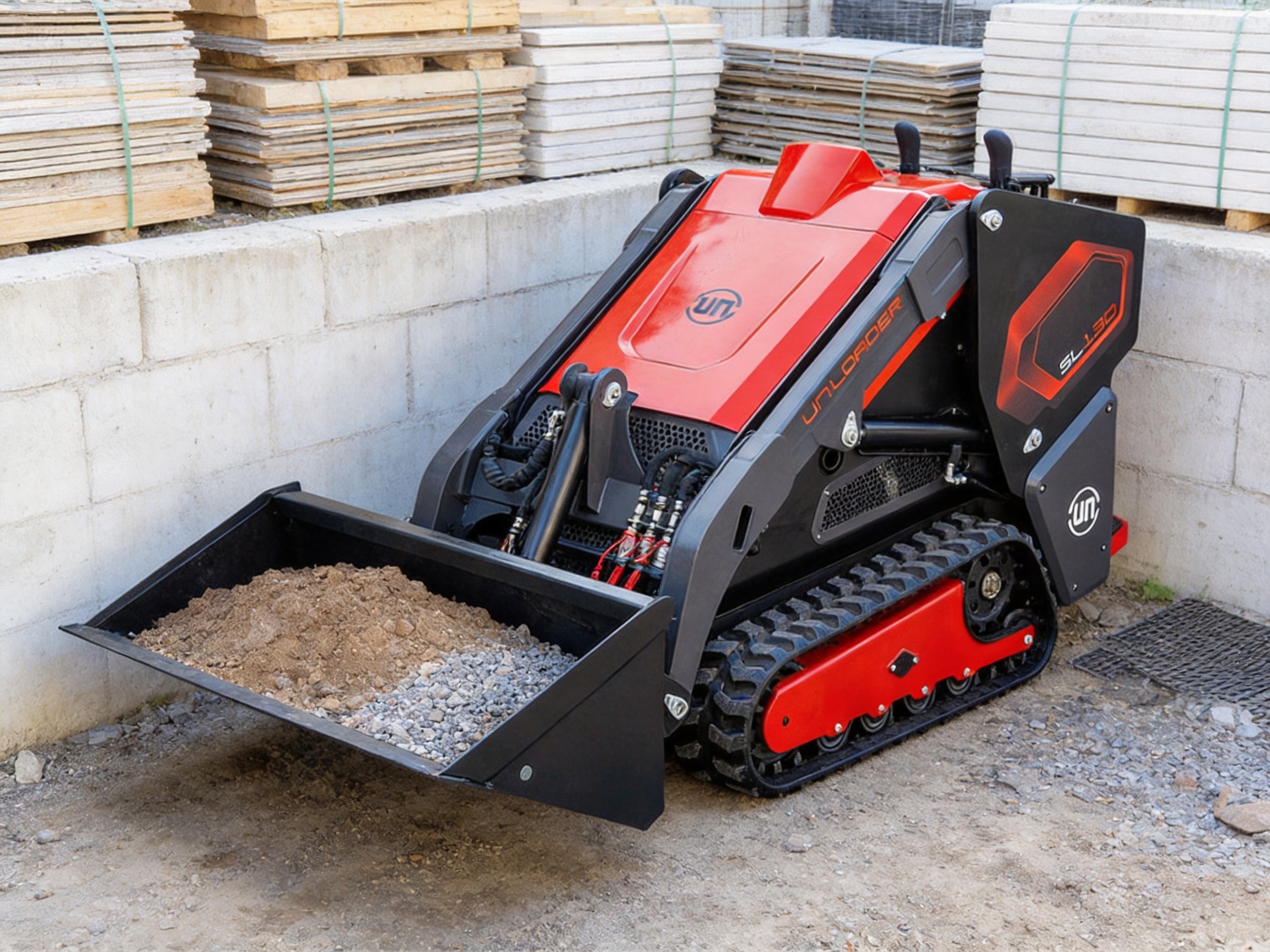
The SL130 includes a high-definition display that provides real-time monitoring of fuel level, coolant temperature, and engine speed. Access to this information helps the operator understand the machine’s operating condition during work.
Fuel-level information supports planning and reduces the risk of unexpected refueling interruptions. Coolant-temperature monitoring helps the operator identify abnormal operating conditions before they become more serious. Engine-speed information allows the operator to observe how the diesel engine is responding to the selected task and operating demand.
A display does not replace regular inspection or scheduled maintenance. Operators should still check fluids, tracks, attachment connections, controls, visible components, and safety systems before operation. Nevertheless, clear real-time information is valuable because it keeps important operating data in the operator’s normal field of attention.
Compared with basic compact loaders that provide limited information, a high-definition display can improve machine awareness and support more consistent operation. It can also help maintenance personnel understand operating symptoms when a machine requires inspection. The display is therefore not merely a convenience feature; it supports a more informed operating process.
Safety Features for Controlled Operation
The SL130 is equipped with a key switch, an emergency stop switch, and a main power cut-off switch. These controls provide multiple methods for controlling machine power and responding to abnormal situations.
The key switch manages normal starting and shutdown procedures. The emergency stop switch provides a rapid way to stop the machine when an immediate hazard or unexpected condition occurs. The main power cut-off switch allows the machine’s primary electrical power to be disconnected when required by the operating or maintenance procedure.
Safety controls are most effective when operators understand their location and function before beginning work. Employers should provide appropriate training and ensure that operators know how to respond to attachment problems, unexpected movement, loss of visibility, personnel entering the work zone, or other hazards.
Safe operation also depends on correct load handling. Operators should keep loads within the rated capacity, avoid sudden movements, maintain clear visibility, use appropriate travel speeds, and consider the effect of slopes and uneven ground. When working near people, vehicles, buildings, or stored goods, the operator should follow the site’s traffic-management rules.
The presence of emergency and power isolation controls gives the SL130 a stronger safety foundation than a basic machine without dedicated shutdown provisions. These systems should be inspected regularly and kept accessible. They must never be bypassed, damaged, or used as a substitute for proper operator training.
Engine and Powertrain Configuration
The SL130 uses a Kubota D1105 diesel engine. Diesel power is widely used in construction, agriculture, industrial service, and material-handling equipment because it is suited to continuous work and variable loads. In this loader, the diesel engine supports the hydraulic and drive functions required for loading, lifting, turning, and attachment operation.
The engine selection gives the machine a familiar power source for users already operating diesel equipment. It also supports applications where a compact machine must work away from fixed electrical infrastructure. Contractors and agricultural users can refuel the machine as part of their normal equipment management practices.
As with any diesel-powered machine, users should observe fuel-handling, ventilation, emissions, and maintenance requirements. Indoor operation requires particular attention to exhaust management and local regulations. Regular servicing is essential for reliable performance and long service life.
The ground drive speed is specified as approximately 3.4 mph, or 5.4 km/h. This speed is appropriate for a compact loader focused on controlled work rather than high-speed transportation. Skid steer loaders are typically most productive when they minimize travel distances, maintain accurate attachment positioning, and perform efficient loading cycles.
Main Technical Specifications
The following table summarizes the principal specifications provided for the SL130. Imperial and metric values are shown together where available.
| Specification | Value |
|---|---|
| Model | SL130 |
| Rated operating capacity | 1,300 lb (590 kg) |
| Ground drive speed | 3.4 mph (5.4 km/h) |
| Engine model | Kubota D1105 |
| Fuel | Diesel |
| Ground contact length | 38 in (963 mm) |
| Length with standard bucket | 93 in (2,352 mm) |
| Length without standard bucket | 65 in (1,665 mm) |
| Height | 51 in (1,307 mm) |
| Width | 42 in (1,057 mm) |
| Wheel tread | 38 in (970 mm) |
| Turning radius with standard bucket | 61 in (1,537 mm) |
| Turning radius without standard bucket | 32 in (804 mm) |
These dimensions show the central design priorities of the machine: compact access, a short operating footprint, and tight turning. The difference between the length with and without the standard bucket also demonstrates why attachment selection matters when planning transport, storage, and work-area access.
Advantages Compared with Larger or Less Flexible Equipment
The SL130’s main competitive advantage is not simply one isolated specification. Its value comes from the combination of compact dimensions, zero-radius turning, tracked stability, attachment flexibility, operator-focused controls, and a practical rated capacity.
Compared with larger wheel loaders, the SL130 generally requires less space for access and maneuvering. It can be suitable for narrow yards, small sites, agricultural buildings, and facility areas where a larger machine may be inefficient or unable to enter. Its smaller size can also make transport and storage easier.
Compared with basic compact loaders that use only one attachment, the SL130 offers greater functional flexibility through its quick attachment change system and compatibility with buckets, forks, plows, sweepers, snow blowers, and grapple buckets. This helps users adapt the machine to different materials, seasons, and industries.
Compared with machines that provide limited operator information, the high-definition display improves access to fuel level, coolant temperature, and engine speed. Compared with machines that lack dedicated emergency and main power cut-off controls, the SL130 provides a clearer approach to power management and emergency response.
Compared with lightly constructed compact equipment, the box-type boom provides a more substantial structural arrangement for lifting and attachment work. The 200 mm rubber tracks and extended ground contact also support a stable platform for controlled operation.
These advantages should be evaluated against the specific job. The SL130 is not intended to replace a large high-capacity loader in every application. Its strength lies in combining useful lifting capability and attachment versatility with exceptional access to confined work areas.
Manufacturing Strength and Engineering Background
The SL130 is produced by Zhejiang UN Forklift Co., Ltd., a material-handling equipment manufacturer that integrates research and development, production, sales, and service. This integrated structure is important because product development, manufacturing, field support, and customer feedback can be managed within a connected business system.
The company was founded in 1978 and occupies approximately 53,400 square meters. Its stated annual production capacity is 15,000 units. A manufacturing organization with this scale can support structured production planning, product-family development, component coordination, quality procedures, and international customer service.
The company’s experience includes a broad range of forklifts and material-handling products. It offers 17 varieties, 96 series, and more than 200 specifications. This product breadth creates a useful engineering background for compact equipment because many design principles overlap across material-handling machines, including load management, operator controls, hydraulic systems, structural design, safety, and serviceability.
The company also reports a history of technological development, including the production of China’s first reach forklift and VNA truck, national patents related to electric forklift technologies, and participation in the formulation of Chinese electric forklift industry standards. While these achievements are not direct performance specifications for the SL130, they demonstrate an established engineering and product-development foundation.
The company serves international markets through a worldwide sales and service network, with partners in Europe, South America, North America, Africa, and Asia. International distribution and support experience can be valuable for users who require spare parts, technical communication, service coordination, and equipment assistance across different regions.
Production Capacity, OEM Experience, and Product Development
In addition to its own product portfolio, the company is described as a designated OEM supplier for well-known domestic and overseas companies, including Hyundai Heavy Industries and Xuzhou Construction Machinery Group. OEM experience generally requires consistent production standards, documentation, delivery coordination, and the ability to meet customer-specific requirements.
The company’s manufacturing background includes internal-combustion forklifts designed for international markets and equipment developed for high-emission-standard regions such as the European Union and North America. This indicates familiarity with the need to adapt products to different market expectations and regulatory environments.
The company also develops new-energy equipment, including diesel-to-lithium-ion forklifts and standard lithium-ion battery forklifts. Although the SL130 itself is a diesel-powered skid steer loader, this broader research direction reflects a manufacturer responding to changing expectations regarding energy consumption, emissions, efficiency, and sustainability.
For buyers, a manufacturer’s strength is not limited to the machine’s visible components. It also includes design capability, production organization, quality control, parts support, technical documentation, warranty administration, and the ability to continue improving products. The SL130 benefits from being part of a broader manufacturing organization rather than an isolated one-off machine.
Maintenance and Ownership Considerations
Long-term value depends on more than the purchase price. Owners should consider maintenance access, fuel consumption, attachment requirements, track wear, service support, operator training, and the availability of replacement parts. A compact machine that is properly maintained can provide more reliable productivity than equipment that is frequently unavailable for service.
Routine inspections should include the engine, fluids, tracks, visible hydraulic components, attachment connections, control handles, display functions, emergency stop switch, and main power cut-off switch. The exact maintenance schedule should follow the manufacturer’s instructions and the operating environment.
Track condition deserves attention because the tracks are central to both traction and stability. Work on abrasive surfaces, sharp debris, excessive loads, or unsuitable terrain can accelerate wear. Operators should avoid unnecessary spinning and should inspect the track system regularly.
Attachments should also be inspected before use. A bucket, fork, grapple bucket, plow, sweeper, or snow blower introduces different loads and visibility conditions. The attachment must be securely connected, correctly matched to the loader, and used only for its intended purpose.
Owners can improve equipment utilization by planning attachment use in advance. For example, a construction contractor may use a bucket and grapple bucket during site preparation, then add a sweeper for final cleanup. A property service company may use forks for material handling, a bucket for landscaping, and a snow tool during winter. Planned attachment use helps convert the loader’s versatility into measurable operational value.
Choosing the SL130 for a Fleet
The SL130 can be a practical addition to fleets that already include larger forklifts, loaders, excavators, or warehouse equipment. It fills the gap between hand-operated tools and larger construction machines. Its compact format enables it to perform support work without tying up a high-capacity machine.
For rental fleets, the multiple-attachment concept can broaden the range of customer applications. A rental provider may offer the loader with a standard bucket for general work and provide additional tools according to seasonal or project demand. The compact dimensions may also simplify yard storage and transport planning.
For contractors, the machine can support jobs where access is more important than maximum capacity. For farms, it can help with daily material movement and seasonal tasks. For municipalities, it can provide a flexible platform for maintenance and snow clearing. For industrial facilities, it can support cleanup and material handling in selected areas.
Fleet managers should compare the rated operating capacity and dimensions with their real workloads. If most tasks involve loads above 1,300 pounds, a larger machine may be more appropriate. If the typical work involves narrow access, short travel distances, repeated attachment changes, and moderate loads, the SL130’s design may be especially well matched.
Operating Practices for Maximum Productivity
Productivity begins with selecting the correct attachment and planning the work path. The operator should assess the material, travel distance, pile arrangement, access width, ground condition, and unloading point before starting. Efficient cycles normally involve controlled approach, stable loading, safe lifting, short travel, accurate placement, and smooth return.
The zero-radius turning capability should be used carefully. Pivoting in place can save space, but excessive track spinning may increase surface disturbance and track wear. Operators should use the minimum movement required to position the machine accurately.
Loads should be kept as low as practical during travel, especially on uneven ground. The operator should avoid abrupt turns with a raised or unstable load. When visibility is restricted, the work area should be controlled and a spotter should be used where appropriate.
Engine speed and machine response should be monitored through the display and by observing how the loader performs under load. If coolant temperature rises abnormally or another warning condition occurs, the operator should stop safely and follow the appropriate inspection procedure.
Good operating habits help preserve the machine, reduce unnecessary fuel use, and support consistent output. The SL130’s compact design provides the physical capability for tight work, but skilled operation determines how effectively that capability is converted into productivity.
Q&A: Common Questions About the SL130
What type of machine is the SL130?
The SL130 is a compact tracked skid steer loader designed for loading and short-distance transportation of bulk materials. It can also operate a variety of attachments for handling, sweeping, snow removal, and other tasks.
What is the rated operating capacity?
The rated operating capacity is 1,300 pounds, or 590 kg. The safe working load may vary according to the attachment, load position, terrain, and operating conditions. Users should follow the manufacturer’s capacity guidance and never exceed the applicable limit.
How narrow is the machine?
The listed machine width is approximately 42 inches, or 1,057 mm. Site access should still be measured carefully because door frames, mirrors or attachments, surface conditions, and turning space can affect actual access.
Can the SL130 turn in place?
Yes. Its skid-steer tracked configuration provides zero-radius 360-degree turning. This allows the machine to pivot in confined spaces and reduce the amount of area required for repositioning.
What engine powers the loader?
The loader uses a Kubota D1105 diesel engine. Diesel power supports the machine’s drive, lifting, and attachment functions and is suitable for many construction, agricultural, industrial, and municipal applications.
What attachments can be used?
Compatible attachment types include buckets, forks, snow plows, enclosed sweepers, snow blowers, grapple buckets, and other suitable tools. Attachment compatibility must be verified according to connection requirements, capacity, hydraulic needs, and operating instructions.
Is the loader suitable for warehouse work?
It can be suitable for selected warehouse or industrial applications, particularly where the access width and floor conditions are appropriate. Because it is diesel-powered, indoor operation must comply with ventilation, emissions, safety, and facility regulations.
How does the tracked system help?
The 200 mm-wide rubber tracks and approximately 38-inch ground contact length provide a stable working platform and support traction on suitable surfaces. Ground conditions, slopes, moisture, and load distribution must still be considered before operation.
What information is shown on the display?
The high-definition display provides real-time information including fuel level, coolant temperature, and engine speed. Operators should combine display monitoring with regular inspections and scheduled maintenance.
What safety controls are included?
The SL130 includes a key switch, emergency stop switch, and main power cut-off switch. Operators should understand these controls before operation and verify that they remain functional and accessible.
Is the SL130 a replacement for a full-size loader?
It is not intended to replace every full-size loader. Its strongest advantage is compact access, tight maneuverability, and attachment versatility for moderate-capacity work. Applications requiring significantly higher capacity or long-distance transport may require larger equipment.
Why is the quick attachment system important?
The quick attachment system allows the operator to change tools more efficiently. This makes it possible to use one machine for several work functions and can reduce the need for separate dedicated equipment.
Conclusion
The SL130 skid steer loader is designed around a clear practical objective: provide useful loading and attachment capability in places where space is limited. Its 1,300-pound rated operating capacity, Kubota D1105 diesel engine, 200 mm rubber tracks, box-type boom, and zero-radius turning capability create a balanced compact machine for material handling and support work.
Its compatibility with buckets, forks, grapple buckets, sweepers, snow plows, snow blowers, and other attachments gives it a broader role than a single-purpose loader. The quick attachment change system can help users respond to changing job requirements, while the cushioned foot platform, padded operator contact area, integrated armrest controls, and high-definition display support more comfortable and informed operation.
The machine also benefits from the manufacturing capabilities of Zhejiang UN Forklift Co., Ltd., including integrated research and development, production, sales, service, international distribution, OEM experience, and a broad material-handling product portfolio. The company’s history, production capacity, engineering development, and new-energy research provide a substantial manufacturing foundation behind the product.
For farms, construction contractors, landscapers, industrial facilities, warehouse service teams, municipalities, ports, terminals, and property maintenance providers, the SL130 offers a flexible approach to compact loading and multi-purpose equipment use. Its greatest competitive advantage is the combination of maneuverability, attachment versatility, operator-focused design, and practical structural strength in a small tracked platform.
References
1. Product specification materials for the SL130 Skid Steer Loader, including dimensions, rated operating capacity, engine information, drive speed, and turning radius.
2. Product feature materials describing the SL130 tracked drive system, box-type boom, attachment compatibility, operator ergonomics, display, and safety controls.
3. General principles of skid steer loader operation, attachment selection, load handling, ground stability, and construction equipment safety.
4. Manufacturer-provided corporate information concerning research and development, production capacity, OEM manufacturing, international service, patents, and material-handling equipment development.
5. General maintenance and fleet-management practices for compact diesel-powered construction and material-handling equipment.
Product: SL130 Skid Steer Loader
For exclusive deals and latest offers, sign up by entering your email address below.
Stay In Touch
ADDRESS : NO.1 ROAD ONE, XINDENG NEW DISTRICT, FUYANG, HANGZHOU, ZHEJIANG, CHINA 311404.
PHONE : +86-571-8688 8355 (AMERICA)
PHONE : +86-571-8886 9363 (EUROPE)
PHONE : +86-571-8688 8377 (ASIA, AFRICA, OCEANIA)
EMAIL : [email protected]
EMAIL : [email protected](PARTS INQUIRY)

