


 中文简体
中文简体 Français
 русский
 Español
 عربى
عربى Deutsch



Compact Lithium-Powered Three-Wheel Electric Forklift for High-Performance Indoor Handling
Admin 2026-08-10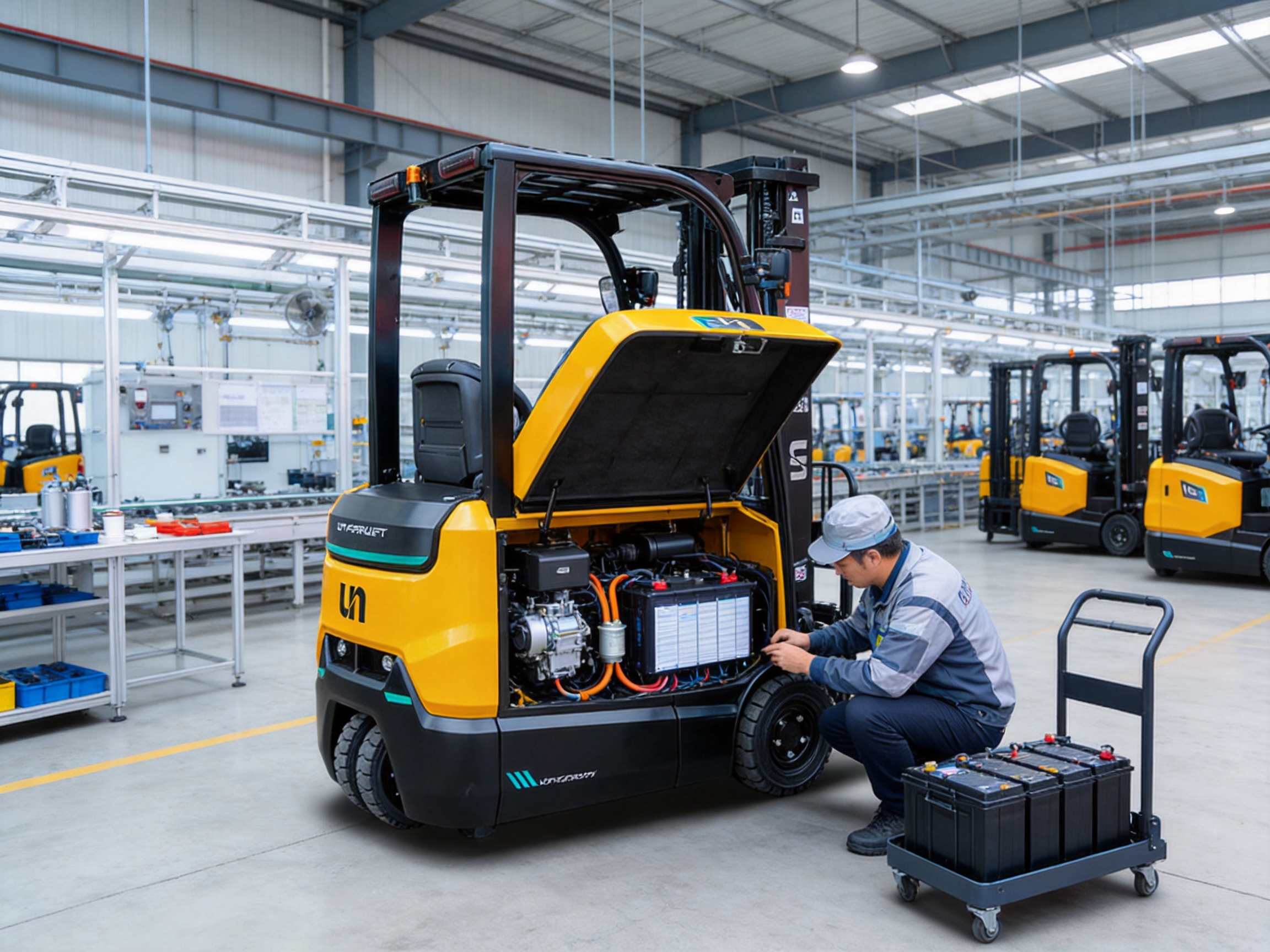
Modern warehouses, production facilities, distribution centers, and retail logistics operations increasingly require material handling equipment that combines productivity, precision, safety, and low operating costs. In these environments, a forklift must do more than lift a specified load. It must move confidently through narrow aisles, make accurate turns, operate for extended shifts, protect workers and goods, and remain easy to maintain.
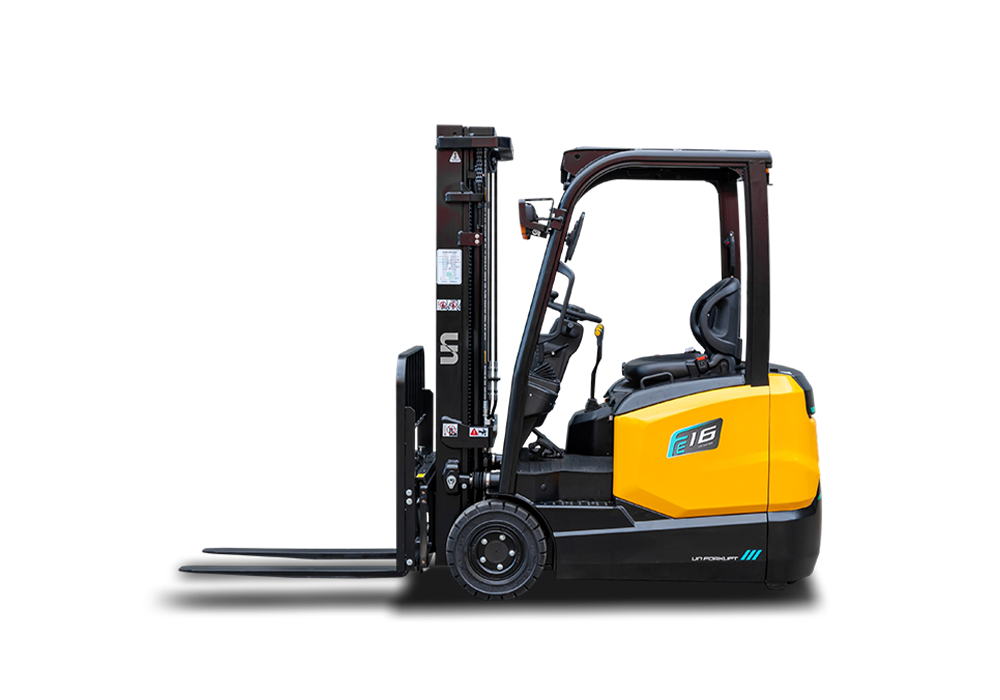
The FE Series 1.6T–2.0T three-wheel electric forklift is designed to address these requirements. Available in 1,600 kg, 1,800 kg, and 2,000 kg capacity configurations, the series combines a compact three-wheel layout with a lithium-powered drive system, dual drive motors, intelligent regenerative braking, advanced electronic control, and a carefully engineered operator environment. Its design is particularly suitable for indoor operations where space is limited and maneuverability directly affects productivity.
Developed as a fully upgraded model based on the previous V Series platform, the forklift represents a practical balance between compact dimensions and heavy-duty performance. It offers travel speeds of up to 13 km/h with a full load and 14 km/h without a load, a rated lift height of 3,000 mm, a turning radius as low as 1,560 mm on selected models, and a pallet aisle width starting at 3,261 mm for 1,000 × 1,200 mm pallets handled crossways.
Behind the product is Zhejiang UN Forklift Co., Ltd., an established material handling equipment manufacturer with experience spanning research and development, production, sales, and service. Its long-term manufacturing base, product range, engineering capabilities, and international service network support the development of electric forklifts intended for demanding global applications.
Why Three-Wheel Electric Forklifts Matter in Modern Warehouses
Warehouse space is expensive, and many facilities need to increase storage density without slowing down material flow. Conventional four-wheel forklifts provide excellent stability, but their larger turning envelopes can make them less efficient in confined areas. A three-wheel configuration can reduce the space needed for turning while preserving the lifting capability required for common pallet-handling tasks.
The FE Series uses a compact structure and a small outside turning radius to support agile operation. The 1.6-ton and 1.8-ton models have an outside turning radius of 1,560 mm, while the 2.0-ton configuration has a turning radius of 1,655 mm. These dimensions help operators work more effectively around racking, production lines, loading areas, and staging zones.
A smaller turning radius does not only benefit the forklift itself. It can help warehouse planners make better use of available floor space, reduce unnecessary travel, and create more practical traffic patterns. In operations with frequent positioning changes, the ability to turn efficiently can contribute to shorter handling cycles and reduced congestion.
Electric power also makes the forklift well suited to indoor use. Unlike internal combustion equipment, a battery-powered forklift produces no direct exhaust emissions during operation. This is valuable in enclosed warehouses, food and beverage facilities, pharmaceutical environments, manufacturing plants, and distribution centers where air quality and noise control are important.
The combination of three-wheel maneuverability and electric operation gives the FE Series a clear application focus: high-frequency material handling in areas where space, cleanliness, and operating comfort are priorities.
Product Overview and Capacity Range
The FE Series is offered across a rated capacity range of 1.6 to 2.0 tons. The principal models are FBT16, FBT18, and FBT20, corresponding to rated load capacities of 1,600 kg, 1,800 kg, and 2,000 kg respectively. Each model uses a 500 mm load center, allowing the equipment to serve standard pallet-handling applications when the load is positioned correctly.
The series uses a seated operator configuration. This layout is appropriate for operations involving repeated travel, lifting, lowering, and load positioning over extended work periods. The adjustable steering wheel and flexible seat adjustment allow the operator to establish a more comfortable driving position, which can help reduce fatigue during long shifts.
All models use electric drive systems. Depending on the selected battery configuration, customers can specify a conventional 48 V/460 Ah or 48 V/540 Ah battery system, or a 77.28 V/150 Ah lithium battery option. The 1.6-ton and 1.8-ton models are available with battery weights of 748 kg or 780 kg depending on the configuration, while the 2.0-ton model lists battery weights of 866 kg or 780 kg for the relevant options.
With a 3,000 mm rated lift height, the forklift can support common warehouse stacking and retrieval tasks. The standard mast lowered height is 2,025 mm, and the overhead guard height is 2,085 mm. These dimensions should be compared with facility doorways, container openings, rack clearances, and other site-specific restrictions before purchase.
| Model | Rated Capacity | Wheelbase | Outside Turning Radius | Overall Width |
|---|---|---|---|---|
| FBT16 | 1,600 kg | 1,355 mm | 1,560 mm | 1,090 mm |
| FBT18 | 1,800 kg | 1,355 mm | 1,560 mm | 1,090 mm |
| FBT20 | 2,000 kg | 1,450 mm | 1,655 mm | 1,120 mm |
The capacity range enables fleet managers to match equipment to actual handling requirements rather than using one oversized forklift for every task. The 1.6-ton model is suitable for lighter palletized goods and intensive indoor movement. The 1.8-ton model provides additional capacity for heavier loads while retaining a compact footprint. The 2.0-ton model is intended for operations that require a higher rated load but still benefit from three-wheel maneuverability.
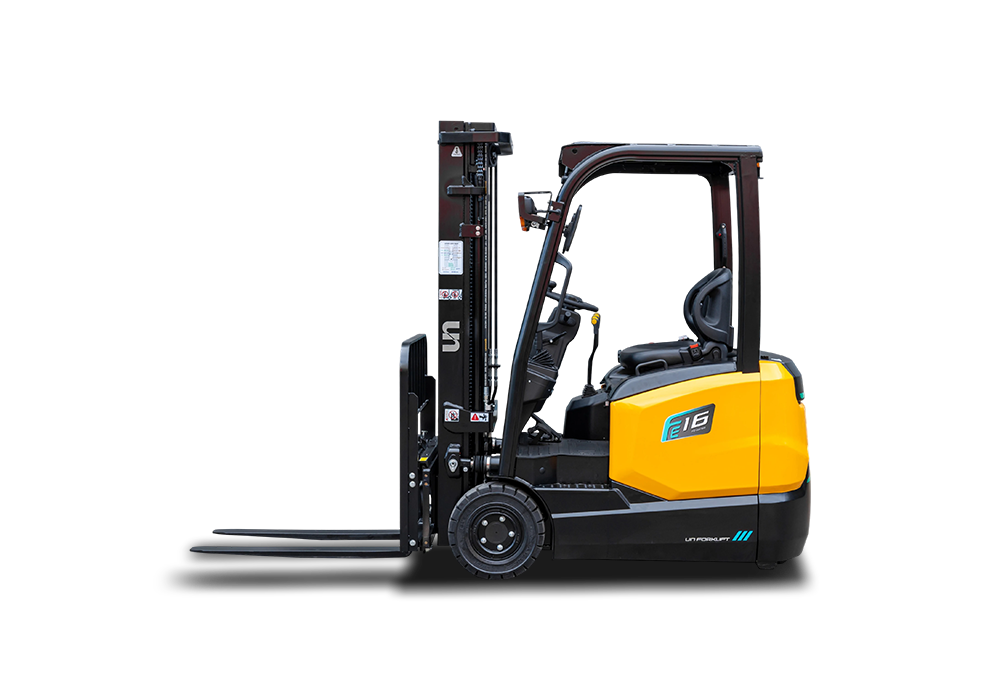
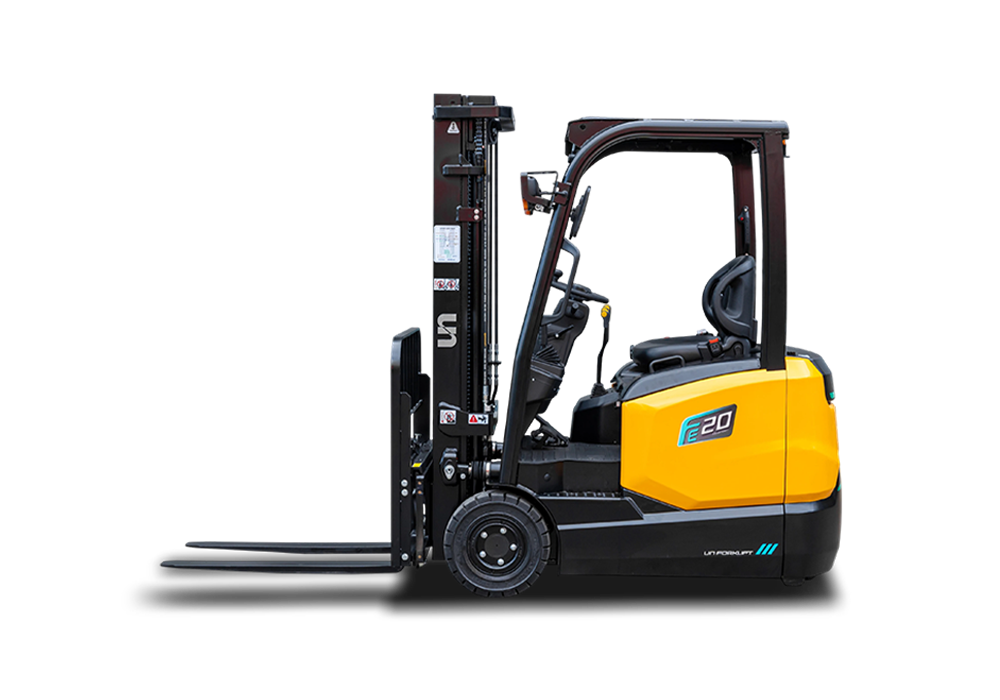
FE Series 1.6T-2.0T 3-Wheel Electric Forklift
Compact Dimensions and Maneuverability
One of the most important advantages of the FE Series is its focus on compact operation. The FBT16 and FBT18 measure 1,930 mm in length to the face of the fork without the fork and 1,090 mm in overall width. The FBT20 measures 2,025 mm in length and 1,120 mm in overall width. These dimensions help the forklift navigate areas where a larger machine would require wider aisles or additional turning space.
The specified aisle width for 1,000 × 1,200 mm pallets handled crossways is 3,261 mm for the FBT16 and FBT18, and 3,351 mm for the FBT20. For 800 × 1,200 mm pallets handled lengthways, the figures are 3,386 mm and 3,476 mm respectively. These values give warehouse designers useful reference points when evaluating storage layouts.
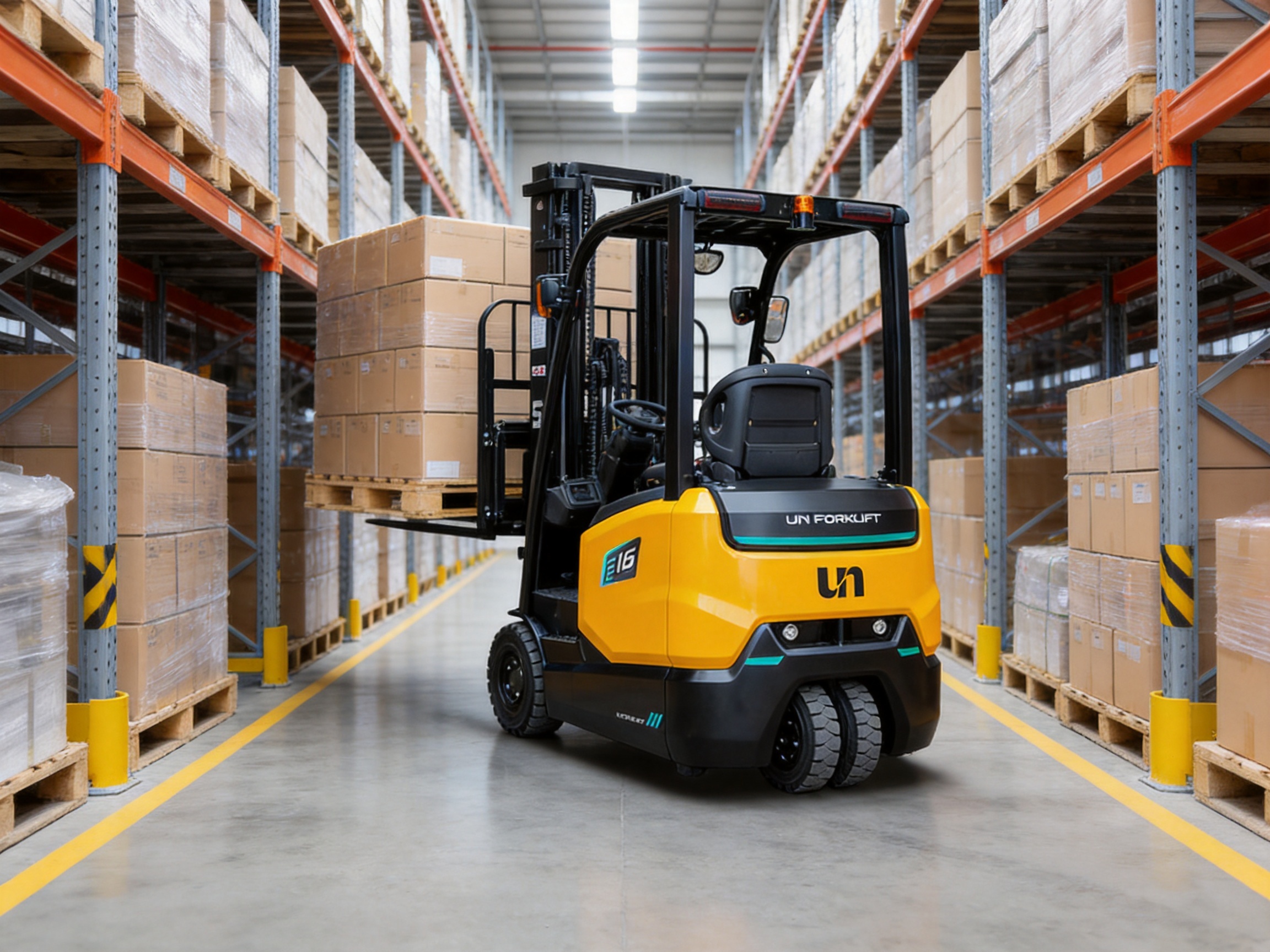
Three-wheel construction can be particularly valuable in applications with frequent directional changes. The forklift can reposition efficiently at the end of an aisle, approach a pallet from a limited angle, and maneuver around workstations without requiring the same turning space as many conventional four-wheel alternatives.
The design also includes double rear tires to enhance stability. This is an important engineering feature because compact maneuverability must be balanced with load support and predictable handling. The rear tire arrangement contributes to a stable platform while the front drive system provides traction and propulsion.
The front tire specifications are 18X7-8 for the FBT16 and FBT18, while the FBT20 uses 200/50-10 front tires. All three models use 15 × 4.5-8 rear tires. The listed tire type is pneumatic, making tire selection and operating conditions important considerations for each customer. Facilities with smooth floors may evaluate additional tire choices according to application, floor protection requirements, and operating environment.
Compared with larger four-wheel forklifts, a compact three-wheel electric forklift can offer a more favorable balance between capacity and maneuverability in narrow indoor areas. Compared with smaller walk-behind or pedestrian equipment, it provides a seated operator position, higher travel speed, greater lift capacity, and stronger capability for repeated pallet transport.
Electric Drive System and Energy Efficiency
The FE Series uses a lithium-powered drive system designed to deliver responsive performance with reduced energy waste. Electric power is especially suitable for applications with frequent starts, stops, direction changes, and short travel cycles. In these operating conditions, the drive system can respond immediately without the warm-up requirements associated with internal combustion engines.
Dual drive motors provide propulsion through a balanced electric drive arrangement. The drive motor rating is listed as 2 × 4.8 kW or 2 × 5 kW depending on the selected configuration. Using two drive motors supports controlled power delivery and can help the forklift respond smoothly during acceleration, turning, and load movement.
Intelligent regenerative braking technology contributes to energy efficiency. During deceleration, the system can recover a portion of kinetic energy and return it to the battery rather than dissipating all of it as heat. Regeneration is especially useful in indoor facilities where forklifts repeatedly accelerate and slow down throughout a shift.
The forklift also incorporates electric braking together with wet braking, providing two layers of braking protection. This arrangement supports controlled stopping and adds a mechanical or hydraulic braking backup to the electrical deceleration function. The service brake is specified as hydraulic, while the parking brake is mechanical.
Travel speeds are rated at 13 km/h with a full load and 14 km/h without a load. These speeds provide productive movement while remaining appropriate for controlled warehouse operation. Actual safe speed should always be adapted to floor conditions, pedestrian traffic, visibility, load dimensions, aisle width, and site rules.
The battery options are designed to support extended operation. A high-capacity battery provides longer runtime and stronger power output, reducing the frequency of charging interruptions. The listed battery systems include 48 V/460 Ah, 48 V/540 Ah, and 77.28 V/150 Ah configurations. The correct choice depends on shift length, duty cycle, charging infrastructure, required acceleration, and customer preferences for battery technology.
The third-generation battery configuration is specified with IP67 waterproof and dustproof protection. This rating indicates a high level of enclosure protection, although operators must still follow the manufacturer’s instructions for cleaning, charging, inspection, and environmental limitations.
Advanced Electronic Control
Electronic control is central to the FE Series operating experience. The forklift uses a ZAPI controller with a high-frequency MOSFET integrated control mode. The system supports computer-controlled management of driving, steering, lifting, and tilting functions.
By coordinating these functions electronically, the forklift can offer consistent and responsive control. Multiple speed modes allow operators or fleet managers to adapt performance to different environments. A slower mode may be appropriate for congested areas or work near pedestrians, while a higher-performance mode can be selected for open warehouse travel when conditions permit.
The load-sensing steering gear contributes to efficient hydraulic response and supports increased lift speed. The hydraulic system is equipped with a high-power hydraulic pump motor and a low-noise, high-displacement pump. This combination is intended to provide productive lifting while controlling operating noise, an important consideration in indoor facilities.
The lifting speed is rated at 300 mm/s with a full load. Without a load, the listed lifting speed is 400 mm/s for the standard model table and 440 mm/s for the detailed FBT16 specification. These figures demonstrate the difference between configuration-specific data and general series data. Customers should confirm the exact performance values for the selected model, mast, battery, and option package before placing an order.
The maximum gradeability is listed as 15 percent with a full load and 15 percent without a load. Gradeability depends on surface condition, tire condition, load security, battery state, and ramp design. Facility operators should conduct a site assessment rather than treating the maximum published figure as a routine operating target.
Safety and Reliability Features
Safety is a combination of equipment design, operator training, site management, and maintenance discipline. The FE Series incorporates several design features intended to support predictable handling and equipment reliability.
The robust stamped overhead guard helps protect the operator from falling objects within the limits of its design and applicable safety standards. The fully enclosed instrument console contributes to a protected operator area and helps organize controls and displays in front of the driver.
Electric braking combined with wet braking provides dual-layer braking protection. The turning-speed deceleration function can reduce travel speed during turns, helping the operator maintain better control when maneuvering in confined spaces. This feature is particularly relevant to a compact three-wheel forklift because turning performance is a central part of its operating profile.
Proportional lifting function supports smoother load positioning. Instead of relying only on abrupt full-speed hydraulic movement, proportional control allows the operator to make finer adjustments when placing goods on racks or aligning forks with pallets. More precise control can reduce product damage and improve confidence during elevated-load operations.
Double rear tires enhance stability, while the dual drive motors provide controlled power delivery. The battery enclosure protection specified for the third-generation battery supports operation in environments where exposure to dust or moisture may occur. Nevertheless, safe use requires appropriate inspections and compliance with the battery supplier’s charging and handling procedures.
The forklift’s safety advantages over less sophisticated competitors are most apparent when several systems work together. Electronic speed control, turning deceleration, proportional lifting, dual braking, a stable chassis, and a clear display can create a more predictable operating environment than a basic machine with limited electronic assistance.
Safety performance also depends on correct load handling. The rated capacity applies at the stated 500 mm load center and under the applicable mast and configuration conditions. Loads that extend beyond the rated load center can reduce capacity and affect stability. Operators should use the capacity plate, follow site procedures, and never exceed the approved load rating.
Operator Ergonomics and Workplace Comfort
Operator comfort influences productivity, attention, and safe decision-making. Forklift operators often repeat the same actions hundreds of times per shift, including steering, reversing, checking loads, lifting, lowering, and entering or exiting the machine. A poorly arranged workstation can increase physical strain and reduce concentration.
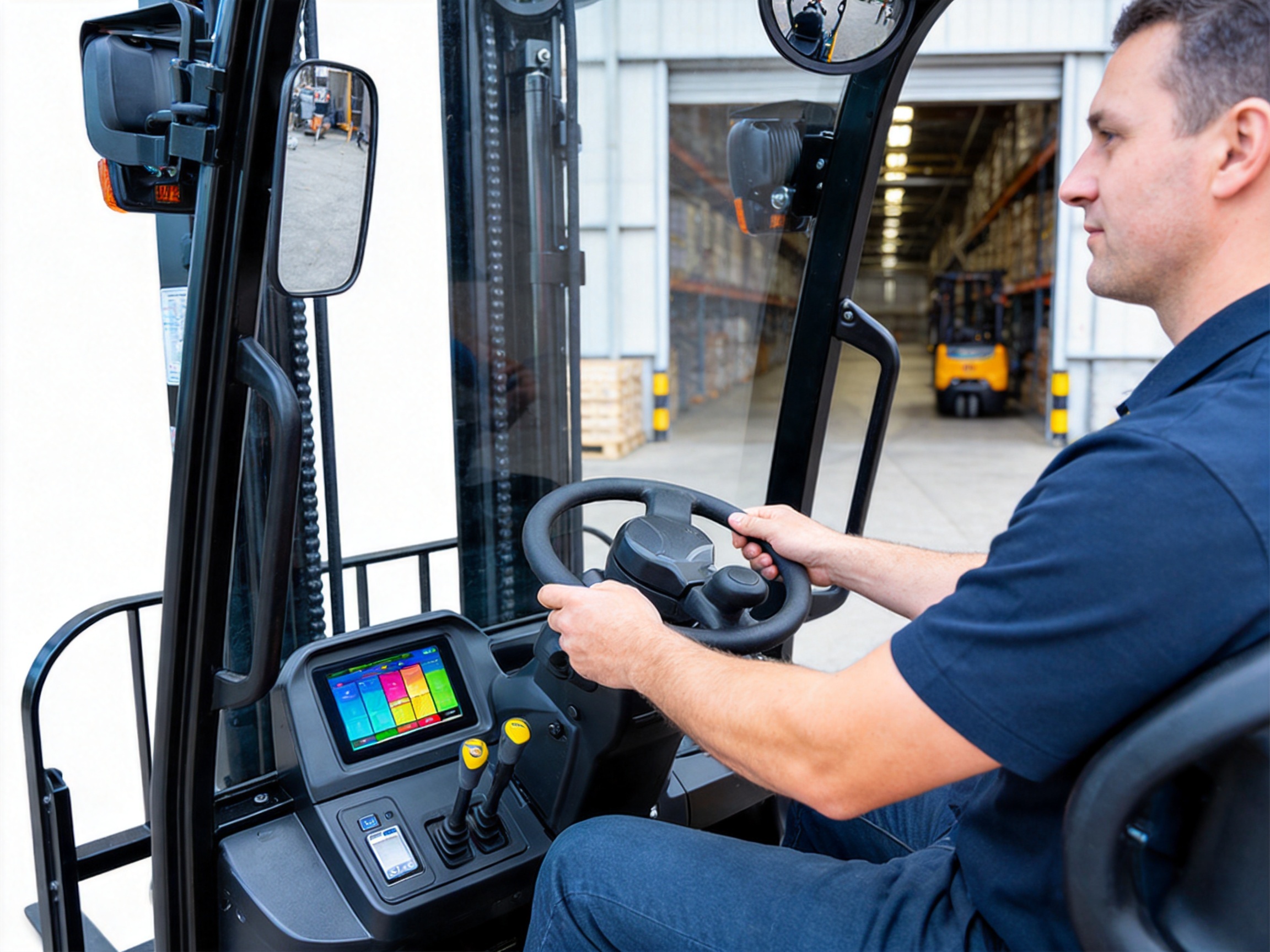
The FE Series uses an adjustable steering wheel to help operators select a comfortable position. The seat includes flexible adjustment options, allowing the driver to establish a suitable relationship between the seat, pedals, steering wheel, controls, and forward visibility.
The multifunction color display panel provides clear and intuitive operating information. A well-organized display can help the operator monitor battery condition, operating status, speed mode, warnings, and other key information without excessive distraction.
A document holder provides convenient storage for work instructions, checklists, delivery documents, or other materials. A USB port supports charging and connectivity for mobile devices, which can be useful in modern warehouse environments where communication and digital work orders are part of daily operations.
The fully enclosed instrument console contributes to a clean and organized workstation. The combination of the console, adjustable controls, display, seat, and steering wheel is intended to make the forklift easier to operate for different drivers and across varying shifts.
Reduced noise is another benefit of electric operation. The low-noise hydraulic pump and absence of an internal combustion engine can help create a more comfortable indoor work environment. Lower noise may also make it easier for operators and pedestrians to communicate, although warning alarms, traffic controls, and pedestrian separation remain essential.
Hydraulic Performance and Load Handling
The lifting system is designed to support regular pallet handling at rated loads up to 2,000 kg. A 9.5 kW lift motor is listed for the principal specification, while the series table also identifies 9.5 kW or 11 kW configurations depending on the selected option.
The load-sensing steering gear and hydraulic pump arrangement help balance hydraulic demand with operating requirements. A high-displacement, low-noise pump supports lifting and attachment functions while helping maintain a suitable acoustic environment for indoor work.
The standard fork dimensions vary by model. The FBT16 and FBT18 use forks measuring 920 × 100 × 35 mm, while the FBT20 uses 1,070 × 100 × 40 mm forks. The distance between fork arms is listed as 200/1,010 mm. These dimensions should be checked against pallet openings, load design, and any attachments used in the facility.
The mast tilts 6 degrees forward and 6 degrees backward. Mast tilt can help stabilize a load during travel and assist with positioning when engaging or placing pallets. Operators should use tilt carefully, particularly when handling unstable, tall, liquid, or uneven loads.
The standard rated lift height is 3,000 mm, with a free lift height of 85 mm for the FBT16 and FBT18 and 80 mm for the FBT20. The mast extended height with backrest is 4,052 mm. These values help determine whether the forklift can work under existing rack levels, ceilings, sprinkler systems, beams, and doorways.
For customers using attachments, the listed operating pressure is 17.5 MPa. Attachment compatibility must be confirmed before installation, including hydraulic flow, pressure, residual capacity, visibility, load center changes, and approval requirements.
Maintenance-Friendly Engineering
Downtime can be more expensive than the initial equipment purchase, particularly in distribution centers and production facilities operating on tight schedules. The FE Series includes several features intended to simplify inspection and service access.
The engine cover, used here as the main equipment cover, swings open entirely to provide access to internal components. The electrical control cover also opens fully, allowing technicians to reach control systems more efficiently. A tool-free floor plate removal system makes it easier to access service areas without spending unnecessary time removing fasteners.
The side battery extraction system supports practical battery handling and maintenance. Side extraction can be valuable where overhead lifting equipment is unavailable or where fleet operators prefer a dedicated battery exchange process. The exact battery removal procedure should be carried out according to the manufacturer’s safety instructions and with appropriate lifting or extraction equipment.
Easy access can improve the quality of preventive maintenance because technicians are more likely to complete inspections when service points are not unnecessarily difficult to reach. Routine checks may include battery condition, electrical connections, tire wear, brake operation, hydraulic leaks, mast chains, forks, overhead guard components, steering performance, and warning systems.
Electronic diagnostic capability is another advantage of modern electric forklifts. With computer-controlled driving, steering, lifting, and tilting, technicians can use appropriate diagnostic procedures to identify system warnings and operating irregularities. The use of a recognized electronic control platform can also support structured service processes when trained technicians and approved tools are available.
Maintenance requirements remain dependent on operating conditions. Heavy dust, uneven floors, water exposure, continuous multi-shift use, frequent ramp travel, and aggressive acceleration can all influence service intervals. Fleet owners should develop a maintenance plan based on actual duty cycles rather than relying only on calendar intervals.
Manufacturing Strength and Product Development Capability
The product’s engineering strengths are supported by the manufacturer’s broader industrial background. Zhejiang UN Forklift Co., Ltd. was founded in 1978 and has developed experience across material handling equipment design, manufacturing, sales, and service. The company’s production base covers approximately 53,400 square meters and has an annual production capacity of 15,000 units.
This scale provides a foundation for systematic manufacturing rather than purely small-batch assembly. A substantial production facility can support dedicated processes for fabrication, component preparation, assembly, testing, quality inspection, and finished-equipment logistics.
The manufacturer offers a broad product portfolio covering 17 varieties, 96 series, and more than 200 specifications. This range indicates experience adapting forklift platforms to different capacity classes, energy systems, operating environments, and customer requirements. Such experience is valuable when developing a compact electric model because the machine must integrate structural design, hydraulics, electronics, battery technology, ergonomics, and safety into one platform.
The company has also participated in the formulation of Chinese electric forklift industry standards and holds national patents related to electric forklift technologies. These activities reflect involvement in technical development beyond the assembly of standard components. The company’s history includes the development of early reach forklift and very-narrow-aisle truck products, providing relevant background in equipment designed for space-constrained warehouse work.
Manufacturing quality depends on process control at every stage. Structural components must be fabricated accurately to maintain mast alignment and chassis strength. Hydraulic systems require clean assembly and leak control. Electrical systems require correct wiring, connector protection, controller programming, and functional testing. Battery systems require careful handling, safe installation, and verification of charging and protection functions.
For an electric forklift, integration is especially important. A reliable product is not created simply by combining a battery, motors, controller, and hydraulic system. These components must communicate correctly and deliver predictable performance under different loads and operating conditions. The FE Series reflects this integrated approach through coordinated control of drive, steering, lifting, tilting, braking, and display functions.
The company’s international sales and service network extends across Europe, South America, North America, Africa, and Asia. This global presence can help support customers who require equipment for different regulatory environments, climate conditions, applications, and service expectations. Local availability of parts and technical support remains an important purchasing consideration, particularly for fleets operating multiple shifts.
How the FE Series Compares with Competing Forklift Types
Product comparisons should consider the application rather than a single headline specification. The FE Series has several advantages when compared with common alternatives, although the most suitable choice depends on load type, operating surface, duty cycle, aisle layout, and local requirements.
Compared with Four-Wheel Electric Forklifts
Four-wheel electric forklifts are often selected for their stability and broad application range. However, they generally require more space to turn. The three-wheel FE Series is designed for tighter maneuvering, with a compact body and outside turning radius beginning at 1,560 mm. In a dense warehouse, this can allow improved access to rack positions and reduce the space required for vehicle circulation.
The trade-off is that customers must evaluate stability requirements carefully. Loads should remain within the rated capacity and load center, and operators must follow safe turning procedures. For indoor pallet handling where maneuverability is a dominant requirement, the three-wheel configuration can offer a strong practical advantage.
Compared with Internal Combustion Forklifts
Internal combustion forklifts can be advantageous for outdoor work, rough surfaces, long continuous operation, and heavy-duty applications. However, they produce exhaust emissions and generally generate more noise than electric equipment. The FE Series is better suited to indoor environments where clean operation, lower noise, and precise electronic control are more important than outdoor terrain capability.
The electric model also benefits from regenerative braking and reduced routine engine-related maintenance. It does not require engine oil, fuel filters, spark plugs, or other combustion-engine service items. Battery management and electrical inspection remain essential, but the maintenance profile can be more suitable for warehouse fleets.
Compared with Walk-Behind and Pedestrian Equipment
Pedestrian pallet trucks and stackers are compact and useful for short-distance handling. However, they do not provide the same seated driving comfort, travel speed, rated capacity range, or ability to move loads over longer warehouse routes. The FE Series is intended for operations where the forklift must transport and position heavier loads repeatedly while maintaining operator comfort.
Compared with Basic Electric Forklift Designs
Basic electric forklifts may provide battery power but lack advanced electronic control, speed modes, regenerative braking, proportional lifting, turning deceleration, or a sophisticated operator display. The FE Series combines these functions into a more integrated operating system. These features can improve control, energy use, and operator feedback when properly configured and used.
The series also benefits from a relatively complete approach to ergonomics and serviceability. Adjustable controls, a multifunction display, document storage, USB charging, full cover access, tool-free floor plate removal, and side battery extraction demonstrate attention to the daily needs of operators and maintenance teams.
Application Areas
The FE Series is particularly suitable for indoor warehouses with narrow aisles and frequent pallet movement. It can support the movement of raw materials, finished goods, packaged products, components, and general industrial cargo.
In manufacturing plants, the compact turning radius helps the forklift move between production lines, storage zones, and loading areas. The electric power system is beneficial where exhaust emissions are undesirable or where noise must be controlled.
In distribution centers, the three capacity options allow fleet managers to assign equipment according to product weight. The 1.6-ton and 1.8-ton models can handle many standard warehouse loads, while the 2.0-ton model provides additional capacity for heavier palletized goods.
In retail and wholesale logistics, the forklift can assist with receiving, put-away, replenishment, order staging, and outbound loading. Its compact dimensions are useful where back-of-house areas are crowded or where access routes are shared with other equipment.
In battery-sensitive operations, customers can evaluate the available battery options according to shift pattern and charging strategy. Lithium battery technology may be appropriate for operations seeking quick opportunity charging, lower routine maintenance, and stable performance, provided the charging infrastructure and operating procedures are suitable.
The forklift can also be considered for food, beverage, and other indoor applications where a cleaner operating environment is preferred. The final suitability depends on hygiene requirements, tire selection, facility rules, battery protection, and any industry-specific certification or configuration requirements.
Recommended Selection Process
Choosing the correct forklift begins with understanding the task. Customers should document the maximum and average load weights, load dimensions, center of gravity, pallet type, lifting height, travel distance, floor condition, aisle width, shift pattern, and indoor or outdoor exposure.
The rated capacity should be selected with the actual load center in mind. The FE Series specifications use a 500 mm load center. If loads are longer, irregular, offset, or handled with attachments, the effective load center may increase and the available capacity may decrease.
Mast selection is also important. The standard listed lift height is 3,000 mm, but customers should compare the mast lowered height and extended height with building clearances. Sprinkler systems, door frames, mezzanines, ceiling beams, and rack structures must all be considered.
Battery selection should reflect the complete work cycle. A fleet operating one short shift may require a different battery configuration from a fleet operating two or three shifts. Charging time, opportunity charging, battery exchange, ambient temperature, and available electrical capacity all influence the best choice.
Tire selection should reflect the floor and working environment. Pneumatic tires can be appropriate for certain surfaces and operating conditions, but smooth indoor floors, debris exposure, floor protection needs, and traction requirements should be reviewed with the supplier.
Customers should also identify any attachments required for the application. Side shifters, fork positioners, clamps, rotators, and other attachments can improve productivity but may alter the load center, residual capacity, hydraulic requirements, visibility, and overall dimensions.
Before final approval, the customer should request a configuration-specific quotation and technical confirmation. The exact model, battery, mast, fork dimensions, controller, tire type, attachments, safety equipment, charging system, and service package should all be documented.
Operating Practices for Best Performance
Operators should complete a pre-shift inspection before using the forklift. The inspection should cover tires, forks, mast chains, hydraulic hoses, battery condition, connectors, brakes, steering, lights, alarms, display warnings, overhead guard components, and visible structural damage.
Loads should be centered on the forks and positioned as close to the mast as practical. Forks should be fully inserted under the pallet when conditions allow, and the load should be stable before travel. Operators should avoid sudden acceleration, sharp turns with elevated loads, and travel with the load raised higher than necessary.
Turning-speed deceleration can support safer maneuvering, but it does not replace operator judgment. Speed should be reduced in narrow aisles, at intersections, on ramps, near pedestrians, and wherever visibility is restricted.
Battery charging should take place in an approved area using compatible charging equipment. Operators should follow the specified charging sequence and avoid unauthorized modifications. Battery compartments, connectors, and protective covers should remain clean and secure.
Regular maintenance should be scheduled according to operating hours and application severity. Preventive attention to brakes, steering, tires, hydraulics, mast components, battery systems, and controller diagnostics can reduce unexpected downtime and preserve performance.
Key Technical Specifications
| Specification | FBT16 | FBT18 | FBT20 |
|---|---|---|---|
| Rated load capacity | 1,600 kg | 1,800 kg | 2,000 kg |
| Load center | 500 mm | 500 mm | 500 mm |
| Wheelbase | 1,355 mm | 1,355 mm | 1,450 mm |
| Total weight | 3,280 kg | 3,380 kg | 3,430 kg |
| Overall width | 1,090 mm | 1,090 mm | 1,120 mm |
| Mast lowered height | 2,025 mm | 2,025 mm | 2,025 mm |
| Rated lift height | 3,000 mm | 3,000 mm | 3,000 mm |
| Overhead guard height | 2,085 mm | 2,085 mm | 2,085 mm |
| Travel speed with full load | 13 km/h | 13 km/h | 13 km/h |
| Travel speed without load | 14 km/h | 14 km/h | 14 km/h |
| Maximum gradeability | 15% | 15% | 15% |
| Front tire specification | 18X7-8 | 18X7-8 | 200/50-10 |
| Battery options | 48 V/460 Ah or 77.28 V/150 Ah | 48 V/460 Ah or 77.28 V/150 Ah | 48 V/540 Ah or 77.28 V/150 Ah |
The specifications above are representative of the listed series configurations. Equipment characteristics can vary with battery selection, mast arrangement, tire configuration, attachments, and market requirements. Final technical data should be confirmed with the supplier before purchase.
Frequently Asked Questions
What is the rated capacity range of the FE Series?
The series covers rated capacities from 1,600 kg to 2,000 kg. The main models are FBT16, FBT18, and FBT20, with capacities of 1,600 kg, 1,800 kg, and 2,000 kg respectively.
Why choose a three-wheel electric forklift?
A three-wheel configuration provides a compact turning envelope and agile maneuverability. It is particularly useful in indoor warehouses, production facilities, and other locations where aisles and turning areas are restricted.
What type of battery does the forklift use?
The listed battery options include 48 V/460 Ah, 48 V/540 Ah, and 77.28 V/150 Ah configurations, depending on the model and specification. Customers should select the battery according to shift length, charging strategy, duty cycle, and available infrastructure.
Is the forklift suitable for indoor use?
Yes. The electric drive system, compact dimensions, low-noise hydraulic pump, and zero direct exhaust emissions during operation make the forklift well suited to indoor material handling. Floor, tire, ventilation, and facility safety requirements should still be reviewed.
What is the standard lifting height?
The listed rated lift height is 3,000 mm. The mast lowered height is 2,025 mm, and the overhead guard height is 2,085 mm. Customers should confirm clearance requirements for the selected configuration.
What is the turning radius?
The FBT16 and FBT18 have an outside turning radius of 1,560 mm. The FBT20 has an outside turning radius of 1,655 mm.
Does the forklift use regenerative braking?
Yes. The FE Series uses intelligent regenerative braking technology to support energy recovery during deceleration. It also combines electric braking with wet braking for additional braking protection.
How does the forklift support operator comfort?
The forklift includes an adjustable steering wheel, an adjustable seat, an enclosed instrument console, a multifunction color display, a document holder, and a USB port for mobile device charging and connectivity.
What maintenance access features are included?
The main equipment cover swings open fully, the electrical control cover opens for access, the floor plate can be removed without tools, and a side battery extraction system supports battery service and exchange procedures.
Can attachments be installed?
Attachments may be available depending on the configuration. The listed operating pressure for attachments is 17.5 MPa. Attachment compatibility must be confirmed because attachments can change the load center, residual capacity, hydraulic requirements, visibility, and dimensions.
What should customers confirm before ordering?
Customers should confirm the exact model, rated capacity, load center, mast type, lift height, battery, tire type, forks, attachments, aisle requirements, charging system, operating environment, safety equipment, and local service arrangements.
Conclusion
The FE Series 1.6T–2.0T three-wheel electric forklift is designed for businesses that need compact maneuverability without giving up meaningful lifting and travel performance. Its principal strengths include a three-wheel layout, small turning radius, lithium-powered drive system, dual drive motors, regenerative braking, advanced electronic control, proportional lifting, turning-speed deceleration, and a comfortable seated operator station.
With rated capacities of 1,600 kg, 1,800 kg, and 2,000 kg, the series provides a practical choice for different indoor handling requirements. Its dimensions and aisle performance make it well suited to warehouses and production facilities where floor space is limited. Its electric architecture supports cleaner indoor operation, while its battery options provide flexibility for different duty cycles.
The manufacturer’s long history, broad product portfolio, production capacity, electric forklift development experience, patented technologies, standardization involvement, and international service network provide additional support for the product platform. These capabilities are important because a forklift’s value depends not only on its published specifications but also on manufacturing consistency, technical support, parts availability, and long-term serviceability.
For operations seeking an agile electric forklift for confined indoor environments, the FE Series offers a balanced solution. Correct model selection, operator training, preventive maintenance, and application-specific configuration remain essential to achieving the best possible safety, productivity, and total cost of ownership.
References
1. FE Series 1.6T–2.0T Three-Wheel Electric Forklift Product Specifications, manufacturer-provided technical materials.
2. FE Series Main Specifications, including capacity, dimensions, performance, battery, braking, and hydraulic data.
3. Manufacturer Product Development and Company Profile Information, Zhejiang UN Forklift Co., Ltd.
4. General principles of industrial truck operation, load handling, operator training, and preventive maintenance.
5. General guidance on electric forklift battery management, regenerative braking, hydraulic systems, and warehouse traffic safety.
Product: FE Series 1.6T-2.0T 3-Wheel Electric Forklift
For exclusive deals and latest offers, sign up by entering your email address below.
Stay In Touch
ADDRESS : NO.1 ROAD ONE, XINDENG NEW DISTRICT, FUYANG, HANGZHOU, ZHEJIANG, CHINA 311404.
PHONE : +86-571-8688 8355 (AMERICA)
PHONE : +86-571-8886 9363 (EUROPE)
PHONE : +86-571-8688 8377 (ASIA, AFRICA, OCEANIA)
EMAIL : [email protected]
EMAIL : [email protected](PARTS INQUIRY)

