


 中文简体
中文简体 Français
 русский
 Español
 عربى
عربى Deutsch



Electric Counterbalanced Stacker for Efficient Warehouse Handling
Admin 2026-10-01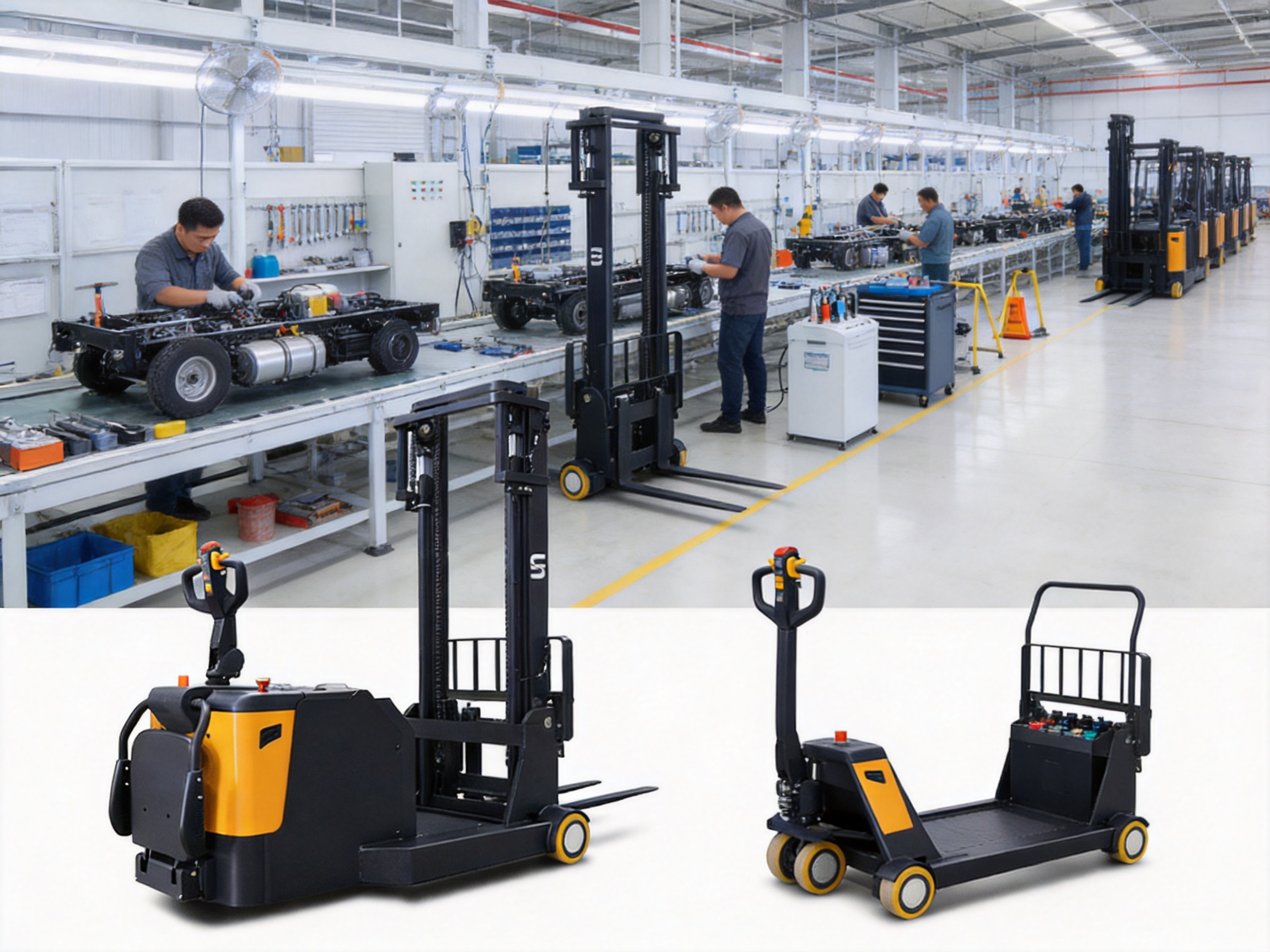
Modern warehouses, factories, distribution centers, and loading operations require material-handling equipment that can move pallets safely while using space and energy efficiently. The Electric Stacker PS12/15CB-C is designed for these demanding working environments. Combining counterbalanced construction, electric drive technology, adjustable operating configurations, and lifting capacities of 1,200 or 1,500 kilograms, it provides a practical solution between a pedestrian stacker and a conventional forklift.
This electric pallet stacker is intended for applications that require frequent loading, unloading, stacking, and short-distance transportation. It can be used in factories, warehouses, logistics centers, retail distribution facilities, and vehicle-loading areas. Its counterbalanced design allows the machine to handle loads without requiring the same type of stabilizing support legs used on many basic walkie stackers. This makes it suitable for a broad range of pallet configurations and working conditions.
The PS12/15CB-C is available in two primary capacity versions. The PS12CB-C is rated for 1.2 tonnes, while the PS15CB-C is rated for 1.5 tonnes. Depending on the configuration, users can select a pedestrian operating arrangement or an optional foldable rider platform with protective side arms. This flexibility enables one product family to serve different operating patterns, from occasional pallet movement to more intensive warehouse transportation.
Product Overview and Operating Purpose
An electric stacker is a vertical material-handling vehicle designed to raise pallets to storage levels and move them across a facility. Unlike a standard counterbalance forklift, it is more compact, generally operates at lower travel speeds, and is optimized for indoor or semi-indoor warehouse work. Unlike a simple manual pallet truck, it can lift pallets to substantial heights and can reduce the physical effort required from operators.
The PS12/15CB-C expands on this concept through its counterbalanced configuration. Counterbalance weight distribution helps the stacker manage loads without relying entirely on extended support legs under the forks. This arrangement can improve versatility when handling different pallet designs, closed-bottom pallets, and loads that require a more conventional fork approach.
The rated load capacities are 1,200 kilograms for the PS12CB-C and 1,500 kilograms for the PS15CB-C. Both versions use a 500-millimeter load center distance. Selecting the correct model should be based on the heaviest intended load, the load center, lift height, operating frequency, floor conditions, and the available aisle width.
The machine is powered entirely by electricity. A 24-volt industrial lead-acid battery supplies energy to the drive, lifting, steering, and control systems. The standard battery ratings are 24 volts and 210 ampere-hours for the PS12CB-C and 24 volts and 270 ampere-hours for the PS15CB-C. A larger 350 ampere-hour battery is available as an option for applications requiring extended operating time between charging periods.
Electric operation provides several benefits compared with internal-combustion equipment. There are no direct exhaust emissions during operation, noise is reduced, and the machine is better suited to enclosed facilities. Electric drive also allows precise speed control and smooth starting, which are valuable when working near stored products, personnel, racking, and loading docks.
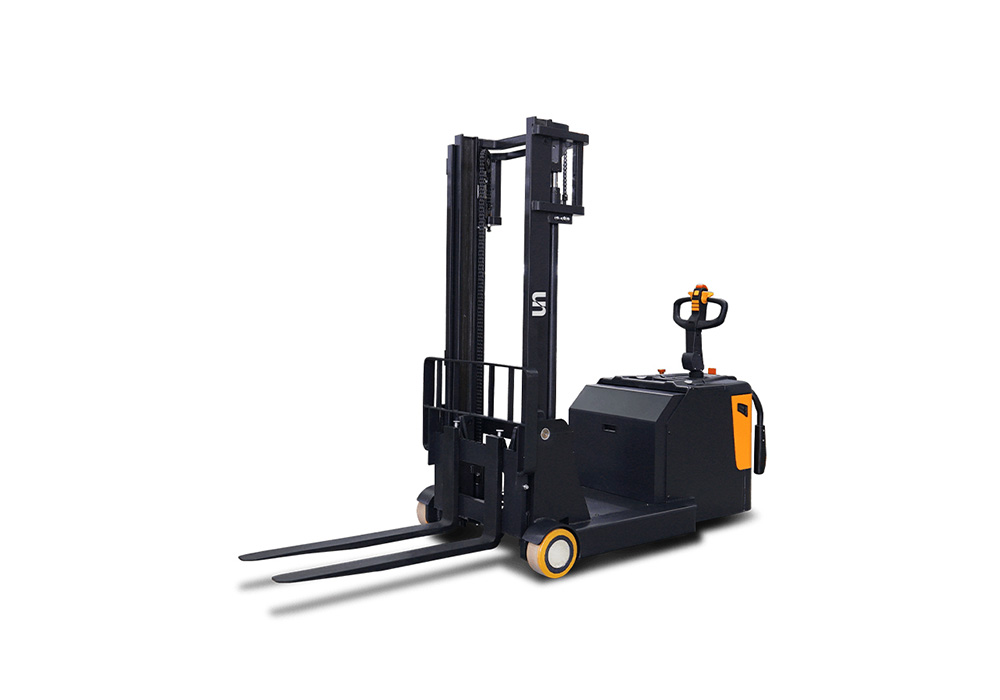
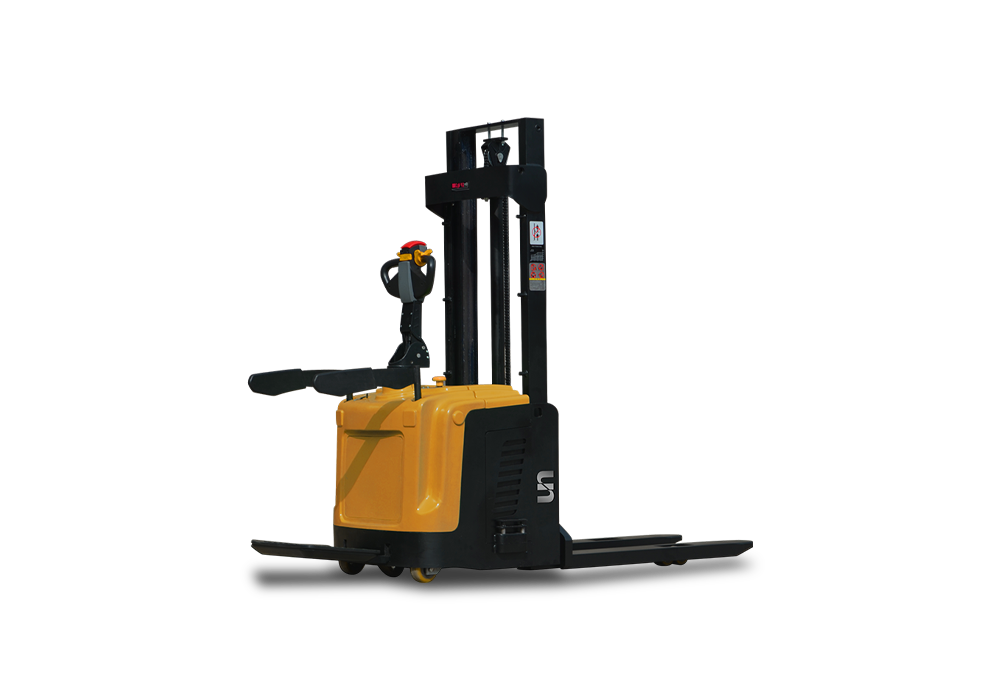
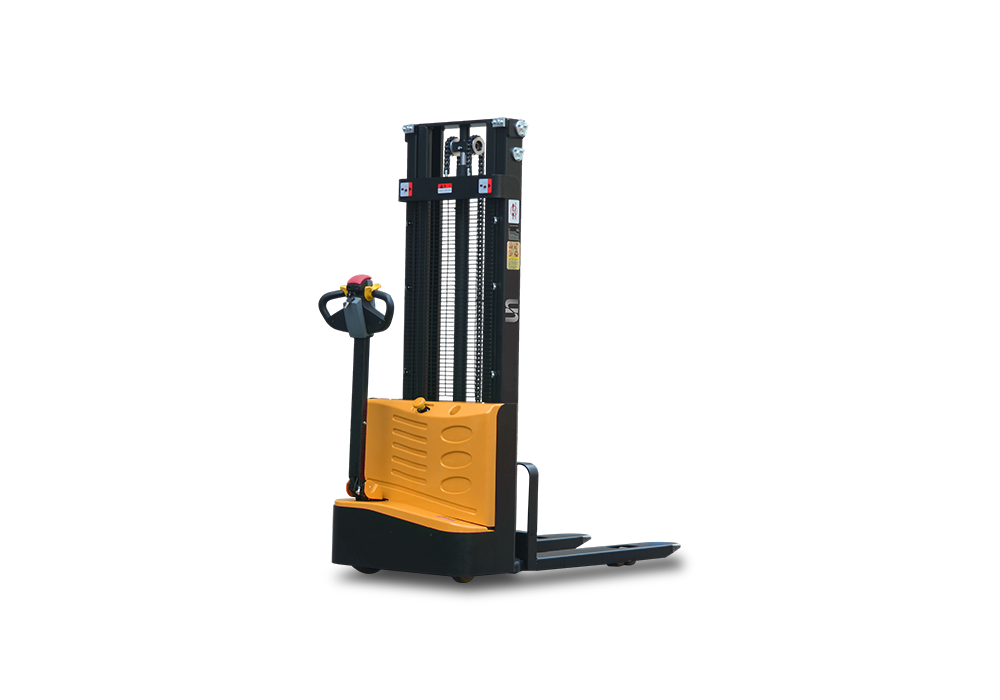
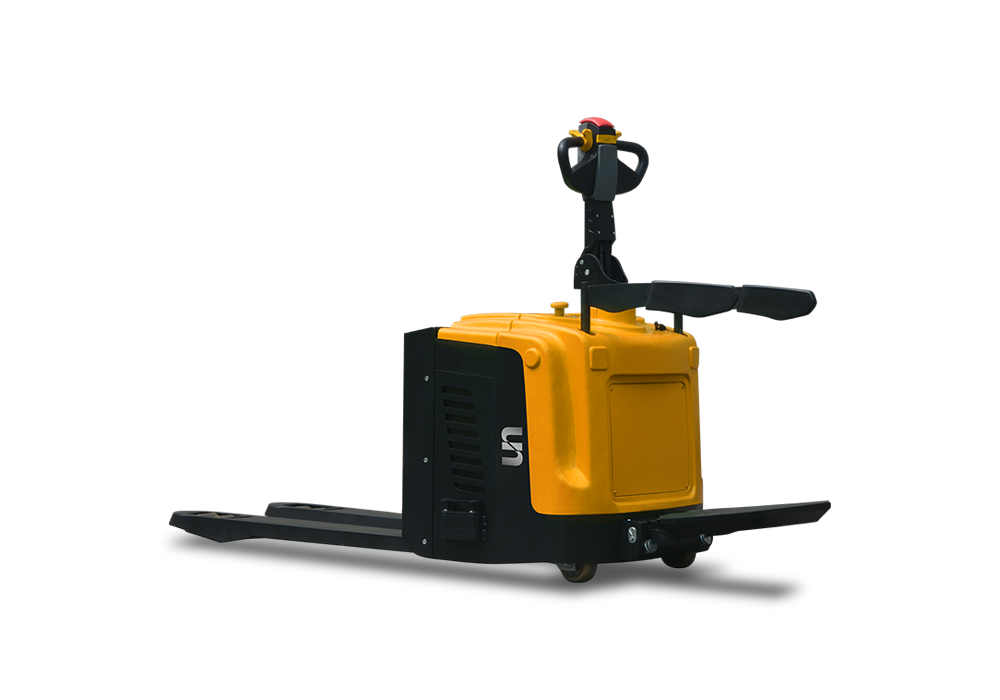
Electric Stacker PS12/15CB-C
Key Advantages in Competitive Applications
Counterbalanced Versatility
Many entry-level stackers are designed around support legs that extend beneath the pallet. While this arrangement can be effective with compatible pallets, it may restrict the type of load that can be approached or the way a pallet can be positioned. The counterbalanced structure of the PS12/15CB-C gives operators greater freedom when approaching loads and can make the machine more adaptable to mixed pallet conditions.
This versatility is especially useful in facilities that handle multiple pallet sizes, varied packaging formats, or loads that are not always presented in exactly the same way. The adjustable fork-arm distance ranges from 220 to 760 millimeters, allowing the operator to accommodate different pallet openings and load widths within the limits of the selected configuration.
Capacity Options for Different Workloads
A single capacity rating is not appropriate for every operation. The 1.2-tonne model can be a practical choice for routine warehouse loads where lower capacity is sufficient, while the 1.5-tonne version provides additional capacity for heavier pallets and more demanding loading tasks. Offering both versions helps users avoid purchasing a larger machine than necessary while still providing a higher-capacity option when required.
The capacity range also creates a useful alternative to a full-size forklift. In operations that do not need high travel speed, outdoor terrain capability, or very high lifting capacity, a compact electric stacker can deliver the necessary performance with lower operating complexity. It can also occupy less floor space and produce fewer emissions than an internal-combustion truck.
Pedestrian or Rider Platform Operation
The PS12/15CB-C can be configured for pedestrian operation or equipped with an optional foldable platform. Pedestrian operation is useful in short travel cycles where the operator frequently walks beside the vehicle or where maneuvering distance is limited. The rider platform is advantageous when travel distances are longer or when repeated movement between storage and loading areas would otherwise increase operator fatigue.
The optional platform includes sideways protective arms. When folded, it helps preserve the machine’s compact operating profile. When deployed, it gives the operator a more secure riding position and helps support safer travel. This two-mode design gives the machine a degree of flexibility that is not always available on basic pedestrian stackers.
Low Energy Consumption
Energy efficiency is a central advantage of electric material-handling equipment. The PS12/15CB-C uses an electric drive motor rated at 1.6 kilowatts and a lift motor rated at 2.2 kilowatts on the PS12CB-C or 3.0 kilowatts on the PS15CB-C. The motors are sized for warehouse lifting and transport duties while helping control battery consumption.
The battery system is designed for extended operating time. The PS12CB-C uses a 24-volt, 210-ampere-hour battery, while the PS15CB-C uses a 24-volt, 270-ampere-hour battery. The optional 350 ampere-hour battery can further extend work cycles when the application requires longer periods between charging opportunities.
Compared with fuel-powered equipment, electric operation can reduce energy-related operating costs, particularly in facilities with regular indoor duty cycles. The total result depends on electricity prices, battery maintenance, charging practices, duty intensity, and the cost of ventilation or exhaust management for combustion equipment.
Compact Maneuverability
The overall width is approximately 1,090 millimeters, making the stacker suitable for many warehouse aisles and loading areas. The turning and aisle requirements depend on the selected model and pallet orientation. The published aisle width for 1,000 by 1,200 millimeter pallets in the crossways direction is 2,991 millimeters for the PS12CB-C and 3,125 millimeters for the PS15CB-C. For 800 by 1,200 millimeter pallets in the lengthways direction, the figures are 3,076 and 3,210 millimeters respectively.
These measurements should be treated as planning references rather than universal guarantees. Actual space requirements can change according to pallet condition, load overhang, operator behavior, racking design, floor condition, and safety clearances. Facility managers should conduct a practical aisle assessment before final installation.
Construction and Major Components
Industrial Lead-Acid Battery
The machine uses a quality industrial lead-acid battery designed for repeated warehouse operation. The battery is an important structural and functional component because it supplies energy while also contributing to the vehicle’s stability. The available capacities support different operating durations and load requirements.
Battery care has a direct effect on productivity and service life. Charging should be performed according to the battery supplier’s instructions, with adequate ventilation and appropriate personal protective equipment where required. Operators and maintenance personnel should inspect terminals, cables, connectors, electrolyte condition where applicable, and signs of damage or overheating.
For high-utilization applications, fleet managers may consider a battery rotation plan, opportunity-charging strategy where compatible, or the optional larger battery. The correct choice depends on shift length, charging infrastructure, operating temperature, and the time available for scheduled charging.
Robust Battery Cover and Storage Tray
The battery cover is designed as a robust tray that provides a convenient storage area for tools and stretch film used in packaging operations. This feature can help keep frequently used items near the point of work rather than requiring a separate cart or repeated trips to a supply area.
Storage areas must be managed carefully. Tools, wrapping material, and other items should be secured so that they cannot fall into the travel path, interfere with controls, or create a trip hazard. The tray is intended for light operational accessories and should not be treated as an additional load platform.
AC Vertical Drive System
The AC vertical drive system is one of the principal technical features of the stacker. Alternating-current drive technology can provide responsive acceleration, smooth speed modulation, and reduced routine maintenance compared with some older drive arrangements. The vertical drive layout is also intended to make the power unit compact and accessible within the vehicle design.
Reduced maintenance does not mean maintenance-free operation. Drive wheels, electrical connections, brakes, steering components, control switches, and protective covers still require regular inspection. However, an efficient AC system can help reduce the service burden associated with mechanical wear and support consistent performance over the working life of the machine.
Electric Power Steering
Electric power steering reduces the physical effort required to guide the stacker. This is particularly useful when the vehicle is maneuvering in narrow aisles, around pallet positions, or near loading ramps. Smooth steering response can also help operators position the forks more accurately when approaching a pallet.
Power steering contributes to productivity because it reduces the amount of manual force required during repeated directional changes. It can also be beneficial in operations where different operators use the same equipment throughout the day. Steering controls should nevertheless be operated at a safe speed, particularly when the load is raised or when the floor is uneven.
High-Performance Hydraulic Pump
The hydraulic pump is designed to support accurate fork positioning during lifting and lowering. Controlled hydraulic movement is important because sudden fork movement can destabilize a load, damage packaging, or make it harder for the operator to align with a rack or truck bed.
The listed lift speeds vary by model and operating condition. The PS12CB-C has a lift speed of approximately 95 millimeters per second with load and 135 millimeters per second without load. The PS15CB-C has a lift speed of approximately 100 millimeters per second with load and 200 millimeters per second without load. Lowering speeds are also specified according to loaded and unloaded conditions.
Hydraulic performance depends on oil condition, temperature, load weight, mast configuration, and maintenance condition. Regular checks for leaks, damaged hoses, unusual noise, and inconsistent movement are important for safe operation.
Emergency Switch and Electromagnetic Braking
An emergency switch allows the operator to quickly interrupt machine operation when an unsafe condition occurs. It is a fundamental safety feature, but it must remain accessible and functional at all times. Operators should be trained in its location and use, and service personnel should verify that it operates correctly during scheduled inspections.
The service braking system is electromagnetic. Electromagnetic braking can provide controlled stopping and automatic braking behavior when the travel control is released or when specific safety conditions are met. The braking system should be tested on a regular basis and must not be considered a substitute for safe travel speed, adequate visibility, or proper load handling.
Performance and Technical Specifications
The following table summarizes the principal published data for the two capacity versions. Some values are common to both models, while others vary according to capacity or configuration.
| Specification | PS12CB-C | PS15CB-C |
|---|---|---|
| Rated capacity | 1,200 kg | 1,500 kg |
| Power source | Electric | Electric |
| Operating method | Pedestrian or standing | Pedestrian or standing |
| Load center | 500 mm | 500 mm |
| Wheel type | Polyurethane | Polyurethane |
| Wheel size, drive side | 230 × 82 mm | 230 × 82 mm |
| Wheel size, load side | 230 × 100 mm | 230 × 100 mm |
| Travel speed, laden/unladen | 5.5/6 km/h | 5.5/6 km/h |
| Lift speed, laden/unladen | 95/135 mm/s | 100/200 mm/s |
| Lowering speed, laden/unladen | 100/100 mm/s | 180/180 mm/s |
| Maximum gradeability, laden/unladen | 6/15% | 6/15% |
| Drive motor | 1.6 kW | 1.6 kW |
| Lift motor | 2.2 kW | 3.0 kW |
| Battery | 24 V/210 Ah | 24 V/270 Ah |
| Optional battery | Available according to configuration | Up to 350 Ah option |
| Overall width | 1,090 mm | 1,090 mm |
| Fork dimensions | 35/100/950 mm | 35/100/950 mm |
| Fork-arm distance | 220–760 mm | 220–760 mm |
| Ground clearance | 52 mm | 52 mm |
| Electromagnetic service brake | Standard | Standard |
| Sound level at operator’s ear | 68 dB(A) | 68 dB(A) |
The stated travel speed is 5.5 kilometers per hour when laden and 6 kilometers per hour when unladen. These speeds are appropriate for controlled warehouse transport rather than high-speed outdoor movement. The moderate speed supports load stability and helps operators maintain better control around pedestrians and storage systems.
The maximum gradeability is listed as 6 percent when laden and 15 percent when unladen. Operators should not assume that every ramp is suitable. Ramp length, surface condition, load security, battery charge, weather, and local safety rules must be considered before operation. Loads should be kept low during travel, and slopes should be approached according to the manufacturer’s operating instructions.
The machine uses polyurethane wheels. Polyurethane is commonly selected for warehouse equipment because it offers good rolling efficiency, low noise on suitable floors, and resistance to many forms of indoor wear. Wheel condition remains critical. Flat spots, cuts, embedded debris, excessive wear, or damage can affect braking, steering, stability, and floor protection.
Lift Heights and Mast Configurations
The published specifications include several mast and lift-height values. The PS12CB-C is listed with a lowered mast height of approximately 2,400 millimeters and a lift height of approximately 3,600 millimeters. The PS15CB-C is listed with a lowered mast height of approximately 2,100 millimeters and a lift height of approximately 4,500 millimeters. Extended mast heights are approximately 4,200 millimeters and 5,395 millimeters respectively.
These figures demonstrate that the product family can support different storage arrangements. However, the appropriate mast selection should be based on the lowest overhead clearance, the highest rack beam, the required free lift, ceiling height, door height, and the type of goods being stored. A nominal lift height alone does not determine whether a truck is suitable for a specific building.
Free lift is the distance the forks can rise before the mast begins to extend. The published specifications identify different free-lift values by model and configuration. Free lift is important when stacking beneath low ceilings, passing through doorways, or placing loads into racks where mast extension must be delayed.
The lowered fork height is listed as approximately 40 millimeters. Keeping forks close to the floor during travel can help reduce the risk of striking obstacles and can improve load stability. Operators should avoid dragging the forks across the floor and should raise them only as much as necessary when traveling.
Ergonomics and Operator Experience
Operator comfort is directly related to productivity and safety. The PS12/15CB-C includes electric power steering, an adjustable tiller position, and an optional suspension foldable platform. The listed tiller height in the driving position ranges from approximately 923 to 1,358 millimeters. This range allows the operator to position the control handle more comfortably according to operating posture and task requirements.
The foldable platform is especially useful for facilities with mixed travel distances. During short movements, an operator can fold the platform and use the stacker as a pedestrian machine. During longer transport cycles, the platform can be deployed to reduce walking effort. Protective side arms provide additional support while riding, although operators must still follow site rules regarding speed, footwear, visibility, and load height.
Control layout, visibility, steering response, and braking behavior all influence how quickly a new operator can become competent. Training should cover startup checks, pedestrian awareness, pallet approach, load center positioning, mast operation, travel with a raised load, charging, emergency stop use, and parking procedures.
Safety Features and Responsible Operation
Safe operation begins with matching the truck to the application. The rated capacity is based on defined conditions, including the load center and mast configuration. As the load center increases or the load is raised higher, the effective capacity can decrease. Operators should consult the capacity plate and never use the nominal 1,200 or 1,500 kilogram rating as a universal capacity at every height.
Loads should be stable, evenly distributed, and suitable for the pallet. Damaged pallets, loose cartons, unstable containers, or loads with excessive overhang can create hazards even when the total weight is below the rated capacity. Forks should be inserted fully where possible, and the load should be positioned against the fork shank without exceeding approved dimensions.
Before each shift, operators should inspect the forks, mast, chains, hydraulic hoses, wheels, battery, steering, emergency switch, horn, controls, brakes, and visible structural components. Any oil leak, abnormal sound, damaged fork, loose connection, or unusual braking behavior should be reported and corrected before the machine returns to service.
Travel speed should be reduced at intersections, blind corners, ramps, dock edges, wet floors, and areas with pedestrian traffic. Loads should be carried in a low position, and the operator should maintain a clear view. If the load blocks forward visibility, the operator should travel in the direction that provides the safest view while following site procedures.
The emergency switch is intended for urgent situations, not routine stopping. Frequent unnecessary use can interrupt operations and may indicate a need to improve traffic controls, operator training, or machine settings. Emergency controls must remain unobstructed and clearly understood by every authorized operator.
Manufacturing Strengths and Quality Approach
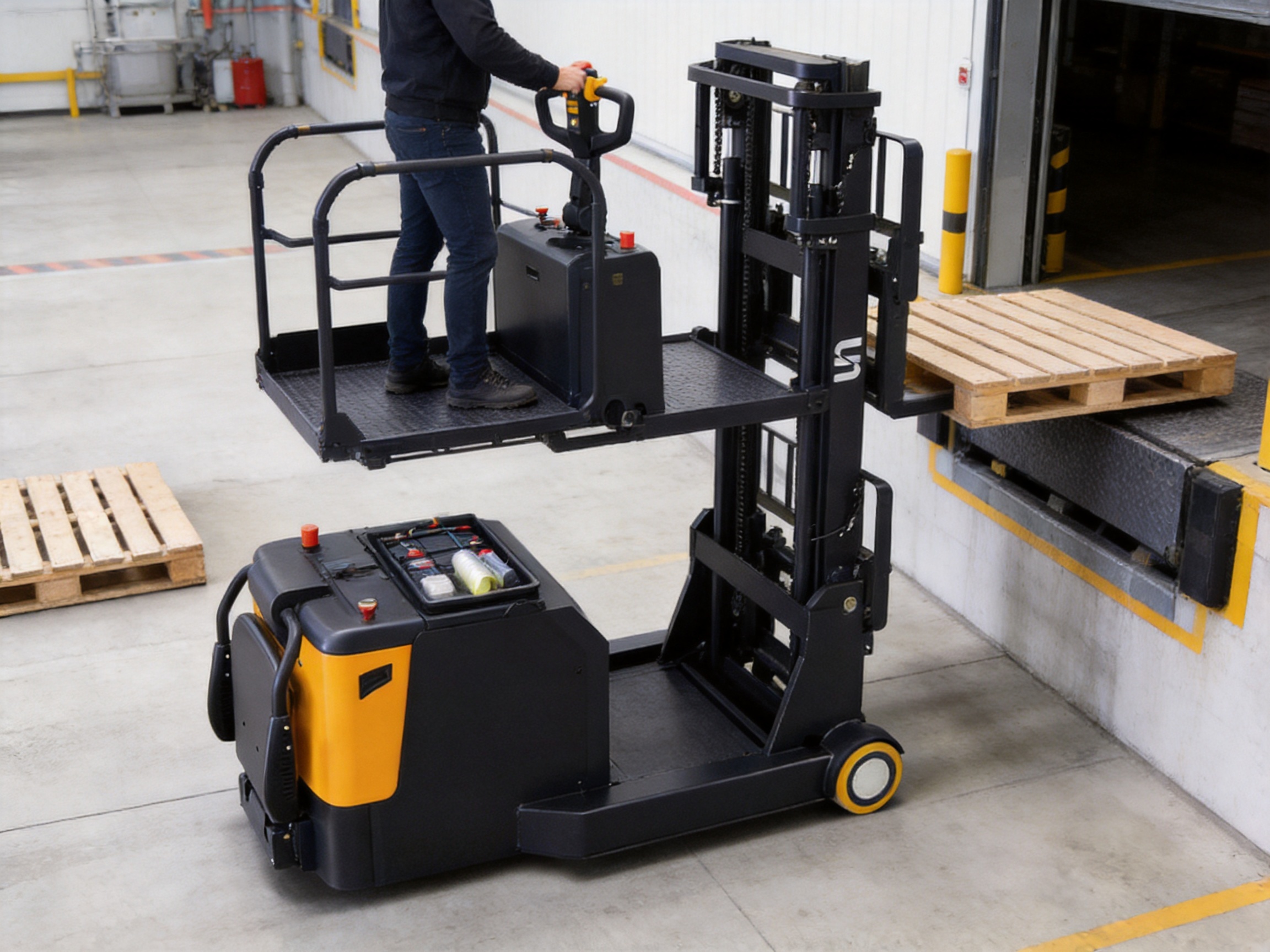
The manufacturer behind this product is an established material-handling equipment producer with experience dating back to 1978. Its stated capabilities include research and development, production, sales, and service. The company operates a manufacturing site covering approximately 53,400 square meters and reports an annual production capacity of approximately 15,000 units.
A broad product portfolio is another manufacturing strength. The company reports 17 varieties, 96 series, and more than 200 specifications across forklift and warehouse equipment categories. This breadth can support component standardization, application-specific product development, and parts availability across related models.
The manufacturer also reports experience in developing reach forklifts, very-narrow-aisle equipment, internal-combustion forklifts, electric forklifts, and new-energy products. Such a product range provides an engineering foundation for understanding different load-handling requirements, stability conditions, control systems, and powertrain technologies.
Research and development experience is particularly relevant to electric stackers. Electric equipment requires coordinated design of batteries, controllers, motors, hydraulic systems, braking, steering, structural components, and operator controls. Improvements in any one area must be compatible with the others. For example, a larger battery may improve operating time but also affect vehicle weight, charging requirements, and service procedures.
The company states that it holds national patents related to electric forklift technologies and has participated in the formulation of electric forklift industry standards in its domestic market. It also reports OEM cooperation with recognized industrial companies. These activities indicate experience in engineering consistency, production coordination, and adaptation to different customer requirements.
Production Process Considerations
Although detailed factory process data for this specific model is not provided, a high-quality electric stacker normally depends on several controlled manufacturing stages. Structural components must be cut, formed, welded, and inspected to maintain dimensional accuracy. Mast alignment is essential because even small deviations can affect fork movement, load stability, and wear on rollers or chains.
Welding quality is important in the chassis, mast, fork carriage, battery compartment, and protective structures. Consistent welding procedures, qualified personnel, appropriate fixtures, and visual or non-destructive inspection methods can help reduce structural defects. After welding, components may require surface preparation and protective coating to resist corrosion and industrial wear.
Hydraulic components should be assembled in a clean environment to prevent contamination. Hoses, fittings, cylinders, pumps, and valves must be installed with correct torque and routing. Hydraulic cleanliness has a direct effect on pump life, valve operation, lowering control, and leakage risk.
Electrical assembly requires careful routing of battery cables, control wiring, emergency circuits, steering components, motor connections, and protective devices. Correct polarity, connector security, insulation, grounding, and controller programming are important for reliable operation. Functional testing should verify forward and reverse travel, braking, steering, lifting, lowering, emergency stop response, and battery indication.
End-of-line testing should include load-handling performance, mast movement, braking distance, steering response, abnormal noise, vibration, and general fit and finish. Testing under representative conditions helps identify problems that may not appear during a static inspection. Documentation of inspection results can support traceability and continuous improvement.
Applications Across Industry
Warehouse Storage and Retrieval
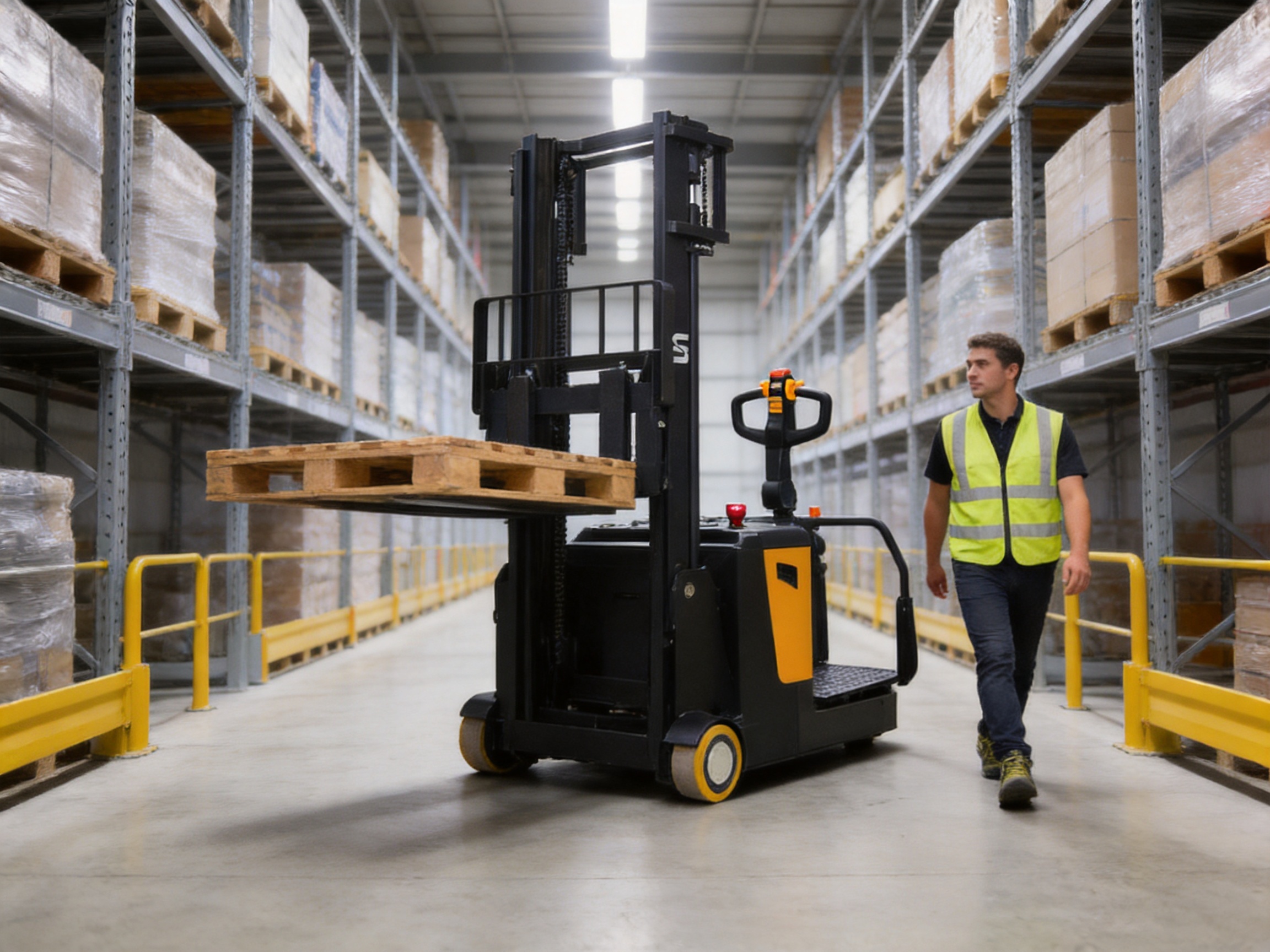
The stacker can be used to move pallets from receiving areas to rack positions, replenish picking locations, and transfer finished goods to dispatch zones. Its lifting capability allows it to serve applications where a pallet truck would be insufficient but a full-sized forklift would be unnecessarily large.
Factory Material Supply
Manufacturing facilities can use the machine to deliver components, packaging materials, and finished goods between storage areas and production lines. Electric operation is beneficial where cleanliness, low noise, and the absence of exhaust emissions are priorities.
Truck and Container Loading Areas
The machine is suitable for loading and unloading goods from lorries and similar vehicles when the surface, ramp, and clearance conditions meet operating requirements. Dock edges, vehicle floors, bridge plates, and ramps require particular attention. The stacker should only be used on loading surfaces with adequate strength and traction.
Retail and Distribution Facilities
Distribution centers and larger retail facilities often need equipment that can perform both short-distance pallet movement and occasional stacking. The pedestrian/rider configuration allows one machine to support multiple work patterns while reducing the need for separate equipment types.
Packaging and Shipping Operations
The integrated tray for tools and stretch film can be convenient in packaging areas. Operators can move a pallet and keep basic wrapping supplies close at hand. This may reduce small interruptions during dispatch preparation, provided the tray is not overloaded or used to carry unsecured objects.
Maintenance and Ownership Value
Total ownership value depends on more than the purchase price. Battery life, tire wear, hydraulic maintenance, availability of service parts, operator training, energy cost, and downtime all influence the long-term result. The PS12/15CB-C is designed with several features that can support controlled operating costs, including AC drive technology, electric steering, polyurethane wheels, and a straightforward electric architecture.
Preventive maintenance should follow a documented schedule. Daily checks can cover visible damage, battery condition, wheels, forks, controls, brakes, steering, mast movement, and leaks. Periodic maintenance should include inspection of chains, rollers, hydraulic oil, electrical connections, drive components, brake operation, and structural fasteners.
Battery maintenance is especially important. Charging areas should be clean, ventilated, and protected from ignition sources where lead-acid charging creates hydrogen gas. Batteries should be secured correctly, and charging connectors should be inspected for heat damage or looseness. If a battery becomes unusually hot, swells, leaks, or produces abnormal odors, it should be removed from service and examined by qualified personnel.
Operators should report small problems before they become major failures. A minor hydraulic seep, unusual wheel vibration, delayed braking response, or intermittent control fault can develop into a safety issue or costly downtime. A clear defect-reporting system encourages early intervention.
Choosing Between the Two Models
The PS12CB-C is appropriate when the maximum routine load is close to 1,200 kilograms or below and when the application benefits from a lower-capacity configuration. Its 24-volt, 210 ampere-hour battery and 2.2-kilowatt lift motor are suited to many standard warehouse duties.
The PS15CB-C is the stronger option for loads up to 1,500 kilograms and for applications that require greater lifting performance. It uses a larger standard battery, a 3.0-kilowatt lift motor, and a higher listed lift height. The additional capacity may provide more flexibility when pallet weights vary or when heavier goods are handled regularly.
Users should not select the PS15CB-C solely because it has a higher rated capacity. The correct choice depends on the application, including available aisle width, rack height, travel distance, charging resources, floor conditions, and the required operating mode. A site survey and load analysis are recommended before ordering.
Environmental and Workplace Benefits
Electric stackers can support workplace environmental objectives by eliminating direct exhaust emissions during operation. This is particularly valuable in enclosed facilities where combustion equipment could require additional ventilation or emissions controls. Electric operation also generally produces less noise than internal-combustion equipment, although the stated sound level of approximately 68 dB(A) should still be considered in overall workplace noise planning.
Lower noise can improve communication between operators and pedestrians, but it may also make approaching equipment less noticeable. Facilities should not rely on sound alone for awareness. Clearly marked travel lanes, warning systems, mirrors, lighting, speed controls, and pedestrian separation remain important.
Energy and environmental performance also depend on battery management and electricity sources. Proper charging, timely battery replacement, recycling, and responsible disposal of lead-acid batteries are essential parts of a sustainable equipment program.
Q&A
What type of equipment is the PS12/15CB-C?
It is an electric counterbalanced pallet stacker designed for lifting and transporting pallets in warehouses, factories, logistics facilities, and loading areas. It can operate as a pedestrian machine or with an optional foldable rider platform.
What are the available load capacities?
The PS12CB-C has a rated capacity of 1,200 kilograms, and the PS15CB-C has a rated capacity of 1,500 kilograms. The actual permissible capacity depends on the load center, mast configuration, lift height, and capacity plate.
What battery does the machine use?
The PS12CB-C uses a 24-volt, 210 ampere-hour battery. The PS15CB-C uses a 24-volt, 270 ampere-hour battery, with a larger battery option available for selected configurations. Battery charging and maintenance must follow the applicable instructions.
Can the stacker be used for long travel distances?
Yes, the optional foldable platform makes it more suitable for longer travel cycles than a basic pedestrian stacker. The platform includes protective side arms. The machine remains intended for controlled warehouse and industrial travel rather than high-speed outdoor transport.
What are the main advantages of the counterbalanced design?
The counterbalanced design can accommodate a broader range of pallet approaches and load configurations than some support-leg stackers. It may be especially useful when handling different pallet styles or when the operator needs more flexibility around the load.
What lifting heights are available?
The published data includes lift heights of approximately 3,600 millimeters for the PS12CB-C and 4,500 millimeters for the PS15CB-C. Actual availability depends on the mast configuration selected for the order.
Is the machine suitable for indoor use?
Yes. Its electric powertrain, polyurethane wheels, compact dimensions, and low-emission operation make it suitable for many indoor warehouse and factory applications. Floor quality, ventilation, aisle width, and site safety requirements must still be evaluated.
How wide are the forks?
The fork dimensions are listed as 35 millimeters thick, 100 millimeters wide, and 950 millimeters long. The distance between the fork arms can be adjusted from approximately 220 to 760 millimeters, subject to the specific configuration.
What safety systems are included?
Reported safety-related features include an emergency switch, electromagnetic braking, controlled hydraulic lifting and lowering, protective side arms on the optional platform, and electric power steering. Safe operation also requires training, inspections, proper load preparation, and compliance with site regulations.
How should buyers compare this stacker with a conventional forklift?
Buyers should compare rated capacity, lift height, aisle requirements, travel distance, operating surface, emissions, noise, battery infrastructure, service support, and total ownership cost. The stacker is advantageous where compact electric handling is required, while a larger forklift may be better for high-speed outdoor work, rough terrain, or substantially heavier loads.
What should be confirmed before purchase?
Customers should confirm the required capacity at the intended load center and lift height, mast dimensions, battery option, platform configuration, fork dimensions, charger requirements, aisle width, floor conditions, service arrangements, and applicable local standards. Any unusual specification should be verified with the supplier before final approval.
Conclusion
The Electric Stacker PS12/15CB-C is a versatile material-handling solution for organizations that need more than a manual pallet truck but do not require a full-sized forklift for every task. Its 1,200- and 1,500-kilogram capacity choices, counterbalanced structure, electric powertrain, optional rider platform, polyurethane wheels, power steering, electromagnetic braking, and controlled hydraulic system make it suitable for a broad range of warehouse and factory applications.
Its strongest competitive advantages are flexibility, compact operation, low-emission electric performance, and the ability to adapt between pedestrian and standing travel. The product is also supported by a manufacturer with long-term experience in forklift production, a broad equipment portfolio, reported electric-technology development, and an international sales and service network.
For the best result, buyers should evaluate the stacker as part of a complete material-handling system. Correct capacity selection, appropriate mast height, safe aisle planning, battery management, operator training, preventive maintenance, and professional service support are all necessary to achieve reliable performance. When these factors are properly matched to the application, the PS12/15CB-C can help improve pallet movement, reduce handling effort, and support more efficient warehouse operations.
References
1. Product specification sheet for the PS12CB-C and PS15CB-C electric counterbalanced stacker.
2. Manufacturer technical information concerning electric drive systems, pallet stackers, forklift products, and warehouse equipment.
3. General principles of industrial truck capacity rating, load center management, and safe pallet handling.
4. General guidance on lead-acid battery charging, inspection, maintenance, and workplace safety.
5. General warehouse planning principles covering aisle width, rack clearance, pedestrian separation, and loading-area safety.
6. General preventive-maintenance practices for electric material-handling equipment, including hydraulic, electrical, steering, braking, wheel, and mast systems.
Product: Electric Stacker PS12/15CB-C

For exclusive deals and latest offers, sign up by entering your email address below.
Stay In Touch
ADDRESS : NO.1 ROAD ONE, XINDENG NEW DISTRICT, FUYANG, HANGZHOU, ZHEJIANG, CHINA 311404.
PHONE : +86-571-8688 8355 (AMERICA)
PHONE : +86-571-8886 9363 (EUROPE)
PHONE : +86-571-8688 8377 (ASIA, AFRICA, OCEANIA)
EMAIL : [email protected]
EMAIL : [email protected](PARTS INQUIRY)

