


 中文简体
中文简体 Français
 русский
 Español
 عربى
عربى Deutsch



Why 2.0T–3.2T Cushion-Tire Lithium-Ion Forklifts Are Reshaping Indoor Material Handling
Admin 2026-09-19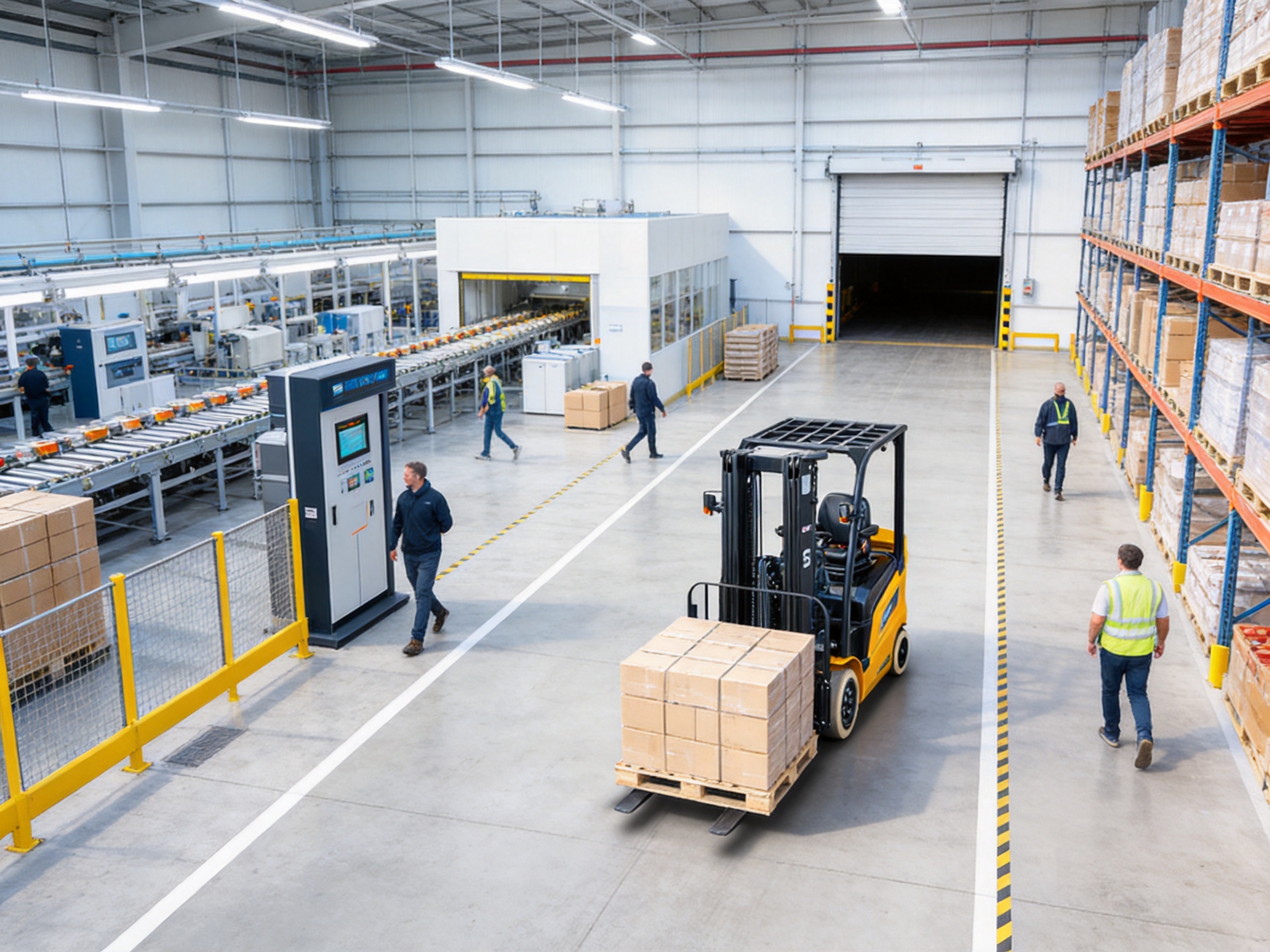
Material handling operations are under constant pressure to move more goods in less time, reduce operating costs, improve workplace safety, and meet increasingly demanding environmental expectations. Forklifts remain central to these operations, but the requirements placed on them have changed significantly. Warehouses, distribution centers, manufacturing plants, retail logistics facilities, and indoor production areas now need equipment that is compact, quiet, energy-efficient, easy to maintain, and dependable throughout repeated work cycles.
The FC Series 2.0T–3.2T lithium-ion battery forklift with cushion tires is designed for precisely this operating environment. It combines the familiar productivity of a four-wheel forklift with the low-noise, low-emission benefits of lithium-ion power. Its cushion-tire configuration supports tight turning spaces and smooth indoor surfaces, while its compact structure helps operators work effectively in aisles, loading zones, production lines, and storage areas where maneuverability is critical.
This article examines the design, performance, application value, manufacturing strengths, and long-term operating advantages of this type of forklift. It also explains how the product compares with conventional internal-combustion forklifts and other electric alternatives, and why the manufacturing capabilities of Zhejiang UN Forklift Co., Ltd. support the product’s reliability and market competitiveness.
1. The Role of the FC Series in Modern Material Handling
The FC Series is positioned as a four-wheel cushion-tire lithium-ion battery forklift for rated capacities from approximately 2.0 to 3.2 tons. This capacity range covers a broad group of daily material handling tasks. It is large enough for many industrial loads, palletized goods, raw materials, finished products, containers, and warehouse supplies, while remaining compact enough for indoor applications where space is limited.
Unlike large outdoor forklifts that are optimized for uneven ground, long-distance travel, and severe weather exposure, a cushion-tire forklift is designed around the needs of paved and relatively smooth operating surfaces. Typical environments include warehouses, distribution centers, factories, loading docks, packaging plants, retail back rooms, and indoor logistics hubs.
The product combines three important characteristics. First, its lithium-ion battery provides an efficient electric power source with no direct exhaust emissions during operation. Second, its four-wheel design provides stability and predictable handling when transporting loads. Third, its cushion tires reduce the overall footprint and support a tight turning radius, which is particularly valuable in crowded indoor work areas.
The supplied specifications identify a representative configuration, the FB25, with a rated load capacity of 5,000 pounds, or 2,270 kilograms. The configuration includes an 80-volt, 350-ampere-hour battery system, a no-load travel speed of up to 8.7 miles per hour, a full-load gradeability rating of 15 percent, and an outside turning radius of approximately 76.8 inches. These specifications place the forklift in a practical performance range for demanding warehouse and light-to-medium industrial work.
2. Core Product Advantages
2.1 Lithium-Ion Power for Efficient Daily Operation
The most important feature of the FC Series is its lithium-ion battery system. Compared with conventional lead-acid electric forklifts, lithium-ion technology can provide a more convenient energy solution for operations that require frequent use, short charging intervals, or multiple shifts.
Lithium-ion batteries generally support opportunity charging. Instead of waiting for a long battery replacement or charging cycle, operators can recharge the forklift during planned breaks, shift changes, or other idle periods when the correct charging infrastructure is available. This can reduce interruptions and help organizations use the same fleet more intensively.
The battery system also avoids many of the routine maintenance tasks associated with traditional lead-acid batteries. There is no need for regular watering, and the work area is not exposed to the same level of acid-handling requirements. This can simplify fleet management and improve the cleanliness of battery charging areas.
Electric drive also supports consistent operation. The forklift can deliver smooth acceleration and controllable travel behavior without the vibration, exhaust, and engine noise associated with internal-combustion equipment. In indoor facilities, these qualities contribute to a more comfortable environment for operators and nearby employees.
2.2 Clean and Quiet Operation
Indoor air quality is a major concern for warehouses and factories. Internal-combustion forklifts can release exhaust gases, particulate matter, and combustion-related pollutants. Even when ventilation systems are installed, emissions may become a concern in enclosed or semi-enclosed work areas.
The FC Series produces no direct tailpipe emissions during operation. This makes it suitable for many indoor applications where diesel, LPG, or gasoline forklifts may be restricted or undesirable. The lower-emission operating profile can be especially useful in facilities handling food packaging, consumer goods, pharmaceutical products, electronics, and other environmentally sensitive materials.
Noise reduction is another important advantage. Electric motors are naturally quieter than internal-combustion engines, particularly during low-speed maneuvering and frequent stop-and-go work. A quieter forklift allows operators to communicate more easily, hear warning signals more clearly, and work in a less stressful environment. It can also reduce disturbance in facilities located near offices, retail areas, or residential districts.
2.3 Cushion Tires for Compact Indoor Work Areas
Cushion tires are made from solid rubber compounds fitted around the wheel. They are designed for smooth, firm surfaces rather than rough terrain. Their compact dimensions enable the forklift to maintain a relatively small overall profile, which is valuable in narrow aisles, congested loading zones, and high-density storage facilities.
The FC Series has a published overall width of approximately 42.5 inches, or 1,080 millimeters, in the representative configuration. Its outside turning radius is approximately 76.8 inches, or 1,950 millimeters. These dimensions help the forklift turn efficiently in areas where a larger pneumatic-tire machine may require additional maneuvering space.
Cushion tires also offer predictable contact with smooth indoor floors. They are not intended for broken pavement, deep gravel, mud, or highly uneven outdoor terrain, but on suitable surfaces they provide stable handling and a compact operating envelope. This makes them a practical choice for manufacturers and warehouse operators seeking to maximize usable floor space.
2.4 Four-Wheel Stability
Three-wheel electric forklifts can deliver excellent maneuverability, but four-wheel forklifts are often preferred when load stability, operator confidence, and general-purpose capability are priorities. The four-wheel configuration of the FC Series supports stable load handling and balanced operation during travel, lifting, and positioning.
For a forklift handling loads up to approximately 2,270 kilograms in the stated configuration, stability is a major consideration. The wheelbase of approximately 55.1 inches, or 1,400 millimeters, contributes to a controlled operating platform. Operators can benefit from the predictable behavior of a four-wheel chassis when transporting palletized goods or handling loads at moderate height.
The four-wheel design also supports a broad range of applications. It is suitable for operators who need more capacity and stability than a compact three-wheel model can provide, but who do not require the larger dimensions and outdoor capability of a heavy-duty pneumatic-tire forklift.
2.5 Practical Travel and Gradeability Performance
The representative configuration offers a no-load travel speed of up to 8.7 miles per hour, or 14 kilometers per hour. This enables efficient movement between storage locations, staging areas, production lines, and loading points. Actual speed should always be selected according to load condition, floor quality, traffic, visibility, and site safety rules.
A maximum gradeability rating of 15 percent at full load indicates that the forklift can manage moderate ramps and inclines when operated within the manufacturer’s requirements. This is useful in warehouses with loading dock approaches, internal ramps, mezzanine access routes, or changing floor levels.
Gradeability should not be interpreted as permission to operate on every slope. The actual safe operating limit depends on the gradient, surface condition, load height, load security, direction of travel, tire condition, and local regulations. Nevertheless, the published figure demonstrates that the forklift is designed for more than completely flat warehouse aisles.
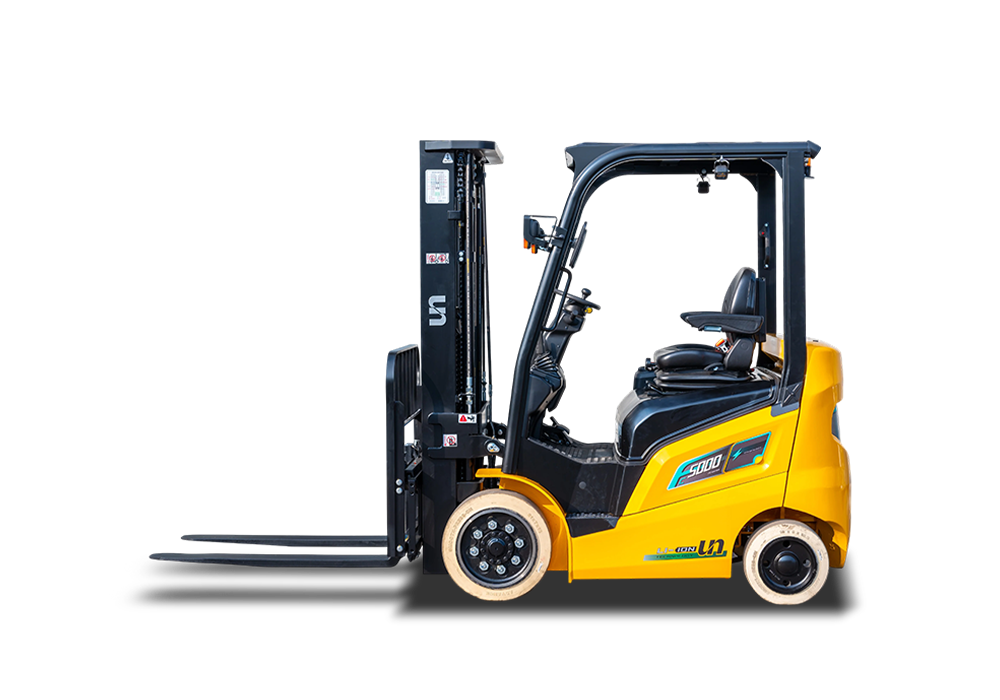
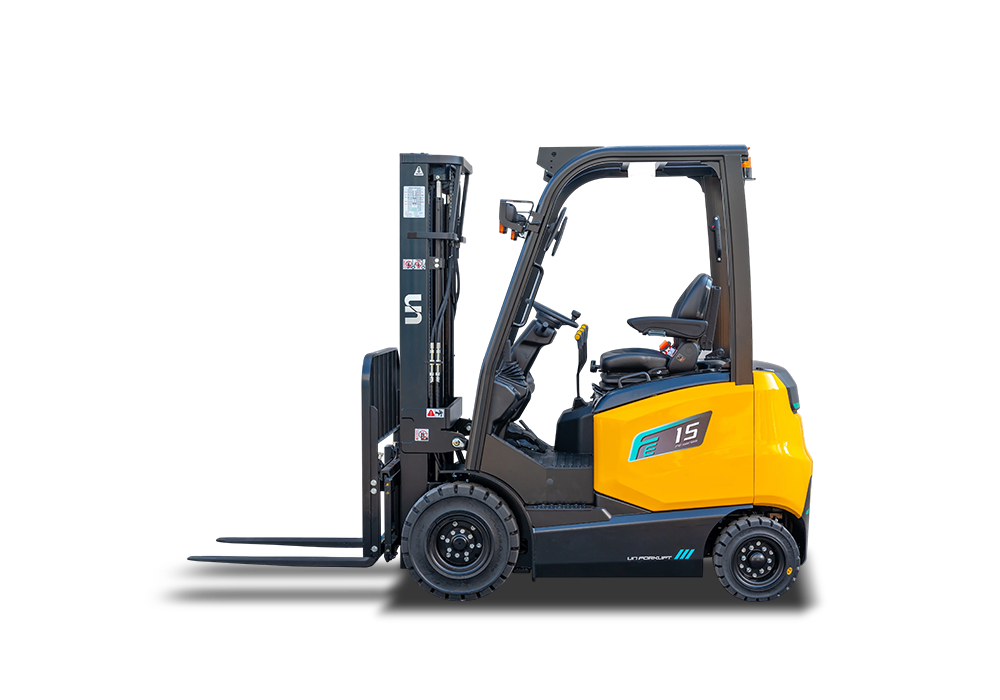
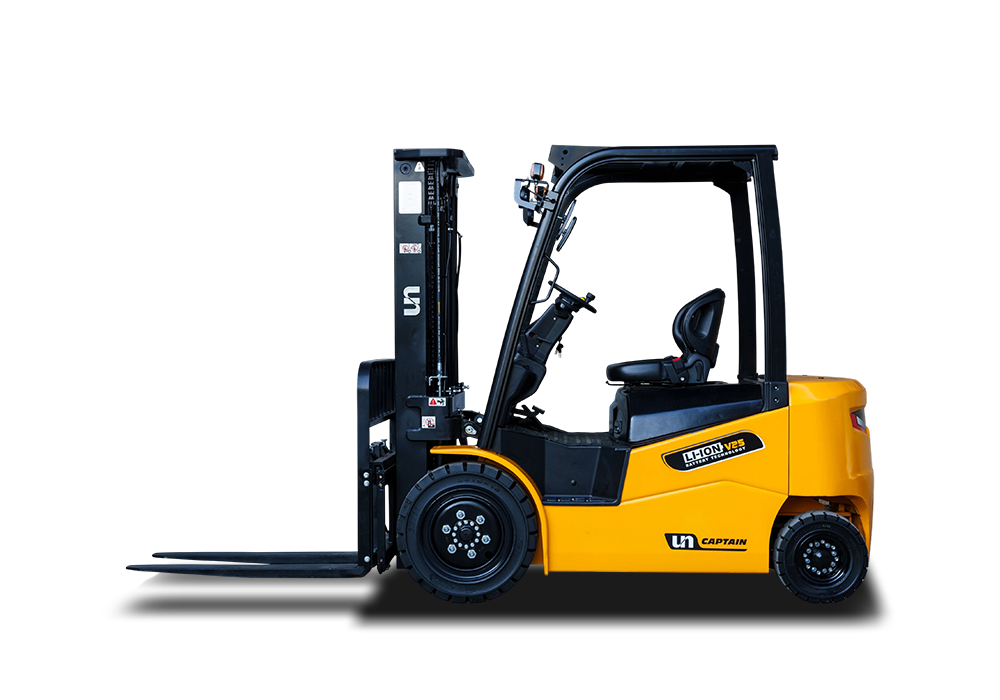
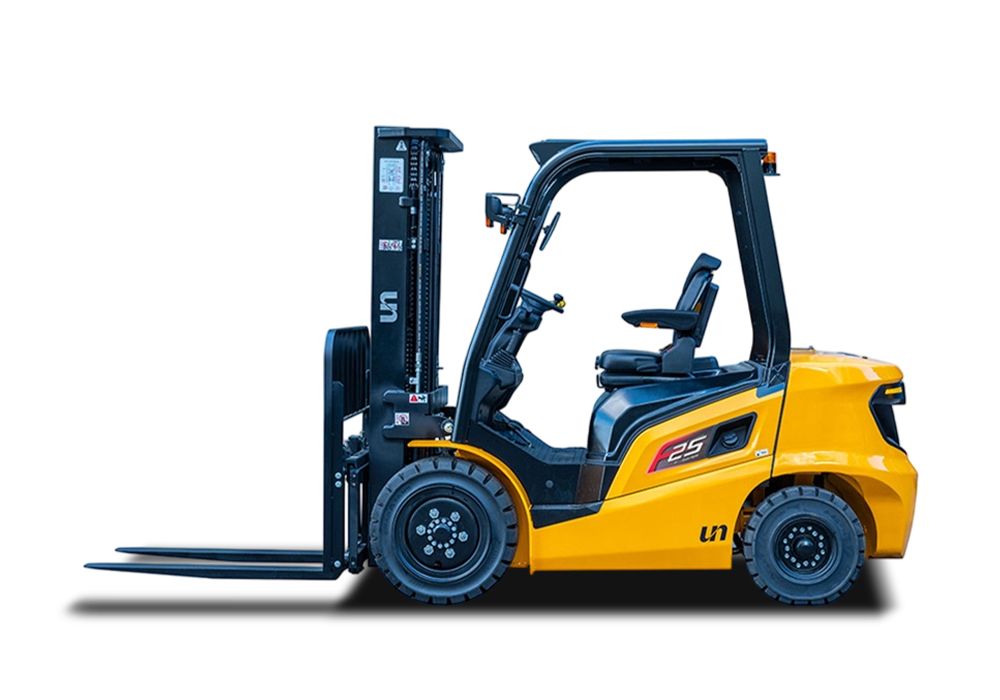
FC Series 2.0T-3.2T Li-ion Battery Forklift (Cushion Tire)
3. Main Specifications and What They Mean in Practice
| Specification | Representative Value | Operational Significance |
|---|---|---|
| Product series | FC Series | Four-wheel cushion-tire lithium-ion battery forklift family |
| Capacity range | 2.0T–3.2T | Suitable for warehouse, distribution, and light-to-medium industrial loads |
| Representative model | FB25 | Configuration shown in the supplied technical information |
| Rated load capacity | 5,000 lb / 2,270 kg | Maximum rated capacity under the applicable load-center conditions |
| Load center | 24 in / 600 mm | Reference point for capacity and load stability calculations |
| Wheelbase | 55.1 in / 1,400 mm | Supports stability and predictable handling |
| Total weight | 9,240 lb / 4,200 kg | Important for floor loading, transport, and operating stability |
| Overhead guard height | 87 in / 2,210 mm | Relevant to doorways, rack clearances, and facility access |
| Length to fork face without fork | 87.6 in / 2,224 mm | Useful for evaluating aisle requirements and turning space |
| Overall width | 42.5 in / 1,080 mm | Supports compact indoor maneuvering |
| Outside turning radius | 76.8 in / 1,950 mm | Helps estimate turning clearance and aisle requirements |
| No-load travel speed | 8.7 mph / 14 km/h | Supports efficient movement across the facility |
| Full-load gradeability | 15 percent | Indicates capability on moderate inclines under rated conditions |
| Battery | 80 V / 350 Ah | High-voltage lithium-ion power system for sustained electric operation |
Specifications should always be reviewed together rather than individually. For example, a rated capacity of 2,270 kilograms applies at a specified load center and under defined mast, attachment, and lifting conditions. If the load center increases, if an attachment is installed, or if the load is raised to a greater height, the allowable capacity may change.
Similarly, the overall width and turning radius are only two elements in aisle planning. Facilities should also consider rack projection, pallet dimensions, fork length, load overhang, pedestrian traffic, fire exits, charging areas, and the required clearance for safe operation.
The overhead guard height of approximately 87 inches is also significant. Before purchasing or deploying the forklift, operators should check doorways, container entrances, low beams, sprinkler systems, dock shelters, and other overhead obstructions. Careful site measurement helps ensure that the forklift can travel through the facility without restrictions.
4. Advantages Over Conventional Internal-Combustion Forklifts
4.1 Lower Indoor Emissions
Internal-combustion forklifts remain useful for outdoor yards, rough surfaces, heavy loads, and long continuous operation. However, they are not always the best choice for enclosed facilities. The FC Series offers a cleaner alternative for indoor work because it does not use a combustion engine during normal operation.
This advantage may reduce ventilation requirements and support a healthier work environment. It can also help companies align equipment decisions with sustainability programs, energy-reduction targets, and customer expectations regarding environmentally responsible operations.
4.2 Reduced Noise and Vibration
Engine vibration and exhaust noise can contribute to operator fatigue and make communication more difficult. Electric forklifts typically offer quieter movement and smoother low-speed control. In a busy distribution center, this can improve awareness and reduce the background noise level.
Lower vibration may also improve the experience of transporting fragile or sensitive goods. While careful driving remains essential, smooth electric travel can support more controlled handling during acceleration, deceleration, and positioning.
4.3 Energy and Maintenance Considerations
Internal-combustion forklifts require fuel, engine oil, filters, cooling systems, exhaust components, and other engine-related maintenance. A lithium-ion forklift eliminates many of these systems. The result can be a simpler daily maintenance routine and potentially lower operating complexity.
The total cost of ownership depends on electricity prices, utilization, battery configuration, charging infrastructure, service requirements, residual value, and local operating conditions. However, lithium-ion technology can provide strong economic value when the forklift is used frequently and opportunity charging is integrated into the workflow.
5. Advantages Over Traditional Lead-Acid Electric Forklifts
Traditional lead-acid electric forklifts remain widely used and can be economical in certain applications. However, lithium-ion technology offers several operational advantages for high-utilization fleets.
Lead-acid batteries often require scheduled charging periods and may need replacement when a shift extends beyond their available operating time. Organizations may need spare batteries, battery-changing equipment, additional storage space, and dedicated ventilation or maintenance areas. Lithium-ion systems can reduce the need for these arrangements when charging is properly planned.
Lead-acid batteries also require water maintenance. Incorrect watering can reduce battery life or create safety and housekeeping problems. Lithium-ion batteries do not require the same watering procedure, which can reduce routine labor and improve equipment availability.
Lithium-ion batteries generally maintain more consistent voltage during use, supporting stable performance over the working cycle. They are also well suited to facilities that operate in multiple shifts and need to keep equipment moving with limited downtime.
However, the right selection depends on the application. A fleet manager should evaluate shift length, duty cycle, charging access, ambient temperature, infrastructure, service support, and purchase budget. The FC Series becomes especially attractive when clean indoor operation, frequent use, compact dimensions, and reduced battery maintenance are important priorities.
6. Manufacturing Strengths Behind the Product
6.1 Long-Term Industry Experience
Zhejiang UN Forklift Co., Ltd. was founded in 1978 and has developed decades of experience in material handling equipment. This history provides a foundation for understanding forklift design, production, application requirements, after-sales support, and market development.
The company integrates research and development, manufacturing, sales, and service. This integrated structure is important because modern forklift performance depends on more than the design of a single component. Chassis engineering, hydraulic systems, electrical controls, battery integration, mast design, ergonomics, software, quality management, and service support must work together.
A long-established manufacturer can also use experience gathered from different markets and operating environments. Feedback from warehouses, factories, logistics companies, distributors, and fleet operators can contribute to product refinement and application-specific improvements.
6.2 Production Capacity and Facility Scale
The company occupies approximately 53,400 square meters and has an annual production capacity of 15,000 units. This scale supports the production of a broad range of equipment while providing the infrastructure needed for organized manufacturing, component management, testing, storage, and shipment preparation.
Production capacity alone does not guarantee product quality, but it can support consistent processes when combined with proper engineering controls and quality systems. A manufacturer capable of producing high volumes can establish dedicated workflows, standardized assembly procedures, inspection checkpoints, and repeatable testing routines.
For customers, manufacturing scale may also support more reliable spare-parts planning and stronger product continuity. This is particularly important for companies building fleets that must remain in service for many years.
6.3 Broad Product Portfolio
UN Forklift offers a product range covering 17 varieties, 96 series, and more than 200 specifications. This breadth is valuable because material handling requirements vary widely. One customer may need a compact indoor electric forklift, while another may require a heavy-duty internal-combustion forklift, reach truck, very-narrow-aisle truck, or specialized warehouse machine.
A broad portfolio enables customers to select equipment according to load capacity, tire type, energy source, mast height, operating environment, aisle width, and duty cycle. It also allows a supplier to support mixed fleets rather than focusing on only one product category.
The company’s historical contribution to the development of reach forklift and VNA truck products further demonstrates its involvement in specialized warehouse equipment. Experience with high-maneuverability machines is relevant to the development of compact electric forklifts for modern storage environments.
6.4 Research and Development Capability
The company holds national patents related to electric forklift technologies and has participated in the formulation of Chinese electric forklift industry standards. These achievements indicate an established commitment to engineering development and technical participation in the material handling sector.
Research and development for lithium-ion forklifts involves more than replacing a lead-acid battery with a lithium-ion pack. Engineers must consider battery management, charging behavior, thermal performance, electrical protection, motor control, regenerative energy, system communication, chassis balance, and service diagnostics.
A well-integrated design helps ensure that the battery, drive system, hydraulic system, controls, and safety functions operate as one coordinated platform. This integration is essential for achieving dependable performance in repeated warehouse cycles.
7. Advanced Manufacturing Processes and Quality Control
7.1 Engineering and Product Planning
Advanced forklift manufacturing begins before metal is cut or components are assembled. Product planning should define the intended application, rated capacity, load center, operating environment, tire configuration, battery voltage, lifting requirements, and ergonomic expectations.
For the FC Series, product planning focuses on the balance between compact dimensions and industrial capability. The forklift must be narrow and maneuverable, but it must also carry substantial loads with stable handling. It must be efficient indoors without sacrificing durability or serviceability.
Computer-aided design and engineering analysis can support the development of the frame, counterweight, mast interface, overhead guard, steering system, battery compartment, and operator area. Careful analysis helps engineers manage weight distribution, structural stress, visibility, and maintenance access.
7.2 Frame and Chassis Manufacturing
The chassis is the foundation of forklift reliability. It must resist repeated impacts, vibration, torsional loads, uneven loading, and the forces generated during lifting and braking. Manufacturing quality therefore depends on accurate cutting, forming, welding, alignment, and inspection.
Consistent welding processes help maintain frame strength and dimensional accuracy. Fixtures can be used to position components during assembly, reducing variation between units. Inspection procedures may include visual examination, dimensional checks, weld-quality assessment, and verification of mounting points.
A carefully manufactured chassis contributes to stable steering, correct mast alignment, tire contact, and predictable load behavior. It also supports the long-term durability of the forklift when operated on suitable surfaces and maintained according to recommended procedures.
7.3 Battery and Electrical System Integration
Lithium-ion battery integration requires precise engineering and careful production control. The battery pack must be correctly mounted, protected from impact, connected to the vehicle control system, and matched with the charging equipment.
The battery management system monitors important conditions such as voltage, current, temperature, charging status, and state of charge. Proper communication between the battery management system and the forklift controller helps support safe and efficient operation.
Manufacturing inspections should verify cable routing, connector security, insulation, grounding, protective covers, charging compatibility, and system communication. Correct installation reduces the risk of electrical faults and supports dependable daily performance.
7.4 Hydraulic and Mast Assembly
The mast and hydraulic system are responsible for lifting, lowering, tilting, and positioning loads. These systems must operate smoothly and withstand repeated cycles. Precision in component assembly is important because small alignment errors can affect lifting behavior, wear, noise, and service life.
Quality control may include checking hydraulic connections, cylinder operation, leakage, chain tension, fork alignment, tilt function, and lifting performance. Final testing should confirm that the mast responds correctly under unloaded and loaded conditions within the rated operating range.
7.5 Drive System and Control Calibration
The electric drive system influences acceleration, braking, travel smoothness, energy consumption, and operator control. Modern controllers can be calibrated to provide responsive performance while avoiding unnecessarily aggressive movement.
Calibration should consider forward and reverse travel, acceleration, regenerative braking, creep speed, ramp behavior, parking brake operation, and fault response. A well-calibrated system can help reduce tire wear, improve load stability, and provide a more comfortable operating experience.
7.6 End-of-Line Testing
Before shipment, a forklift should pass a series of functional and safety inspections. These may include travel testing, braking checks, steering checks, lift and tilt operation, warning devices, display functions, battery charging, emergency controls, and dimensional verification.
Testing is especially important for electric forklifts because the vehicle depends on communication among multiple electronic systems. A final inspection can identify incorrect settings, loose connections, display errors, or unexpected behavior before the product reaches the customer.
Manufacturing quality is therefore a combination of design capability, process discipline, component control, assembly accuracy, testing, documentation, and service feedback. These elements collectively support the reliability expected from professional industrial equipment.
8. Operator Comfort and Workplace Productivity
Forklift productivity depends heavily on the person operating the machine. A forklift that is difficult to control, noisy, tiring, or uncomfortable can reduce performance even if its rated capacity and speed are impressive.
The electric powertrain of the FC Series supports a quieter operator environment. Smooth electric acceleration and braking can reduce sudden movement, while precise steering assists positioning near racks, pallets, trailers, and production lines.
Good visibility is also essential. Operators must be able to see the load, fork tips, travel path, rack positions, pedestrians, and overhead obstacles. The mast, overhead guard, dashboard, steering arrangement, and seat position should work together to provide practical visibility without compromising protection.
The forklift’s compact configuration can reduce the physical effort required to maneuver in tight spaces. However, operators should still receive proper training in reversing, load positioning, ramp travel, pedestrian awareness, and safe speed selection.
A comfortable and predictable forklift can support longer periods of productive work while reducing unnecessary operator fatigue. In a high-throughput warehouse, these benefits may contribute to improved cycle times and more consistent handling quality.
9. Applications Across Multiple Industries
9.1 Warehousing and Distribution
Distribution centers often require frequent pallet movement between receiving, storage, picking, staging, and shipping areas. The FC Series is well suited to these operations because it combines adequate capacity with compact dimensions and low-emission indoor operation.
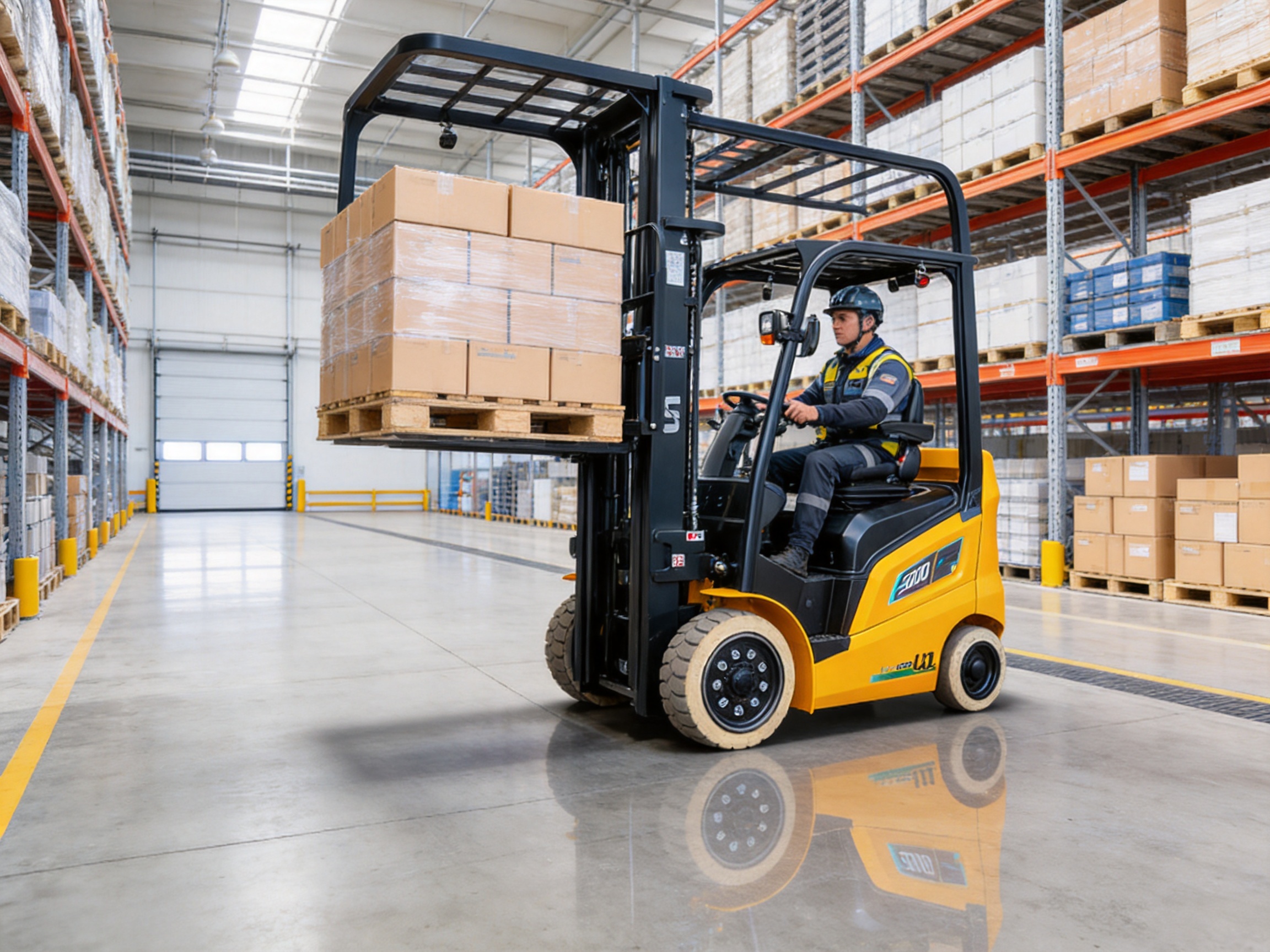
Its cushion tires are appropriate for smooth warehouse floors, while its lithium-ion battery supports repeated daily work. Operators can use the forklift to unload vehicles, position pallets, replenish storage locations, and prepare outbound shipments.
9.2 Manufacturing Plants
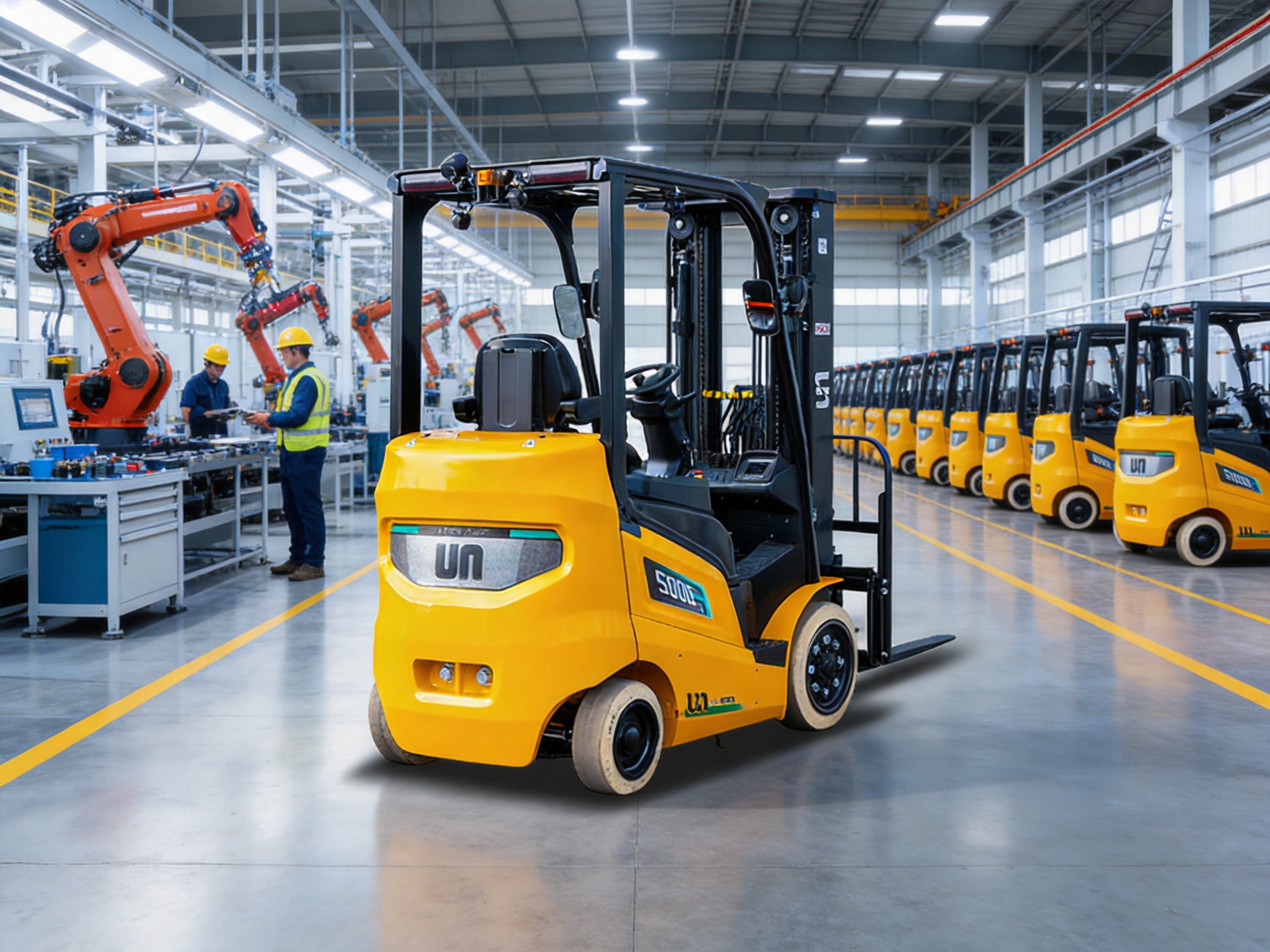
Manufacturing facilities need to move raw materials, components, work-in-process goods, packaging, and finished products. The forklift may travel between production lines, warehouse zones, inspection areas, and dispatch points.
The quiet electric powertrain can be valuable in plants where forklifts operate near workers, machinery, offices, or quality-control areas. The lack of direct exhaust emissions also supports cleaner production environments.
9.3 Retail and Wholesale Operations
Large retail stores, wholesale clubs, and distribution warehouses often have limited maneuvering space and frequent pallet handling requirements. A compact cushion-tire forklift can operate in back-of-house areas and loading zones where space is at a premium.
Because the forklift is designed for indoor work, it can help maintain a cleaner and quieter environment than a combustion-powered alternative. Operators must still confirm that floor conditions, aisle widths, and ceiling clearances are suitable.
9.4 Packaging, Food-Related, and Consumer Goods Facilities
Facilities handling packaged foods, beverages, household products, and consumer goods may value a forklift that does not produce combustion exhaust inside the building. The electric configuration supports a cleaner operating environment, subject to the facility’s hygiene and safety requirements.
Site managers should select tires, attachments, protective equipment, and cleaning procedures according to the specific application. The forklift itself is one part of a complete material handling system.
9.5 Loading Docks and Indoor Transfer Areas
Loading docks require equipment that can move quickly between trailers, staging lanes, and warehouse doors. The FC Series can support these activities when the dock surface is firm, smooth, and suitable for cushion tires.
The published gradeability rating may also help in facilities with moderate ramps. Nevertheless, loading dock operations require strict control of edge protection, trailer restraint, pedestrian movement, visibility, and load stability.
10. Fleet Economics and Total Cost of Ownership
Purchase price is only one part of forklift economics. A professional fleet evaluation should include energy consumption, maintenance labor, parts, battery life, charging equipment, downtime, operator productivity, safety incidents, tire replacement, and resale value.
The FC Series can create value through several potential channels. Its lithium-ion battery may reduce battery maintenance labor. Its electric drive may reduce engine-related service requirements. Its compact dimensions may enable more efficient use of warehouse space. Its quiet, clean operation may support applications where combustion equipment is restricted.
Opportunity charging can also increase fleet utilization when properly managed. Instead of removing a battery for charging, operators may recharge during planned idle periods. This can reduce the need for spare batteries and battery-changing equipment, although the facility must provide suitable charging stations and follow battery safety procedures.
Maintenance planning remains important. Electric forklifts still require inspections of tires, forks, chains, hydraulic systems, brakes, steering, battery connections, safety devices, and structural components. Preventive maintenance helps identify wear before it leads to downtime or unsafe operation.
Fleet managers should compare the expected duty cycle with the battery capacity and charging plan. The correct approach is not simply to select the largest battery, but to match the energy system to actual operating patterns and site infrastructure.
11. Selecting the Right Configuration
Before ordering a forklift in the 2.0T–3.2T class, customers should evaluate several factors. These include the heaviest load, load dimensions, load center, lifting height, aisle width, floor condition, ramp gradient, operating hours, shift structure, attachments, battery charging location, and local safety requirements.
Load center is particularly important. The representative specification identifies a 24-inch, or 600-millimeter, load center. If loads are longer, irregularly shaped, or positioned farther from the fork heel, the effective load center may increase. This can affect residual capacity and stability.
Mast selection should reflect the highest storage location and the lowest overhead obstruction. A facility may require a two-stage, three-stage, or specialized mast depending on rack design. The selected mast should provide sufficient lift height while maintaining acceptable visibility and clearance.
Attachment selection also affects capacity and performance. Side shifters, clamps, rotators, fork positioners, and other attachments add weight and may move the load center forward. The forklift’s capacity must be recalculated according to the attachment and application.
Floor conditions determine whether cushion tires are appropriate. These tires are best for smooth concrete, asphalt, and other firm surfaces. If the facility includes potholes, loose gravel, mud, broken pavement, or frequent outdoor travel, a pneumatic-tire or rough-terrain forklift may be more suitable.
12. Safety and Responsible Operation
Safe forklift operation requires more than selecting a capable machine. Operators must be trained, authorized, and familiar with the equipment. They should complete pre-shift inspections and report defects immediately.
Before work begins, operators should check tires, forks, mast chains, hydraulic lines, steering, brakes, lights, alarms, seat belt, overhead guard, battery condition, display warnings, and other safety devices. Any serious defect should be corrected before the forklift is returned to service.
Loads should be centered on the forks, secured when necessary, and kept within the rated capacity. Operators should travel with the load in a stable low position, maintain clear visibility, reduce speed near corners, sound warnings where appropriate, and remain alert to pedestrians.
Ramps require special care. When traveling on an incline, the load should remain positioned according to recognized forklift safety practices, and speed should be controlled. Turning on ramps, carrying unstable loads, or exceeding site limits can create serious hazards.
Charging must also be managed responsibly. Charging stations should be installed in suitable areas, protected from vehicle impact, kept clear of combustible materials, and operated according to the battery and charger instructions. Personnel should receive training on charging procedures and emergency response.
13. Service Support and Global Market Reach
A forklift is a long-term industrial asset, so supplier support is an important purchasing factor. Zhejiang UN Forklift Co., Ltd. has developed a worldwide sales and service network with partners in Europe, South America, North America, Africa, and Asia.
International service capability can help customers obtain technical assistance, spare parts, maintenance guidance, operator information, and product support across different regions. For companies managing multiple facilities, a supplier with broad market experience may also simplify fleet standardization and communication.
Parts support is particularly important for high-use equipment. Planned replacement of wear components such as tires, forks, chains, filters where applicable, hydraulic seals, brake elements, and electrical components helps maintain availability. Customers should establish a maintenance schedule based on operating hours and working conditions.
Service quality also depends on documentation. Operators and technicians should have access to manuals, inspection procedures, capacity information, charging instructions, troubleshooting guidance, and parts identification. Clear documentation supports safer and more consistent fleet operation.
14. The Company’s Transition Toward New Energy Equipment
Global attention to carbon emissions and energy efficiency has accelerated the development of new energy forklifts. UN Forklift has responded by expanding its development of diesel-to-lithium-ion forklift solutions and standard lithium-ion battery forklift models.
This transition reflects a broader change in the material handling industry. Customers increasingly want to reduce fuel use, control operating costs, meet indoor air-quality expectations, and demonstrate progress toward sustainability goals. Electric forklifts are not suitable for every application, but their role is expanding rapidly in warehouses, factories, distribution centers, and other controlled environments.
The company’s experience in internal-combustion forklifts also provides a useful engineering foundation. Understanding the requirements of heavy-duty chassis design, load handling, power transmission, and industrial durability can support the development of electric machines that are more than simple warehouse vehicles.
New energy equipment must combine environmental benefits with real productivity. A forklift that is clean but underpowered, difficult to charge, or poorly supported will not meet the needs of professional users. The FC Series addresses this balance by pairing lithium-ion power with an industrial four-wheel platform, practical capacity, compact dimensions, and manufacturing experience.
15. Why the FC Series Is Competitive
The FC Series competes through a combination of features rather than a single specification. Its advantages include lithium-ion efficiency, four-wheel stability, cushion-tire maneuverability, practical industrial capacity, low-noise operation, zero direct exhaust emissions, and support from an experienced forklift manufacturer.
Compared with combustion forklifts, it is better suited to clean indoor environments and can reduce noise and engine-related maintenance. Compared with traditional lead-acid electric forklifts, it offers a more convenient battery system for frequent-use operations. Compared with larger pneumatic-tire forklifts, its compact dimensions and cushion tires can be more suitable for smooth indoor floors and restricted aisles.
The product is not intended to replace every type of forklift. Rough terrain, muddy yards, uneven outdoor surfaces, and exceptionally heavy applications may require different equipment. Its competitive strength lies in matching the right technology to the right environment.
For warehouses and factories that require a dependable electric forklift in the 2.0T–3.2T capacity class, the FC Series offers a balanced solution. It combines clean energy with the stability and productivity expected from a professional industrial truck.
16. Frequently Asked Questions
Q1: What type of work is the FC Series designed for?
The FC Series is designed for warehousing, distribution, manufacturing, loading areas, and light-to-medium industrial material handling. It is most suitable for smooth indoor or semi-indoor surfaces where compact dimensions, low noise, and clean electric operation are important.
Q2: What is the capacity of the representative configuration?
The supplied representative configuration, identified as FB25, has a rated load capacity of 5,000 pounds, or approximately 2,270 kilograms, at a 24-inch, or 600-millimeter, load center. Actual capacity may vary according to mast height, attachment, load center, and operating conditions.
Q3: Why are cushion tires useful?
Cushion tires provide a compact wheel and chassis arrangement that supports maneuverability on firm, smooth surfaces. They are useful in warehouses, factories, and loading areas with limited aisle space. They are not intended for rough terrain, deep gravel, mud, or severely uneven ground.
Q4: What battery does the forklift use?
The supplied specification identifies an 80-volt, 350-ampere-hour lithium-ion battery system. Battery performance and charging requirements should be confirmed for the exact configuration ordered.
Q5: Can the forklift operate on ramps?
The representative configuration has a stated full-load gradeability of 15 percent. Actual safe operation depends on the ramp, surface, load, direction of travel, visibility, and site rules. Operators should follow the manufacturer’s instructions and applicable safety standards.
Q6: Is the FC Series suitable for multiple-shift operation?
It can be suitable for multi-shift work when the battery capacity, charging schedule, duty cycle, and facility infrastructure are properly matched. Opportunity charging may help improve availability, but charging procedures must follow the battery and charger requirements.
Q7: What are the main advantages over an internal-combustion forklift?
The main advantages include no direct exhaust emissions during operation, lower noise, reduced vibration, smooth electric control, and fewer engine-related maintenance requirements. Internal-combustion forklifts may still be preferable for rough outdoor terrain, severe environments, or certain heavy-duty applications.
Q8: Does lithium-ion eliminate all maintenance?
No. The lithium-ion battery may reduce watering and certain battery maintenance tasks, but the forklift still requires regular inspections and maintenance. Tires, forks, chains, hydraulics, brakes, steering, safety devices, electrical connections, and structural components must all be checked.
Q9: How should customers verify whether the forklift will fit their facility?
Customers should measure aisle width, doorways, ceiling height, rack clearances, floor conditions, loading ramps, turning areas, and charging locations. They should also confirm load dimensions, load center, lift height, attachment requirements, and pedestrian traffic patterns.
Q10: What manufacturing strengths support the product?
The manufacturer has operated since 1978, integrates research and development with production, sales, and service, occupies approximately 53,400 square meters, and has an annual production capacity of 15,000 units. Its broad product portfolio, electric forklift patents, industry-standard participation, and international service network support its ability to develop and supply professional material handling equipment.
17. Conclusion
The FC Series 2.0T–3.2T lithium-ion battery forklift with cushion tires is designed for companies that need efficient, clean, quiet, and maneuverable material handling equipment. Its four-wheel configuration provides stable load handling, while its cushion tires support compact operation on smooth indoor surfaces.
The representative FB25 configuration demonstrates the product’s industrial capability with a 5,000-pound rated capacity, 80-volt lithium-ion battery, 14-kilometer-per-hour no-load travel speed, 15-percent full-load gradeability, and approximately 1,950-millimeter outside turning radius.
Its value is strengthened by the manufacturing experience of Zhejiang UN Forklift Co., Ltd. The company’s long operating history, integrated R&D and production capabilities, broad product range, large manufacturing base, electric forklift technology development, and global service network provide a solid foundation for the product.
For warehouses, factories, distribution centers, and other indoor facilities, the FC Series represents a practical step toward more efficient and sustainable material handling. By combining lithium-ion energy with a compact four-wheel cushion-tire platform, it offers a balanced alternative to both combustion forklifts and traditional lead-acid electric models.
References
1. Zhejiang UN Forklift Co., Ltd. Product information for the FC Series 2.0T–3.2T lithium-ion battery forklift with cushion tires.
2. Zhejiang UN Forklift Co., Ltd. Technical specifications for the representative FB25 configuration.
3. General principles of industrial truck capacity, load-center evaluation, and safe forklift operation.
4. General guidance on lithium-ion battery charging, preventive maintenance, and electric industrial vehicle operation.
5. General warehouse planning principles covering aisle width, turning radius, overhead clearance, load handling, and pedestrian safety.
Product: FC Series 2.0T-3.2T Li-ion Battery Forklift (Cushion Tire)
For exclusive deals and latest offers, sign up by entering your email address below.
Stay In Touch
ADDRESS : NO.1 ROAD ONE, XINDENG NEW DISTRICT, FUYANG, HANGZHOU, ZHEJIANG, CHINA 311404.
PHONE : +86-571-8688 8355 (AMERICA)
PHONE : +86-571-8886 9363 (EUROPE)
PHONE : +86-571-8688 8377 (ASIA, AFRICA, OCEANIA)
EMAIL : [email protected]
EMAIL : [email protected](PARTS INQUIRY)

