


 中文简体
中文简体 Français
 русский
 Español
 عربى
عربى Deutsch



2.0–2.5 Ton Four-Wheel Electric Forklift: Performance, Safety, Manufacturing Excellence, and Application Value
Admin 2026-07-29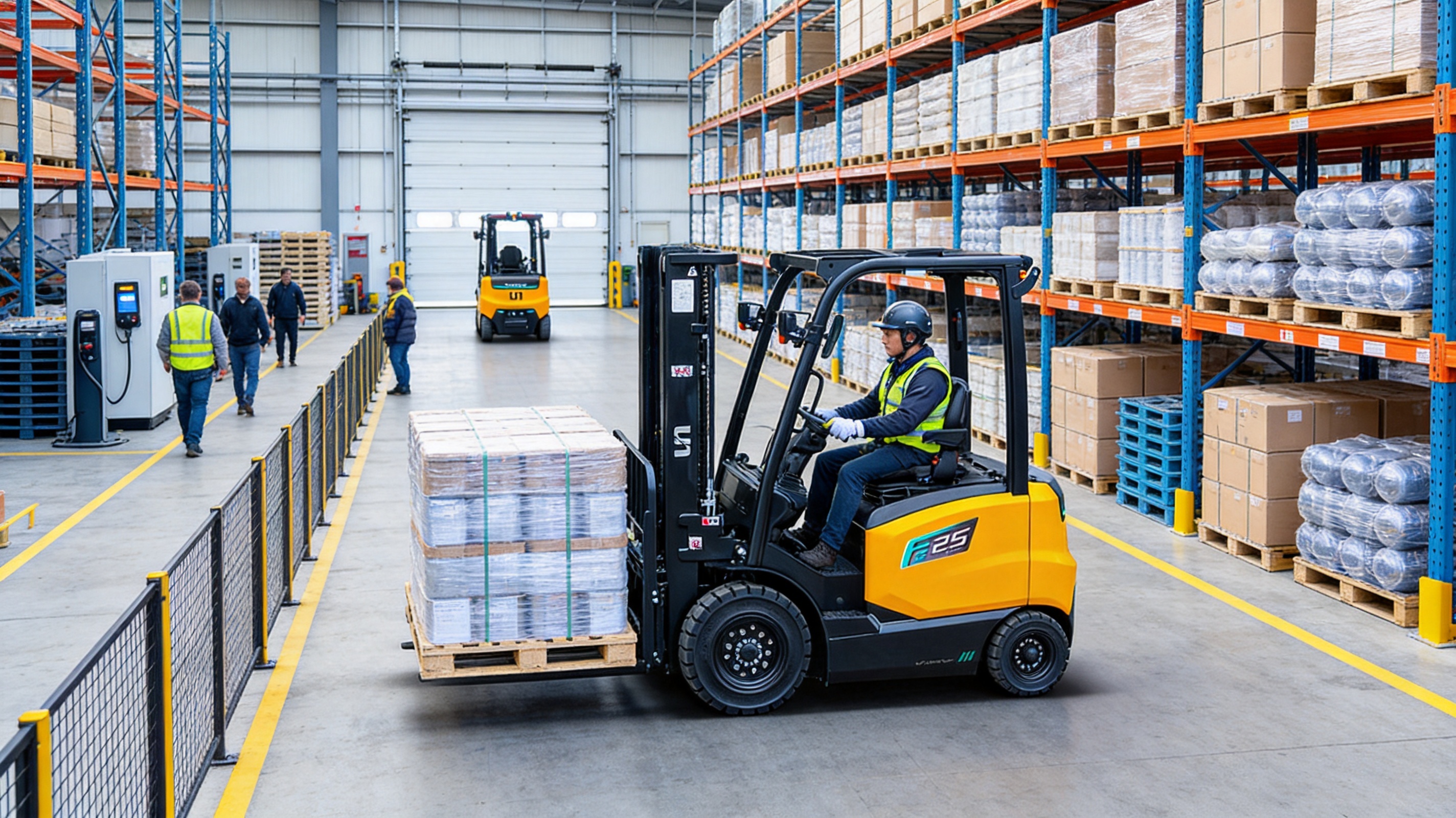
Modern warehouses, distribution centers, manufacturing plants, logistics hubs, and industrial facilities require material-handling equipment that can combine lifting power, operating precision, energy efficiency, and dependable uptime. The 2.0–2.5 ton four-wheel electric forklift is designed to meet these requirements with a balanced combination of structural strength, electric drive technology, ergonomic operation, and flexible battery configurations. It provides the capacity of a conventional medium-duty forklift while offering the cleaner operation, lower noise, and controllable energy consumption expected from modern electric equipment.
This forklift series is a fully upgraded development based on an established four-wheel platform. It is available for rated capacities from 2,000 to 2,500 kilograms and is suitable for medium-intensity indoor handling applications as well as selected outdoor operations on prepared surfaces. Its design integrates a high-capacity lead-acid or lithium-ion battery system, full AC drive technology, adaptive energy management, a high-power hydraulic system, and a reinforced steering axle. Together, these systems create a practical solution for companies seeking reliable daily productivity without the emissions associated with internal-combustion forklifts.
The machine is also supported by the manufacturing capabilities of Zhejiang UN Forklift Co., Ltd., a material-handling equipment producer with decades of experience in research, development, production, sales, and service. The company’s broad product portfolio, production capacity, engineering history, patents, OEM experience, and international service network provide important advantages for customers evaluating a forklift supplier rather than simply purchasing an individual machine.
Why the 2.0–2.5 Ton Electric Forklift Matters
Forklifts in the 2.0–2.5 ton class occupy one of the most useful positions in the material-handling market. Smaller machines may not provide enough capacity or stability for industrial loads, while larger forklifts can consume more energy, require wider aisles, and create unnecessary operating costs. A medium-capacity four-wheel electric forklift offers a useful compromise: sufficient strength for common pallets and production loads, compact dimensions for warehouse maneuverability, and electric operating characteristics that support cleaner workplaces.
The rated load range covers many common applications, including palletized goods, packaged materials, automotive components, metal products, building supplies, food and beverage products, paper goods, and general manufacturing materials. With a standard 500-millimeter load center, the forklift can handle many conventional pallet configurations, subject to the applicable load chart and mast selection.
Compared with an internal-combustion forklift, an electric model can be especially valuable in enclosed or semi-enclosed areas. It does not produce tailpipe exhaust during operation, which helps reduce ventilation requirements and supports cleaner working conditions. Its lower noise level can also improve communication between operators and pedestrians. For facilities operating near offices, retail areas, food-processing zones, or residential surroundings, these characteristics can be significant.
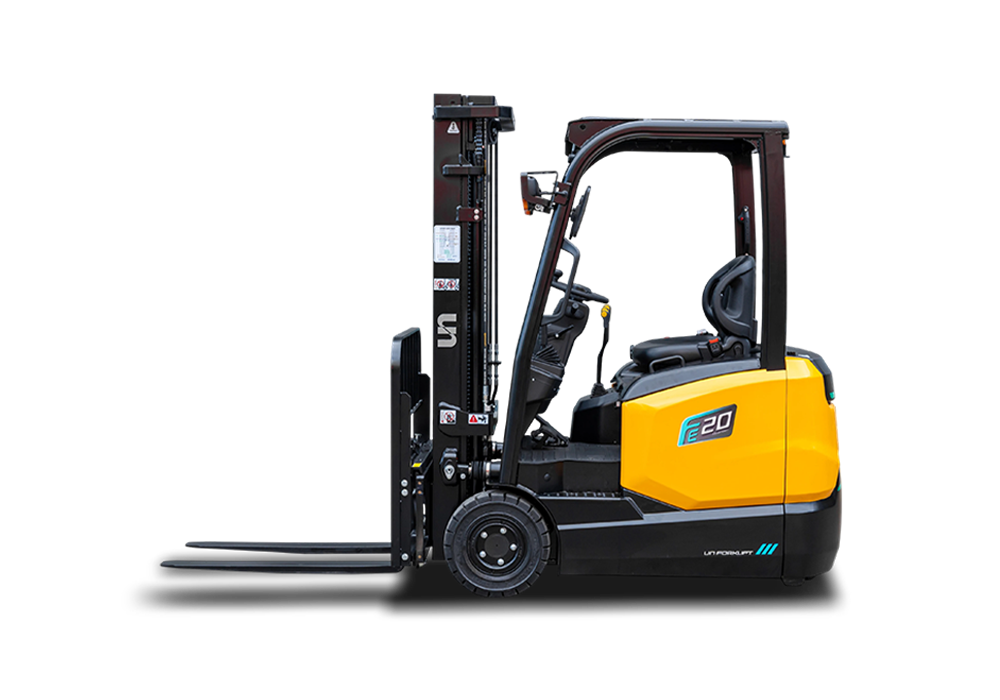
Compared with a compact three-wheel electric forklift, the four-wheel arrangement provides a stronger stability foundation and is generally better suited to heavier loads, uneven working patterns, and applications requiring frequent travel with elevated loads. The four-wheel configuration also contributes to confident handling when the machine is used on ramps, loading areas, and industrial yards with properly prepared surfaces.
Core Product Concept
The forklift is built around a fully electric powertrain with a seated operator position, pneumatic tires, and a forward-facing mast and fork carriage. The standard configuration uses a 48-volt battery system with a nominal capacity of 600 Ah for the 2.5-ton model. Depending on configuration and market requirements, lithium-ion alternatives are also available. The drive motor uses AC technology, while the hydraulic lifting system is powered by a dedicated lift motor.
The principal specification set for the 2.5-ton model includes a rated load of 2,500 kilograms, a 500-millimeter load center, a 1,520-millimeter wheelbase, and a total weight of approximately 4,220 kilograms. With a standard 3,000-millimeter rated lift height, the mast lowered height is approximately 2,050 millimeters, while the overhead guard height is approximately 2,200 millimeters. These dimensions make the forklift suitable for many standard warehouse doorways, production corridors, and storage environments.
The forklift has a length to the face of the fork of approximately 2,345 millimeters without the fork included in the measurement, and an overall width of approximately 1,180 millimeters. Its outside turning radius is approximately 2,060 millimeters. These dimensions allow the machine to work effectively in practical industrial aisles while retaining the stability expected from a four-wheel design.
The standard pneumatic tires measure approximately 7.00-12-12PR at the front and 18×7-8-14PR at the rear. This tire arrangement supports load stability and provides suitable ground contact for industrial applications. Tire choice should always be matched to the floor surface, operating environment, traction requirements, and local safety rules.
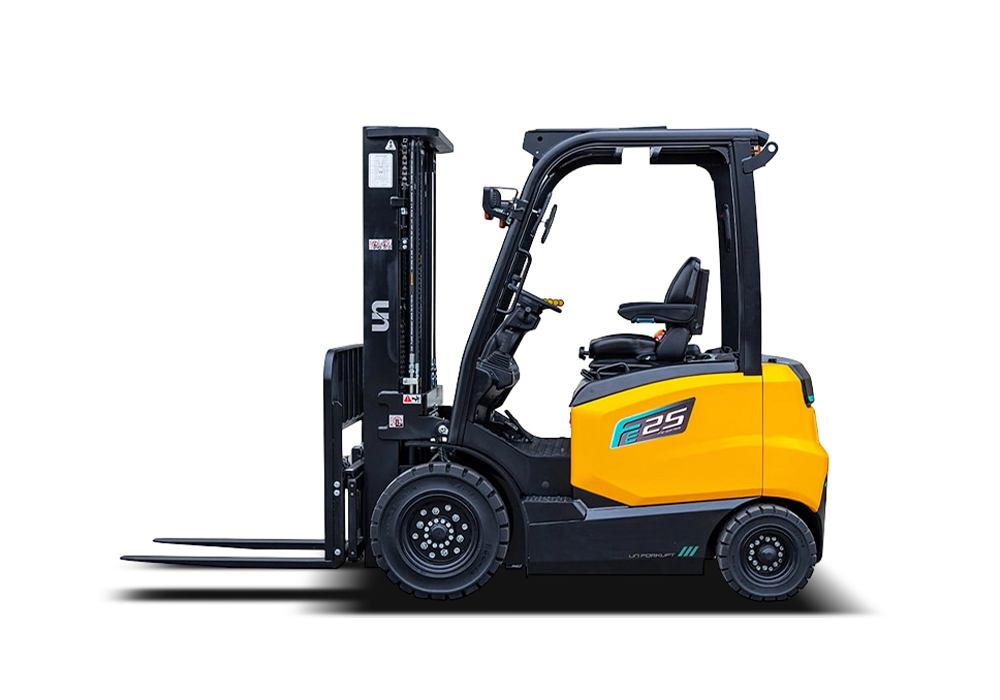
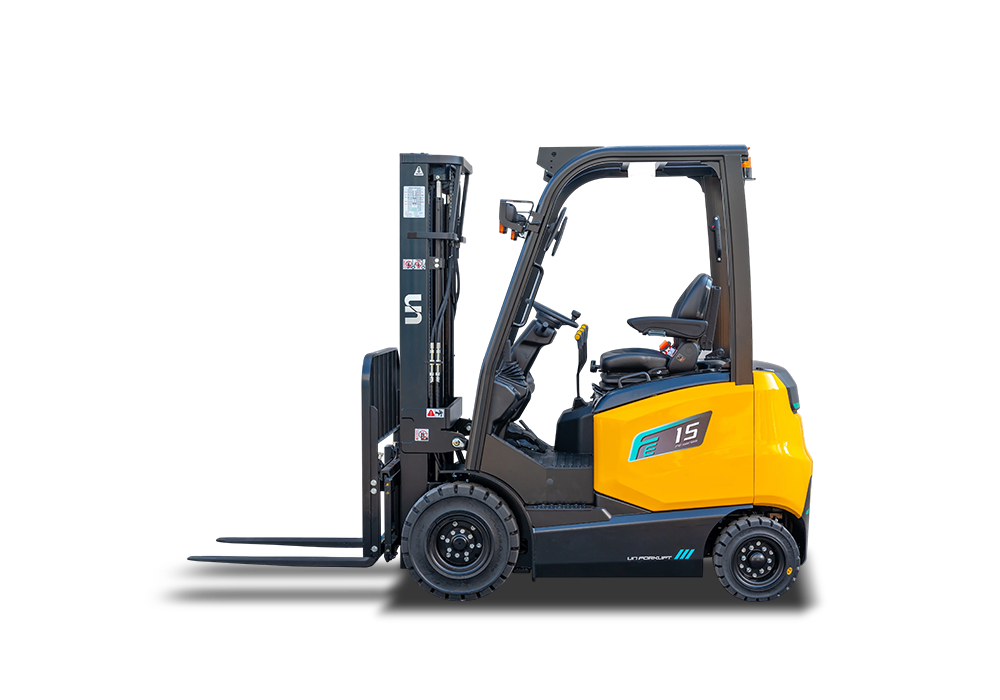
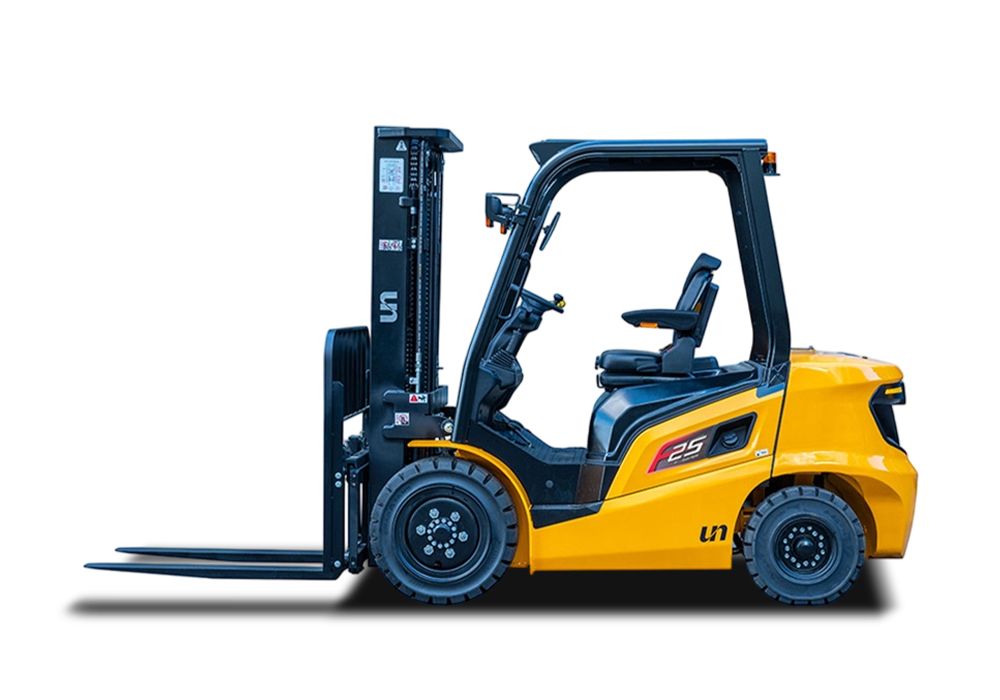
FE Series 2.0T-2.5T 4-Wheel Electric Forklift
Electric Powertrain and Energy Management
One of the most important advantages of the forklift is its full AC drive system. AC drive technology allows the control system to regulate motor output smoothly and efficiently across a wide range of operating conditions. The result is controlled acceleration, responsive travel, reduced mechanical stress, and strong performance during repeated start-and-stop cycles.
The drive motor is rated at approximately 11 kW under the stated operating cycle, while the lift motor is rated at approximately 21 kW. This division of power allows the machine to provide both practical travel performance and strong lifting response. The rated travel speed is approximately 13 kilometers per hour with a full load and approximately 14 kilometers per hour without a load. Lifting speed is approximately 350 millimeters per second at full load and approximately 450 millimeters per second without a load.
These figures are important because productivity is not determined only by maximum speed. In a warehouse, the forklift repeatedly accelerates, brakes, turns, lifts, lowers, and repositions loads. A properly calibrated AC system can provide smooth transitions between these actions, helping the operator maintain control while reducing wasted energy. Multiple speed modes allow the forklift to be adjusted for different working conditions, such as confined aisles, pedestrian-heavy areas, open warehouse floors, or demanding loading operations.
The adaptive energy management system is designed to improve battery utilization during daily operation. Rather than delivering the same response in every condition, the control architecture can coordinate travel and hydraulic demand according to the operating situation. This can help extend battery endurance, maintain consistent performance, and reduce unnecessary energy consumption.
Lead-acid and lithium-ion batteries provide different operating advantages. Lead-acid batteries remain an established choice for customers seeking proven technology, broad availability, and a familiar charging and maintenance routine. Lithium-ion batteries can support opportunity charging, reduced routine maintenance, and improved energy efficiency in applications involving multiple shifts or intensive use.
The lithium-ion configuration includes a charging-heating function that allows charging at temperatures as low as approximately minus 20 degrees Celsius, subject to the selected battery system and applicable operating instructions. This is particularly valuable for cold warehouses, refrigerated logistics areas, and winter operations where charging performance may otherwise be affected by low temperatures.
Battery weight is also an important engineering parameter because it contributes to the forklift’s counterbalance and overall stability. The listed 2.5-ton configuration uses a battery weight of approximately 930 kilograms. The battery is therefore not only an energy source but also an integrated part of the machine’s load-handling balance.
Hydraulic Performance and Lifting Capability
The hydraulic system is designed for responsive lifting and controlled lowering. A high-power hydraulic pump motor supports the required flow, while the low-noise, high-displacement pump helps provide efficient operation with reduced acoustic disturbance. This combination is useful in facilities where operators and pedestrians work in close proximity.
Proportional lifting control allows the operator to regulate the lifting function with greater precision. Instead of relying only on abrupt full-speed commands, the operator can make controlled adjustments when positioning loads on racks, aligning pallets, or placing materials on production lines. This is especially valuable when handling fragile products, high-value components, or loads with limited clearance.
The standard 3,000-millimeter mast configuration provides a practical lifting height for general warehouse use. The product range supports several wide-view, full-free-lift, and three-stage mast options. Available mast heights extend from approximately 2,000 millimeters to 6,000 millimeters, although rated capacity changes as lifting height increases and must be confirmed from the relevant load chart.
Wide-view mast designs help the operator maintain visibility through the mast structure. Full-free-lift masts are useful when the forklift must raise a load within a container, low-clearance area, or building with a restricted ceiling height before the mast begins to extend significantly. Three-stage masts support higher stacking operations while maintaining a relatively practical lowered height.
For the 2.0–2.5 ton models, rated capacity varies according to mast type and lift height. At lower lifting heights, the machine can retain its full rated capacity, while higher mast configurations may reduce capacity progressively. For example, the available capacity information indicates that a 2.5-ton model can handle 2,500 kilograms at several lower mast heights, while capacity is reduced at greater lift heights. This is normal forklift behavior and illustrates why operators must use the correct capacity plate for the exact configuration.
Attachments can also affect capacity. The supplied information indicates that a separated side shifter may reduce load capacity by approximately 150 kilograms, while an integrated side shifter may reduce capacity by approximately 50 kilograms. These figures should be verified for the final configuration, but they demonstrate the importance of considering every attachment when calculating safe working capacity.
Stability, Steering, and Maneuverability
Stability is a central requirement for a forklift that handles loads weighing up to 2,500 kilograms. The machine’s four-wheel structure, extended wheelbase, counterbalanced layout, and robust steering axle work together to support controlled load handling. The steering axle uses a cast axle body with an increase in structural strength compared with the previous design. Tapered roller bearings are used to improve load capacity and durability, while the high-mounted design and flexible connections support smooth steering response.
The H-type parallel arrangement of the drive motor contributes to balanced packaging and structural stability. It helps organize the drive components in a way that supports the chassis layout while maintaining dependable power transmission. The result is a machine designed to remain predictable during travel, turning, and load placement.
The load-sensing steering gear is another important feature. Steering assistance can be matched more closely to the operator’s input, helping reduce unnecessary hydraulic demand and making the steering response more natural. When combined with the relatively compact turning radius, this supports effective maneuvering in warehouse aisles and production areas.
The outside turning radius is approximately 2,060 millimeters for the 2.0–2.5 ton configuration. The recommended aisle width is approximately 3,720 millimeters for 1,000×1,200-millimeter pallets placed crossways and approximately 3,920 millimeters for 800×1,200-millimeter pallets placed lengthways. Actual aisle requirements depend on pallet condition, load dimensions, rack design, operator technique, attachment selection, and the required safety clearance.
The forklift’s maximum gradeability is listed at approximately 15 percent with and without a load. Gradeability is affected by surface condition, battery state, tire condition, load distribution, and operating temperature. It should not be interpreted as permission to operate on any slope without a site-specific risk assessment.
Safety Features for Daily Industrial Work
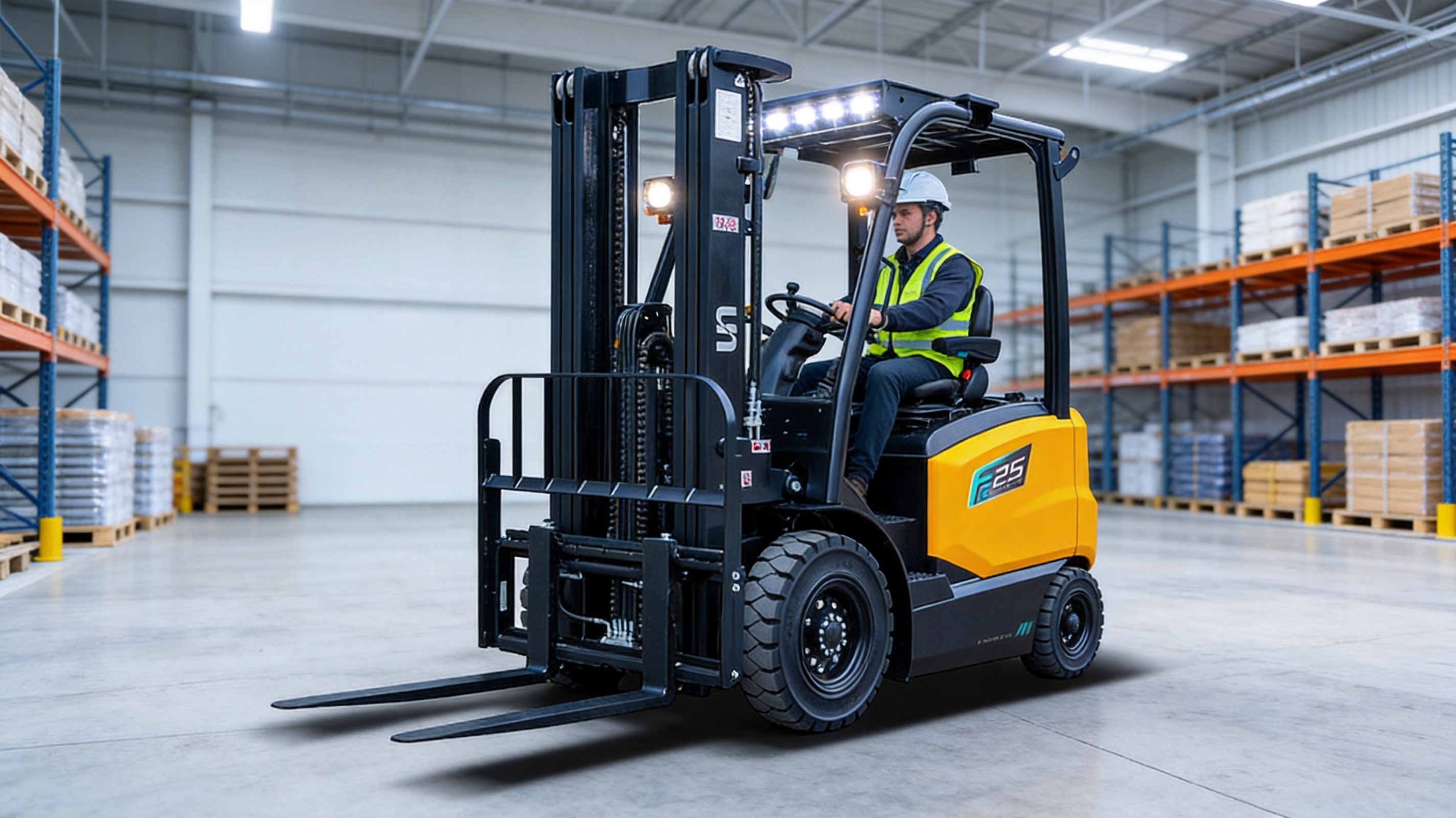
Safety has been integrated into the forklift through structural, electronic, hydraulic, and ergonomic measures. The stamped overhead guard provides a strong protective structure above the operator. Its design also supports a practical balance between overhead protection and visibility.
The wide-view mast helps improve the operator’s line of sight toward the forks and load. Visibility is particularly important during rack entry, pallet pickup, load placement, and reversing. The operator must still follow site procedures and use a spotter when visibility is restricted, but the mast design can reduce unnecessary obstruction in normal operation.
LED lighting provides efficient illumination and can improve visibility in dim areas. LED components generally consume less energy than older lighting technologies and offer long service life. Lighting configuration may vary according to the market, machine option, or customer requirements.
Speed deceleration functions help control travel behavior when the forklift is operating in situations where high speed would be inappropriate. Multiple travel modes can be selected for different conditions, including narrow aisles, pedestrian zones, outdoor yards, or productivity-oriented open areas. Proper training remains essential because electronic speed control is a support feature rather than a substitute for safe driving.
Hydraulic service braking provides controlled stopping, while the mechanical parking brake helps secure the forklift when it is parked. The operator should always lower the forks, neutralize the controls, apply the parking brake, switch off the machine, and follow the facility’s parking procedure before leaving the operator position.
The seating position is designed for a seated operator and can be configured to support practical control access. Reduced vibration, convenient control placement, and a clear field of view can help reduce fatigue during repetitive work. Lower fatigue can support more consistent operation, although operators must still take appropriate breaks and follow occupational health requirements.
The forklift’s safety should be considered as part of a complete system. Safe operation also requires trained operators, maintained floors, proper pallet quality, appropriate rack protection, adequate lighting, traffic separation, pedestrian controls, load inspection, and regular equipment checks.
Structural Durability and Reliability
The machine is designed for repeated industrial use rather than occasional light-duty handling. The reinforced steering axle, durable chassis, high-capacity battery, and robust overhead guard contribute to long-term operating reliability. The structure is engineered to support the combined forces created by lifting, traveling, braking, turning, and placing loads.
The cast steering axle body provides a strong foundation for rear-wheel steering. Tapered roller bearings are suited to applications where radial and axial forces must be controlled over extended service periods. Correct lubrication, inspection, and replacement procedures remain necessary to preserve the intended performance of these components.
The forklift uses pneumatic tires that can provide useful cushioning and traction on suitable industrial surfaces. However, pneumatic tires require routine inspection for pressure, damage, tread wear, and foreign objects. Tire condition affects stability, braking distance, energy consumption, and ride quality.
Electronic reliability is supported by MOS and AC drive control technology, with ZAPI identified as the control system manufacturer in the listed specifications. Electronic control enables accurate motor management, diagnostic support, and programmable operating characteristics. Electrical systems should be serviced by trained technicians using approved procedures and suitable diagnostic tools.
The machine’s specifications are subject to configuration. Battery type, mast selection, tire choice, attachments, weather conditions, floor quality, and maintenance practices can all influence operating performance. A responsible purchase process should therefore confirm the exact equipment configuration rather than relying only on a general series description.
Maintenance-Friendly Design
Maintenance efficiency directly affects total cost of ownership. A forklift that is easy to inspect and service can reduce downtime, simplify routine checks, and help technicians identify developing problems before they become serious failures. This product series incorporates several features intended to make service access more convenient.
The fully opening engine cover creates broad access to the rear compartment and key service components. Even though the forklift is electrically powered, the cover remains an important access panel for electrical components, cooling arrangements, hydraulic equipment, wiring, and other systems located in the rear section.
The electrical control cover can also be fully opened. This helps technicians inspect controllers, connectors, wiring harnesses, fuses, and related components. Improved access can reduce the time required for troubleshooting and support cleaner, more systematic service work.
The tool-free removable floor plate provides access to components below the operator area without requiring unnecessary disassembly. This can be useful for inspection, cleaning, cable checks, and routine service tasks. The floor plate should always be correctly refitted before the forklift returns to operation.
Routine maintenance should include battery inspection, charging-system checks, tire examination, brake testing, hydraulic-fluid monitoring, mast-chain inspection, fork inspection, steering checks, fastener verification, lighting checks, and cleaning of critical areas. Lithium-ion systems may require different service procedures from lead-acid batteries, and technicians should follow the instructions for the selected battery technology.
Preventive maintenance is particularly important for electric forklifts because quiet operation can make abnormal noises less obvious. Operators should report unusual vibration, delayed lifting, irregular steering, reduced travel performance, warning indicators, battery heating, hydraulic leaks, tire damage, and any change in braking behavior.
Manufacturing Strength and Engineering Background
The value of this forklift is closely connected to the capabilities of its manufacturer. Zhejiang UN Forklift Co., Ltd. was founded in 1978 and has developed into a professional material-handling equipment manufacturer integrating research and development, production, sales, and service. The company occupies approximately 53,400 square meters and has an annual production capacity of approximately 15,000 units.
A long manufacturing history provides several practical advantages. It allows engineering teams to collect field experience across different forklift types, operating environments, load conditions, and customer requirements. Lessons from internal-combustion forklifts, electric forklifts, reach trucks, and warehouse equipment can be applied to chassis design, hydraulic systems, operator ergonomics, energy management, and service support.
The company offers a broad portfolio comprising numerous varieties, series, and specifications. This breadth is significant because customers often need more than one type of machine. A supplier able to provide counterbalanced forklifts, electric models, warehouse trucks, rough-terrain units, and related equipment can help standardize service, training, spare parts, and fleet management across a larger operation.
The company’s engineering history includes the development of China’s first reach forklift and very-narrow-aisle truck. It also holds national patents related to electric forklift technologies and has participated in the formulation of Chinese electric forklift industry standards. These achievements indicate experience beyond basic assembly and demonstrate a commitment to product development and industry participation.
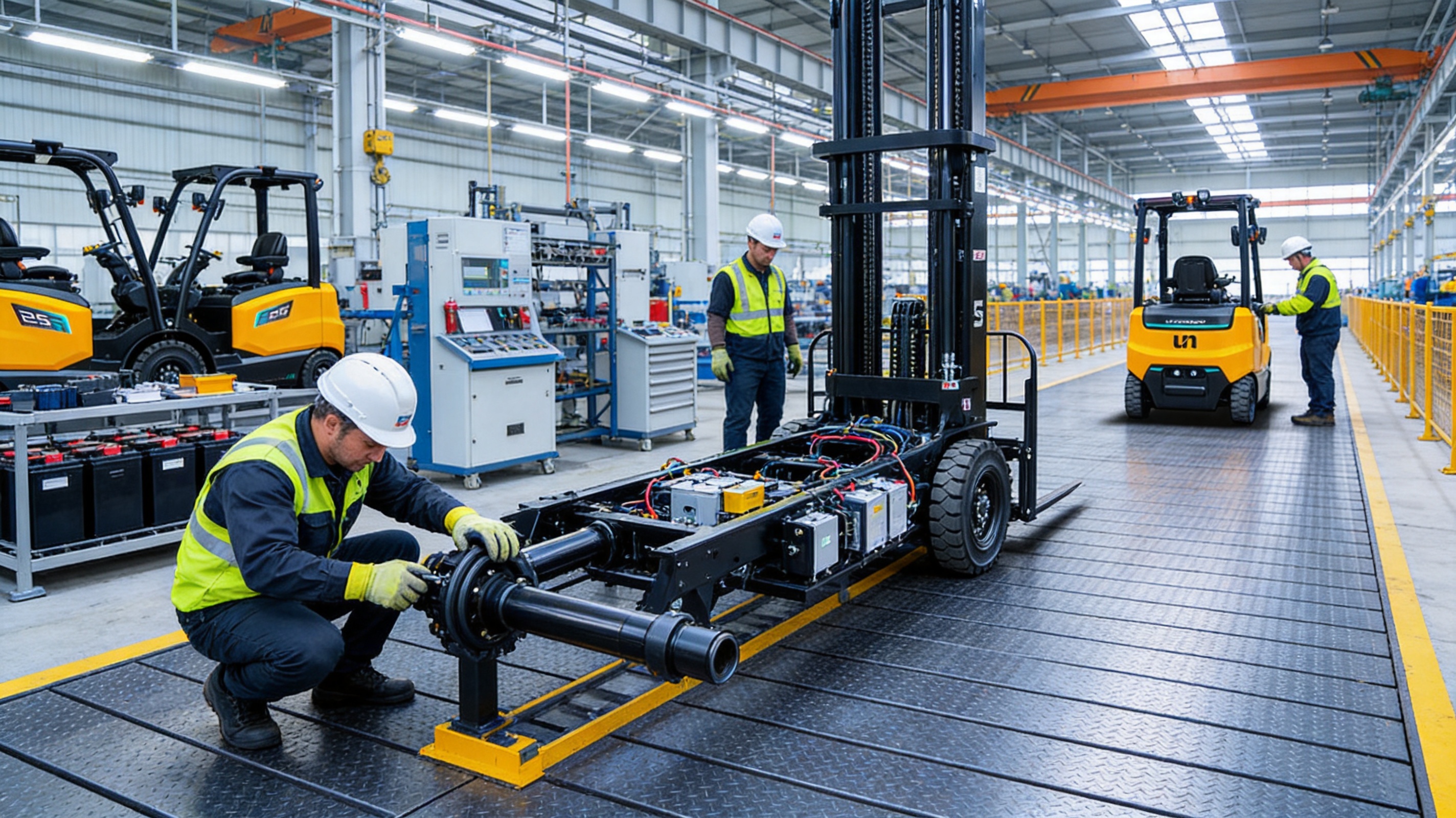
The manufacturing process for a modern electric forklift typically begins with engineering design and configuration control. Product engineers define the chassis, mast, battery compartment, counterweight, drive system, hydraulic circuit, electrical architecture, and safety systems. Computer-aided design and engineering analysis help confirm dimensional compatibility, service access, structural requirements, and component integration before production.
Material preparation and component manufacturing are followed by frame and chassis fabrication. Steel components must be accurately cut, formed, positioned, and welded to maintain dimensional consistency. Welding quality is especially important because the chassis, mast supports, axle mounts, and overhead guard carry repeated dynamic loads. Process control, fixture use, inspection, and surface treatment contribute to consistent production quality.
Mast manufacturing requires close attention to straightness, alignment, weld quality, roller adjustment, chain routing, hydraulic-cylinder installation, and fork-carriage movement. Small deviations can affect lifting smoothness, load stability, and wear. A controlled manufacturing process helps ensure that the mast and carriage operate correctly over repeated cycles.
Electrical integration is another critical stage. The battery, drive motor, lift motor, controller, display, sensors, lights, switches, wiring harnesses, and safety interlocks must work as a coordinated system. Electrical testing can include continuity checks, insulation checks, controller parameter verification, charging-system testing, motor-response testing, and functional inspection under controlled conditions.
Hydraulic assembly requires clean component handling and careful hose routing. The pump, valves, cylinders, pipes, fittings, and reservoir must be assembled to limit contamination and leakage. Pressure testing and functional testing help verify lifting, lowering, tilting, and attachment performance.
Final assembly combines the structural, mechanical, hydraulic, electrical, and ergonomic systems. The forklift is then subject to inspection and testing, which may include no-load travel, loaded travel, steering response, braking, lifting performance, mast tilt, emergency functions, lighting, instrumentation, and noise checks. Configuration records are important because the final machine may differ according to battery, mast, tire, attachment, and regional requirements.
The company also has experience as an OEM supplier for recognized domestic and overseas businesses, including Hyundai Heavy Industries and Xuzhou Construction Machinery Group. OEM experience generally requires disciplined production control, documentation, consistency, quality assurance, and the ability to meet customer-specific technical requirements. These capabilities can benefit customers purchasing standard products as well as customers seeking fleet customization.
Advantages Over Conventional Competitor Options
The first competitive advantage is the balance between capacity and operating efficiency. A 2.0–2.5 ton electric forklift can handle a broad range of industrial loads without the fuel consumption, exhaust emissions, and engine noise associated with many conventional internal-combustion alternatives.
The second advantage is the full AC drive system. AC power control offers smooth acceleration and responsive travel, which can improve operator confidence and reduce stress on driveline components. Multiple speed modes and adaptive energy management further distinguish the forklift from simpler electric models that provide less control over operating behavior.
The third advantage is battery flexibility. Customers can select established lead-acid technology or lithium-ion technology according to shift pattern, charging infrastructure, budget, maintenance resources, and environmental requirements. This is more flexible than a platform limited to one battery type.
The fourth advantage is the combination of strong lifting capability and practical dimensions. The forklift offers a 2.0–2.5 ton rated capacity, a 3,000-millimeter standard lift height, a width of approximately 1,180 millimeters, and a turning radius of approximately 2,060 millimeters. This combination supports many warehouse and production applications without requiring the space associated with larger machines.
The fifth advantage is the range of mast options. Wide-view, full-free-lift, and three-stage configurations allow the product to be matched to low-clearance facilities, standard racks, high-bay storage, containers, and specialized handling environments. A wider configuration range allows distributors and fleet managers to select equipment based on actual application requirements rather than accepting a one-size-fits-all specification.
The sixth advantage is maintenance access. Fully opening covers and a tool-free removable floor plate can simplify routine service and reduce unnecessary downtime. While maintenance quality depends on the service team, good physical access provides a valuable foundation.
The seventh advantage is manufacturer support. A company with decades of experience, a large product portfolio, international partners, OEM exposure, and an established service network can provide greater confidence than an unknown supplier with limited field history. Parts availability, technical documentation, warranty support, and local service arrangements should still be confirmed before purchase, but the organizational foundation is an important differentiator.
Application Scenarios
Warehousing and Distribution
In distribution centers, the forklift can transport pallets from receiving areas to storage locations, feed picking zones, and load outbound vehicles. Electric operation is particularly suitable for facilities where forklifts operate near workers for long periods. The compact dimensions and turning performance can support practical aisle operation, while mast choices can be matched to rack height.
Manufacturing Plants
Manufacturers can use the forklift to move raw materials, work-in-progress, finished products, dies, containers, and production supplies. The proportional hydraulic function helps operators position loads accurately near machines and assembly lines. The low-noise electric powertrain can also support communication in production environments.
Food, Beverage, and Consumer Goods
Indoor electric operation is valuable in facilities where product cleanliness and air quality are important. The absence of exhaust emissions helps reduce contamination concerns associated with combustion equipment. Site hygiene procedures, battery-room requirements, and approved tire materials should be considered for specialized food applications.
Automotive and Component Handling
Automotive plants often require precise movement of pallets, stillages, racks, and component boxes. The forklift’s capacity, steering response, speed modes, and lifting control can support repetitive line-side logistics. Attachments such as side shifters may improve positioning but must be included in the final capacity calculation.
Loading and Receiving Areas
The four-wheel configuration and pneumatic tires can support loading-dock work and movement across suitable prepared surfaces. Operators should assess dock plates, ramps, surface transitions, drainage, and weather exposure before selecting the final tire and battery configuration.
Specification Summary
| Item | 2.0 Ton Configuration | 2.5 Ton Configuration |
|---|---|---|
| Rated load capacity | 2,000 kg | 2,500 kg |
| Load center | 500 mm | 500 mm |
| Operator type | Seated | Seated |
| Drive type | Electric | Electric |
| Wheelbase | Approximately 1,520 mm | Approximately 1,520 mm |
| Total weight | Approximately 3,650–3,820 kg | Approximately 4,220 kg |
| Overall width | Approximately 1,180 mm | Approximately 1,180 mm |
| Overhead guard height | Approximately 2,200 mm | Approximately 2,200 mm |
| Standard rated lift height | Approximately 3,000 mm | Approximately 3,000 mm |
| Outside turning radius | Approximately 2,060 mm | Approximately 2,060 mm |
| Travel speed with full load | Approximately 13–14 km/h | Approximately 13–14 km/h |
| Travel speed without load | Approximately 14–15 km/h | Approximately 14–15 km/h |
| Maximum gradeability | Approximately 15 percent | Approximately 15 percent |
| Drive motor rating | Approximately 11 kW or configuration-dependent | Approximately 11 kW |
| Lift motor rating | Approximately 21 kW | Approximately 21 kW |
| Battery option | Lead-acid or lithium-ion, configuration-dependent | 48 V/600 Ah lead-acid or lithium-ion alternative |
| Drive control | MOS/AC | MOS/AC |
| Control system manufacturer | ZAPI | ZAPI |
The table provides a general comparison, but it should not replace the official capacity plate, technical quotation, or final configuration sheet. Specifications may change according to mast, battery, tire, attachment, and regional requirements.
Total Cost of Ownership Considerations
Purchase price is only one element of forklift economics. Companies should evaluate energy cost, maintenance, battery life, charging infrastructure, operator productivity, downtime, tire wear, parts availability, and resale value. Electric forklifts can provide operating savings through lower energy consumption, reduced routine engine maintenance, and improved suitability for indoor work.
Lead-acid batteries may be attractive where the company already has charging rooms, battery-handling equipment, and trained maintenance staff. Lithium-ion batteries may provide greater flexibility for multi-shift operation because opportunity charging can reduce the need for battery changes, subject to charger compatibility and the battery manufacturer’s instructions.
Productivity should be measured in completed handling cycles rather than only travel speed. Smooth acceleration, responsive lifting, controlled braking, reliable battery endurance, and reduced downtime can all contribute to more useful work per shift. A forklift that is comfortable and predictable may also reduce operator hesitation and handling errors.
Charging infrastructure should be planned before delivery. The site should confirm electrical capacity, charger location, ventilation where required, cable protection, emergency access, fire-safety arrangements, and battery-handling procedures. Lithium-ion and lead-acid systems have different requirements, so the selected technology must be incorporated into the facility’s safety plan.
How to Select the Correct Configuration
The first selection question is the actual load. Customers should identify the heaviest regular load, the load dimensions, the center of gravity, and whether the load is stable or irregular. A 2.5-ton rated forklift does not necessarily lift 2,500 kilograms at every height, load center, or attachment configuration.
The second question is lift height. Measure the highest storage position, the required clearance above the load, and the lowest ceiling or doorway that the forklift must pass through. A wide-view two-stage mast may be sufficient for standard storage, while a full-free-lift or three-stage mast may be required for containers or high racks.
The third question is floor and tire condition. Indoor smooth floors may favor a particular tire type, while outdoor or mixed-surface work may require pneumatic tires. The customer should review thresholds, ramps, drainage, debris, and surface load capacity.
The fourth question is operating intensity. A single-shift warehouse may have different battery needs from a continuously operating distribution center. Estimate daily operating hours, lifting cycles, travel distance, charging opportunities, and the availability of spare batteries or charging stations.
The fifth question is attachment use. Side shifters, clamps, rotators, fork extensions, and other attachments change the machine’s weight, load center, visibility, hydraulic requirements, and rated capacity. Every attachment should be included in the final engineering review.
The sixth question is service support. Confirm warranty terms, spare-parts availability, technician response, software support, battery service, training, and local regulatory compliance. A well-designed forklift delivers its full value only when it is supported throughout its operating life.
Operator Training and Safe Use
Only trained and authorized operators should use the forklift. Training should cover pre-use inspection, controls, steering, braking, load charts, mast operation, battery charging, pedestrian awareness, ramp operation, parking, emergency response, and site-specific traffic rules.
Before each shift, the operator should inspect forks, mast chains, hydraulic hoses, tires, wheels, battery condition, connectors, lights, horn, seat belt, overhead guard, steering, brakes, and warning indicators. Any defect that could affect safe operation should be reported and corrected before the forklift is used.
Loads should be centered on the forks, secured when necessary, and carried at a low travel height. Operators should avoid sudden turns, abrupt braking, excessive speed, unstable pallets, and travel with a raised load. The rated capacity plate must be visible and understood.
Pedestrian safety requires clear separation wherever possible. Operators should sound the horn at blind intersections, maintain a safe speed, keep the forks and load under control, and use a spotter when the view is blocked. The forklift should never be used to lift people unless it is specifically equipped and approved for that purpose under applicable regulations.
Questions and Answers
What is the rated capacity of this electric forklift series?
The series covers rated capacities from approximately 2,000 to 2,500 kilograms. The exact capacity depends on the model, load center, mast, lift height, attachment, and battery configuration.
Is the forklift suitable for indoor use?
Yes. Its electric powertrain, low-noise operation, and lack of tailpipe emissions make it well suited to warehouses, factories, distribution centers, and other indoor environments. Ventilation, charging, floor quality, and site safety requirements must still be assessed.
Can it be used outdoors?
It can be used outdoors on suitable prepared surfaces, particularly with the specified pneumatic tires. Customers should consider weather, slopes, drainage, surface debris, battery protection, visibility, and local operating conditions before approving outdoor use.
What battery technologies are available?
The platform supports high-capacity lead-acid and lithium-ion battery systems, depending on the selected configuration and market. Lead-acid batteries offer established technology, while lithium-ion batteries can support opportunity charging and lower routine maintenance in suitable applications.
What is the standard lifting height?
The listed standard configuration has a rated lift height of approximately 3,000 millimeters. Other mast options are available, including wide-view, full-free-lift, and three-stage designs with higher lifting heights.
Does rated capacity remain constant at all lift heights?
No. Rated capacity normally decreases as lift height increases, and attachments or changes in load center can also reduce capacity. Operators must follow the capacity plate for the exact forklift configuration.
What are the main advantages of AC drive technology?
AC drive technology supports smooth acceleration, responsive travel, efficient power management, reduced mechanical stress, and programmable speed characteristics. It is especially useful in applications involving frequent starts, stops, turns, and changes in operating speed.
How does the forklift support maintenance?
The design includes a fully opening engine cover, a fully opening electrical control cover, and a tool-free removable floor plate. These features provide more convenient access for inspections, troubleshooting, cleaning, and routine service.
Can attachments be installed?
Attachments such as side shifters may be available. The attachment must be approved for the forklift, and its weight, load center, hydraulic demand, visibility effect, and capacity reduction must be included in the final specification.
What type of operator position does the forklift use?
The forklift is designed for a seated operator. Its control layout, overhead guard, mast visibility, steering system, and proportional hydraulic controls are intended to support regular industrial handling work.
Who manufactures the forklift?
The product is manufactured by Zhejiang UN Forklift Co., Ltd., a Chinese material-handling equipment producer founded in 1978. The company integrates research and development, production, sales, and service and supplies a broad range of forklift and warehouse equipment.
What should customers confirm before ordering?
Customers should confirm rated load, load center, mast type, maximum fork height, lowered mast height, overhead guard height, tire type, battery technology, charger, attachment requirements, aisle width, floor conditions, operating hours, local compliance, warranty coverage, and service support.
Conclusion
The 2.0–2.5 ton four-wheel electric forklift is a versatile solution for companies seeking dependable medium-duty handling performance with the environmental and operational advantages of electric power. Its combination of full AC drive technology, adaptive energy management, high-capacity battery options, proportional lifting, reinforced steering components, multiple speed modes, and practical dimensions gives it a strong position in the modern forklift market.
The forklift is not limited to a single application. It can support warehouse distribution, manufacturing logistics, component handling, loading operations, and many other industrial tasks. Its range of mast configurations allows customers to match the equipment to standard storage, low-clearance areas, containers, or higher racks. Its maintenance-oriented design can also help reduce service complexity and improve equipment availability.
Its competitive strength is reinforced by the manufacturer’s long history, engineering experience, electric forklift technology, broad product range, OEM capability, production infrastructure, and international service network. For fleet managers, distributors, warehouse operators, and industrial buyers, these organizational capabilities are as important as the forklift’s headline specifications.
As with any forklift purchase, the final decision should be based on the complete operating application rather than rated capacity alone. Correct selection of mast, battery, tires, attachments, charging system, and service package will determine how effectively the forklift performs. When properly configured, operated, and maintained, this electric forklift platform can provide clean, controlled, and productive material handling for demanding daily operations.
References
1. Manufacturer-provided product description and technical specification data for the 2.0–2.5 ton four-wheel electric forklift series.
2. Manufacturer-provided mast specifications and rated-capacity information for wide-view, full-free-lift, and three-stage mast configurations.
3. Manufacturer-provided general specifications for electric counterbalanced forklift models.
4. Manufacturer-provided information concerning battery systems, AC drive control, hydraulic performance, safety features, and maintenance access.
5. Manufacturer-provided corporate profile describing research and development, production capacity, patents, OEM activities, product portfolio, and international service coverage.
6. General industrial forklift safety and operator-training principles applicable to counterbalanced electric forklifts.
Product: FE Series 2.0T-2.5T 4-Wheel Electric Forklift
For exclusive deals and latest offers, sign up by entering your email address below.
Stay In Touch
ADDRESS : NO.1 ROAD ONE, XINDENG NEW DISTRICT, FUYANG, HANGZHOU, ZHEJIANG, CHINA 311404.
PHONE : +86-571-8688 8355 (AMERICA)
PHONE : +86-571-8886 9363 (EUROPE)
PHONE : +86-571-8688 8377 (ASIA, AFRICA, OCEANIA)
EMAIL : [email protected]
EMAIL : [email protected](PARTS INQUIRY)

